When Should You Choose Stainless Steel Rod Ends?
Choose stainless steel rod ends when corrosion exposure, washdown, or chemical service is the main design driver. Grade still matters: 316 suits many splash or washdown environments, while continuous seawater exposure may require PREN 40+ duplex alloys, and high-load marine linkages may need 17-4PH with careful heat treatment.
Aluminum Rod Ends: Pros, Cons, and Weight-Saving Benefits
Aluminum rod ends can cut linkage weight because the 7075-T6 housing is much lighter than steel, but the steel ball and liner remain. The trade-off is lower shock-load and fatigue margin, especially under misalignment, vibration, steering loads, or severe off-road use where 4130 chromoly is usually safer.
Why Off-Road Racing Prefers 4130 Chromoly Rod Ends
Off-road racing favors 4130 chromoly rod ends because they handle repeated impact cycles better than plain carbon steel, can bend before breaking when properly heat-treated, and remain weldable for custom links when Condition N material and correct technique are used. The advantage disappears if heat treatment, welding, or mounting geometry is wrong.
Chromoly (4130) vs. Carbon steel: which is right for your build?
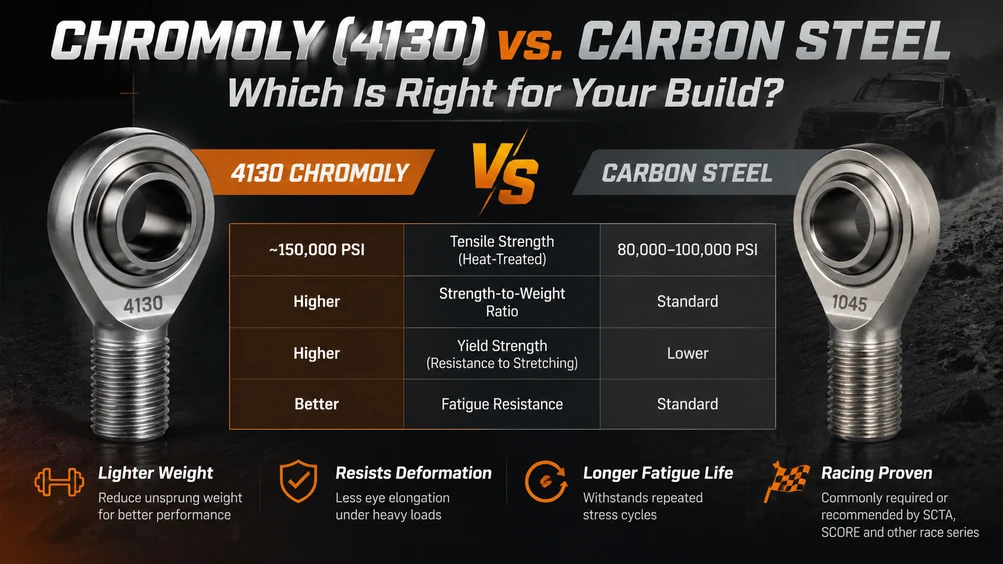
The choice between 4130 Chromoly and carbon steel depends on the required strength, weight, and application. 4130 Chromoly provides a higher strength-to-weight ratio and improved fatigue resistance, allowing properly engineered joints to achieve high load performance with reduced weight. Carbon steel remains a cost-effective option for moderate-load applications, while Chromoly is often preferred for racing, off-road, and high-stress suspension systems where durability and weight savings are critical.
Why small rod ends (M6/M8) are used in racing shift linkages
Small rod ends, such as M6 or M8 metric sizes, are used in shift linkages and throttle controls because they offer zero-play precision and low mass. In racing, replacing rubber bushings or plastic ball-sockets with Heim joints eliminates “mushy” gear shifts, providing the driver with direct mechanical feedback and faster gear changes.
What is a “high misalignment” rod end?
A high misalignment rod end is a joint designed with an extended ball or integral spacers to allow for a much wider pivot angle—often up to 34 degrees. This is achieved by narrowing the contact area of the ball, which allows it to tilt further before the shank or bolt hits the edge of the housing, preventing mechanical “binding.”
Recommended rod end specs for 4-link suspensions
4-link suspensions require the highest strength rod ends because they handle the entire weight and torque of the drivetrain. The standard spec for lower links is a 1-1/4″ shank with a 1″ bore Chromoly joint, while upper links often use 7/8″ or 1″ joints. Using PTFE-lined joints ensures the suspension remains quiet and tight during extreme articulation.
Choosing the right heim joint size for steering systems
For most off-road steering systems, 5/8″ and 3/4″ Chromoly Heim joints are the industry standards. A 5/8″ joint is suitable for lighter UTVs and buggies, while 3/4″ joints (typically with a 5/8″ high-misalignment bolt) are necessary for full-size Jeeps and trucks to handle the use of larger tires and hydraulic assist.
How to calculate the required load rating for your application
To calculate the required load rating, multiply the maximum expected force on the link by a safety factor—typically 3:1 for general use or 5:1 for safety-critical components like steering. You must account for dynamic loads (shocks and jumps), which can momentarily triple the static weight of the vehicle, exceeding the joint’s yield strength.
Load ratings explained: static radial vs. axial capacity
A rod end’s load rating defines its structural limits. Static Radial Load is the maximum force applied perpendicular to the shank. Axial Load is the force applied along the bolt axis (pushing the ball out). In engineering, the axial capacity is typically only 10% to 15% of the radial rating, making proper orientation key for safety.
How to read a heim joint spec sheet
A Heim joint spec sheet is the blueprint for your suspension’s geometry and safety. It translates alphanumeric part numbers into precise dimensions (Bore, Head Diameter, Ball Width), thread specifications (UNF 3A class), and performance limits (Static Radial Load). Mastering these columns allows you to ensure a “slop-free” fit and select a joint that can handle the specific stresses of your application without mechanical interference.
What are bung adjuster nuts and how to use them?
Bung adjuster nuts (BAN/BANL series) are specialized threaded components designed to provide external, on-vehicle adjustment for suspension and steering linkages. By acting as a threaded interface between a weld-in bung and a rod end, they allow you to fine-tune the link length without the need for disassembly, making alignment and maintenance significantly faster and more precise.