The core function: External adjustment
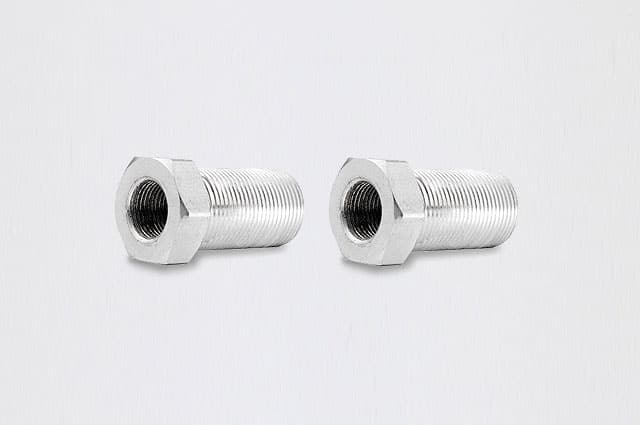
The primary advantage of a bung adjuster nut in a bump steer kit is its ability to facilitate “on-the-fly” adjustments.
- No Disassembly Needed: Traditional links require you to disconnect one end of the rod end to adjust its length. With a bung adjuster nut, you simply loosen the jam nut and turn the hex-head adjuster to extend or retract the linkage.
- Weld-in Bung Compatibility: These components are designed to work seamlessly with threaded weld-in bungs (tube adapters). The adjuster nut screws into the bung, and the rod end screws into the adjuster nut.
- Precision Alignment: Because the adjustment is external and visible, it allows for extremely fine-tuning of toe, caster, or pinion angles in racing and off-road applications.
Bridging components and sizes
While their main job is adjustment, bung adjuster nuts also serve as critical adapters.
- Thread Adaptation: They can bridge the gap between different thread sizes, such as installing a 5/8″ rod end into a 3/4″ weld-in bung.
- Material Strength: SYZ bung adjuster nuts are CNC-machined from chromoly steel with a silver zinc plated finish, providing superior tensile strength and excellent corrosion resistance for high-impact loads.
Related reading: The engineer’s guide to right-hand (RH) and left-hand (LH) threads · Using LH/RH Threads for Quick Linkage Adjustments · Welding Guide: Choosing the Correct Weld-In Bungs