Aluminum rod ends are attractive when every linkage gram matters, but the weight saving is not a free upgrade. A 7075-T6 aluminum body can make the joint much lighter than a steel-bodied rod end, while the hardened steel ball still carries the bearing surface. The real question is where that lower mass helps the design, and where the reduced shock-load and fatigue margin becomes the limiting factor.
An aluminum rod end swaps the steel housing for a 7075-T6 aircraft-aluminum body around the same hardened steel ball used in steel rod ends. The ball itself is never aluminum, because aluminum lacks the surface hardness to resist wear against a rotating load. The trade you’re making is lower mass for lower shock-load margin, and knowing exactly where that trade pays off, and where it does not, is the point of this article.
Why 7075-T6, Specifically
Not all “aluminum rod end” listings use the same alloy, and the difference matters. 7075-T6 is a high-strength aerospace grade, solution heat-treated and artificially aged to peak strength. It approaches the load capacity of mild steel while keeping aluminum’s weight advantage. The more common, cheaper 6061 alloy is meaningfully weaker and forces a lower load rating; a “6061 aluminum rod end” is not equivalent to a 7075-T6 part even at the same dimensions. If a listing does not specify the alloy, that is worth asking about before you buy.
The Weight-Saving Number
Aluminum runs about 2.7 g/cm3 versus roughly 7.85 g/cm3 for steel, close to a 1/3 density ratio. But the finished rod end does not shed weight at that same 1/3 ratio, because the ball, and often the race or liner, stay steel or steel-backed. One breakdown estimates the real per-part weight savings at roughly 50-60%, not the full theoretical reduction. The housing gets much lighter, while the internals do not change much. Note this figure comes from an AI-synthesized estimate, not an independent lab measurement; treat it as a reasonable planning number, not a guaranteed spec for any specific part.
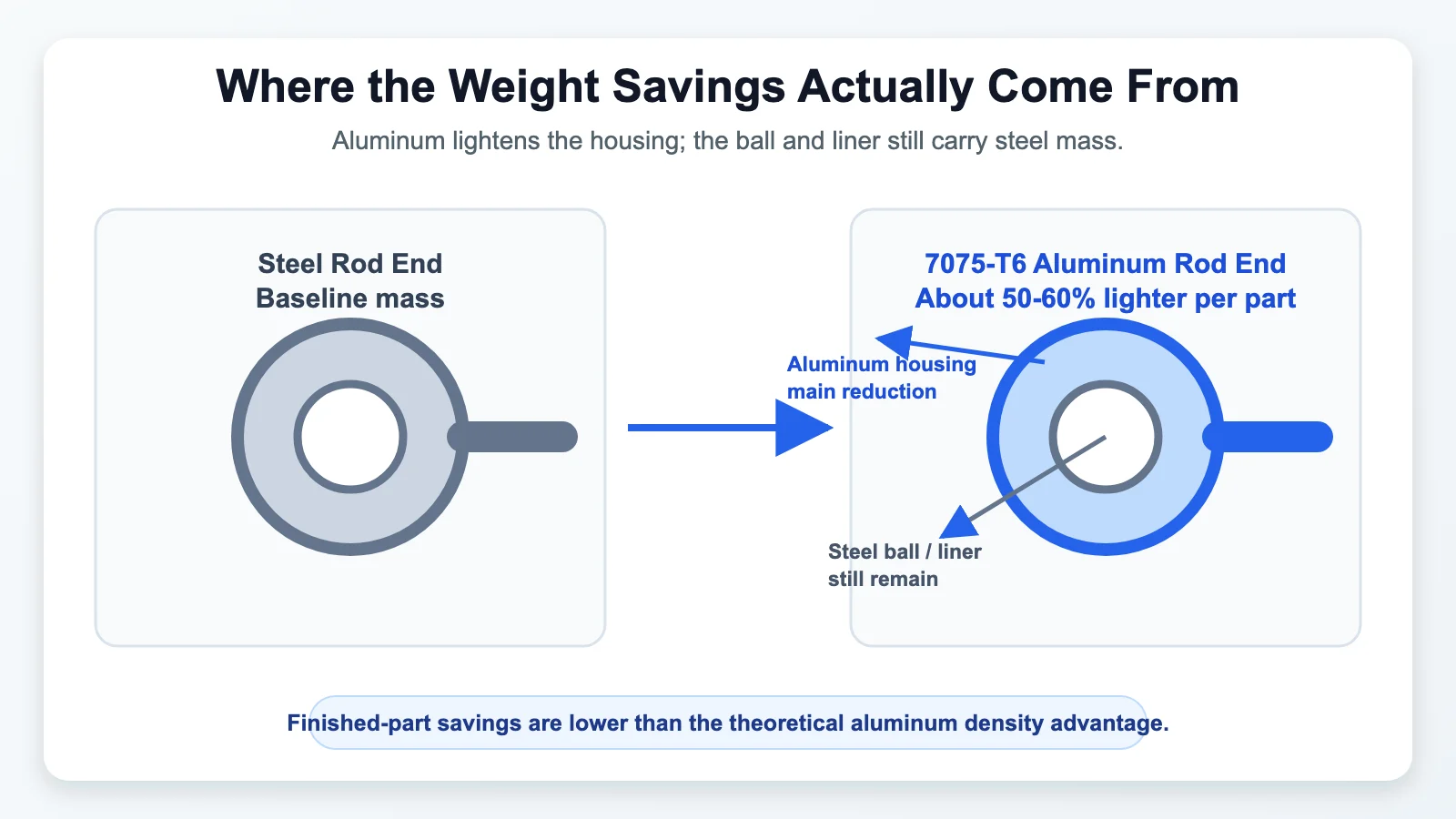
Where that weight reduction actually matters is unsprung and rotating mass: sway-bar links, tie rods, shift linkages, throttle linkages, and non-structural suspension arms where lighter joints let the suspension react faster to terrain without adding mass the springs and dampers have to control.
The Trade-Off: Lower Shock-Load and Fatigue Margin
Here is where the pros/cons framing needs real numbers, not just “aluminum is weaker.” A trade technical article aimed at motorsport fabricators puts it plainly: 7075-T6 rod ends have a load capacity similar to low-carbon steel, and, more importantly for suspension use, they have poor elongation properties. They do not give or bend under high loads the way a tougher alloy does, which the same source flags as a real limitation for load-critical applications.
Two real-world failure examples from a metal fabricator with over two decades in production make this concrete:
- A production-line batch of aluminum rod ends failed within 10 days due to a 7 degree misalignment. The parts were well under their static load rating, but the repeated off-axis stress accelerated fatigue cracking.
- A solar-tracking system using 7075-T6 rod ends loaded at only 30% of tensile limit still fractured after 2 months of mild torsional vibration.
These are supplier-reported field cases, not independent third-party lab tests, but the pattern they illustrate is consistent with the general engineering consensus: aluminum tolerates misalignment and cyclic micro-flexing far worse than steel does. A joint that is well within its static load rating can still fail early if the mounting geometry is not clean or the load path is not purely axial/radial.
Thread Wear and Galvanic Corrosion
Two secondary issues are worth knowing before you spec aluminum:
- Thread galling: aluminum threads are softer than steel. Frequent adjustment, over-torquing, or a steel bolt threaded in without anti-seize accelerates wear and can gall the threads.
- Galvanic corrosion: a steel ball and often a steel bolt sit against an aluminum body. In damp conditions, that dissimilar-metal contact can corrode galvanically. A PTFE liner between the ball and body does double duty here: it reduces friction and acts as a barrier that reduces galvanic contact between the two metals.
Pros vs. Cons at a Glance
| Aluminum (7075-T6) | Chromoly (4130) Steel | |
|---|---|---|
| Weight | ~50-60% lighter per part | Baseline |
| Load capacity | Comparable to low-carbon steel | Significantly higher |
| Fatigue/impact tolerance | Poor: sensitive to misalignment and cyclic micro-flexing | High: built for repeated shock loading |
| Corrosion | Good with anodizing; galvanic risk at ball/bolt contact | Needs plating/coating, no galvanic concern |
| Best for | Weight-critical, light-to-moderate, well-inspected loads | Heavy shock loads, primary steering, severe off-road suspension |
When to Choose Aluminum, and When Not To
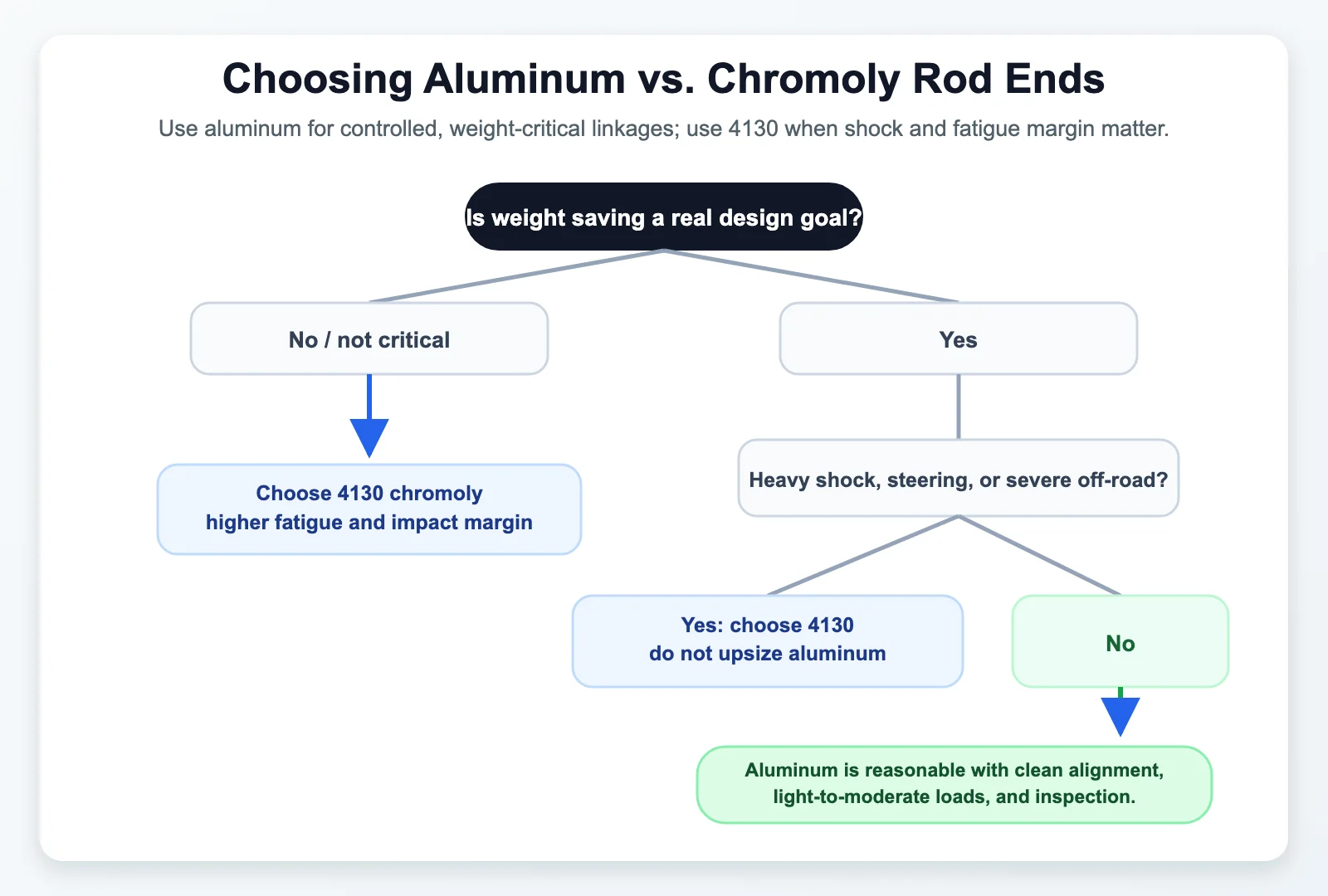
Choose aluminum when:
- Weight reduction at that pivot point is a real design goal, such as racing linkage, robotics, UAV/aerospace mechanisms, or shift/throttle linkage.
- The joint carries light-to-moderate, well-inspected loads.
- You can guarantee clean, low-misalignment mounting geometry.
- The environment is not marine or highly abrasive.
Avoid aluminum when:
- The joint sees heavy shock loads or high-impact stress, such as severe off-road, trophy truck, or rock crawling use.
- It is a primary steering component or structural suspension link without engineering validation.
- The threaded shank will see bending load rather than pure tension/compression.
- The environment is abrasive or salt-exposed enough to erode the anodized finish.
If your build sits in the “avoid” column, the fix is not a bigger aluminum joint. It is 4130 chromoly, which trades the weight savings for the fatigue and impact margin that heavy-duty steering and suspension actually need.
Related reading: Why Off-Road Racing Prefers 4130 Chromoly Rod Ends · When Should You Choose Stainless Steel Rod Ends? · Titanium Heim Joints: Are They Worth the Premium Cost?