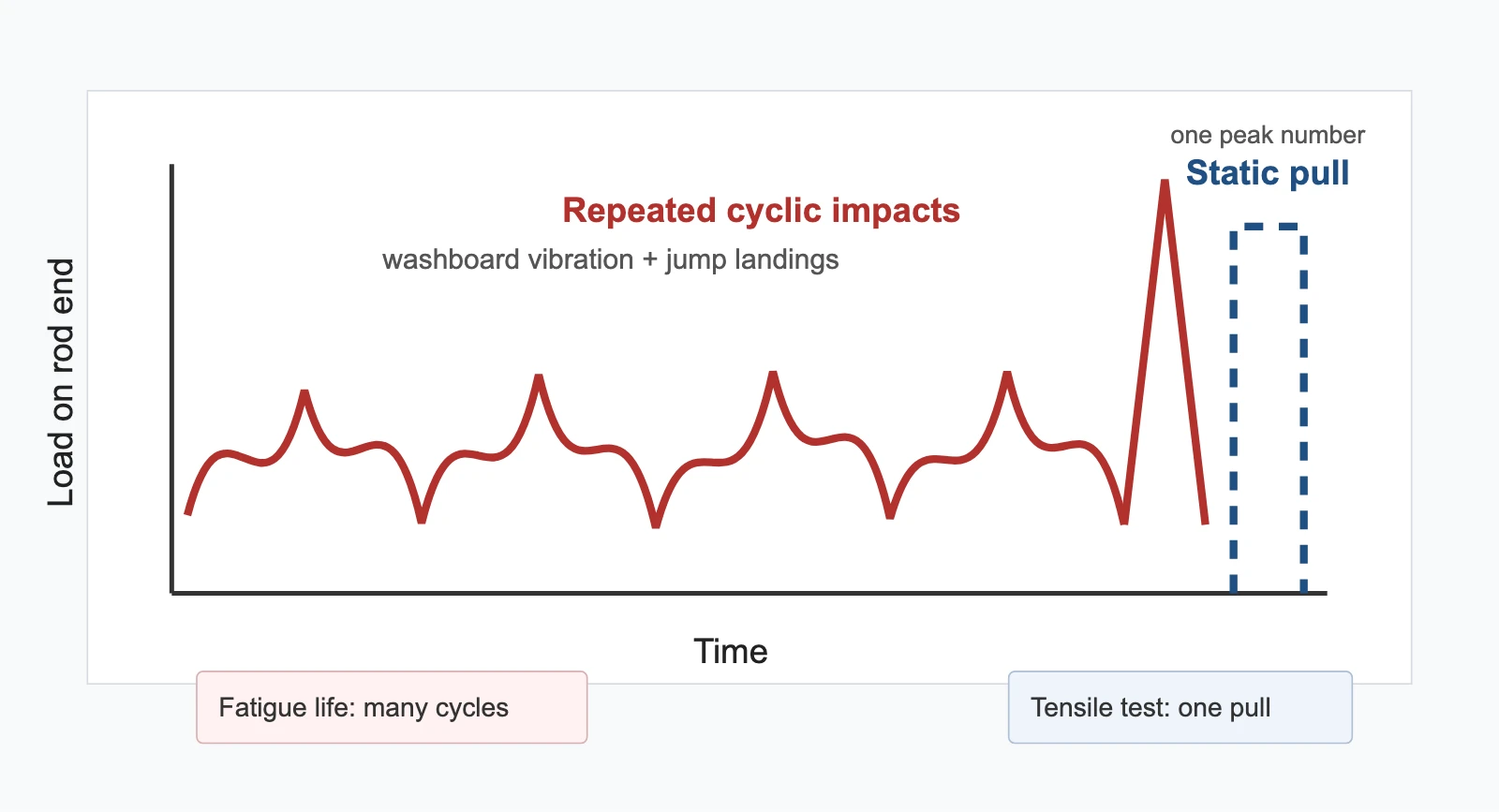
Off-road racing suspensions don’t fail from one big hit — they fail from thousands of smaller ones. A washboard trail or a string of jump landings puts a spherical bearing or rod end through repeated load cycles that a static strength number doesn’t capture. 4130 chromoly earns its place in racing suspension not just because it’s strong, but because it holds up to that specific kind of repeated, high-impact loading better than plain carbon steel — and because, correctly heat-treated, it fails by bending rather than snapping.
If you want the base metallurgy comparison — composition, tensile strength vs. carbon steel, and how eye elongation happens under sustained load — see our companion piece: Chromoly (4130) vs. Carbon Steel: Which Is Right for Your Build?. This article picks up where that one leaves off, focused specifically on why the racing environment favors this alloy.
Fatigue Resistance Matters More Than Peak Strength Here
A static tensile number tells you how much force it takes to break a part once. It doesn’t tell you how many load cycles that part can survive before it cracks from repeated stress well below its breaking point — which is fatigue life, and it’s the number that actually matters on a washboard trail or a rock-crawling course where a rod end sees thousands of load reversals per run.
4130’s chromium and molybdenum content improves its fatigue resistance over plain carbon steel at a comparable strength level, which is why it’s the standard aircraft structural steel for exactly this reason — a role it’s held since the 1930s, when the aviation industry standardized on 4130 for tube-frame fuselages precisely because it “does just about everything you’d want it to do well,” in the words of a widely cited EAA (Experimental Aircraft Association) welding reference. That same fatigue behavior is what off-road racing suspension needs from a rod end: a part that survives repeated hard cycling, not just a single overload event.
Why the Tensile-Strength Numbers You’ll See Don’t Match
If you go looking for “4130 tensile strength,” you’ll find numbers ranging from roughly 94,000 psi to 250,000 psi, and that’s not a data error — it’s the same alloy reported at different heat-treatment states:
- 94,000 psi — normalized aircraft-grade tube stock, the baseline condition with no additional strengthening heat treatment (EAA welding reference).
- ~150,000 psi — normalized 4130 that’s been properly heat-treated and tempered after welding, which is the figure our own metallurgy comparison cites for heat-treated 4130 vs. 80,000–100,000 psi for typical carbon steel. A forum discussion among experienced oval-track chassis builders corroborates this same ~150,000 psi figure for properly tempered 4130 with good ductility — useful as a cross-check, though it’s community-sourced, not an official mill certification.
- Up to 250,000 psi — a high-strength heat-treat condition that’s significantly more brittle and, per that same builder discussion, generally not recommended for chassis or suspension use because it sacrifices the ductility that makes 4130 valuable in the first place.
The takeaway: 4130 isn’t one fixed number. It’s an alloy system that can be heat-treated across a strength/ductility trade-off, and racing suspension applications deliberately target the normalized-and-tempered condition (roughly 150,000 psi) rather than the highest-strength, most brittle option — because ductility is doing real work here, covered next.
Ductility: Bending Before Breaking Is a Safety Feature
A properly heat-treated 4130 part tends to yield — bend, deform, give some warning — before it fractures completely. A harder, more brittle material can fail suddenly with no warning at all. For a steering or suspension component, that difference matters more than an extra 20,000 psi of peak strength: a bent rod end that still holds the wheel on is a very different failure than one that snaps clean.
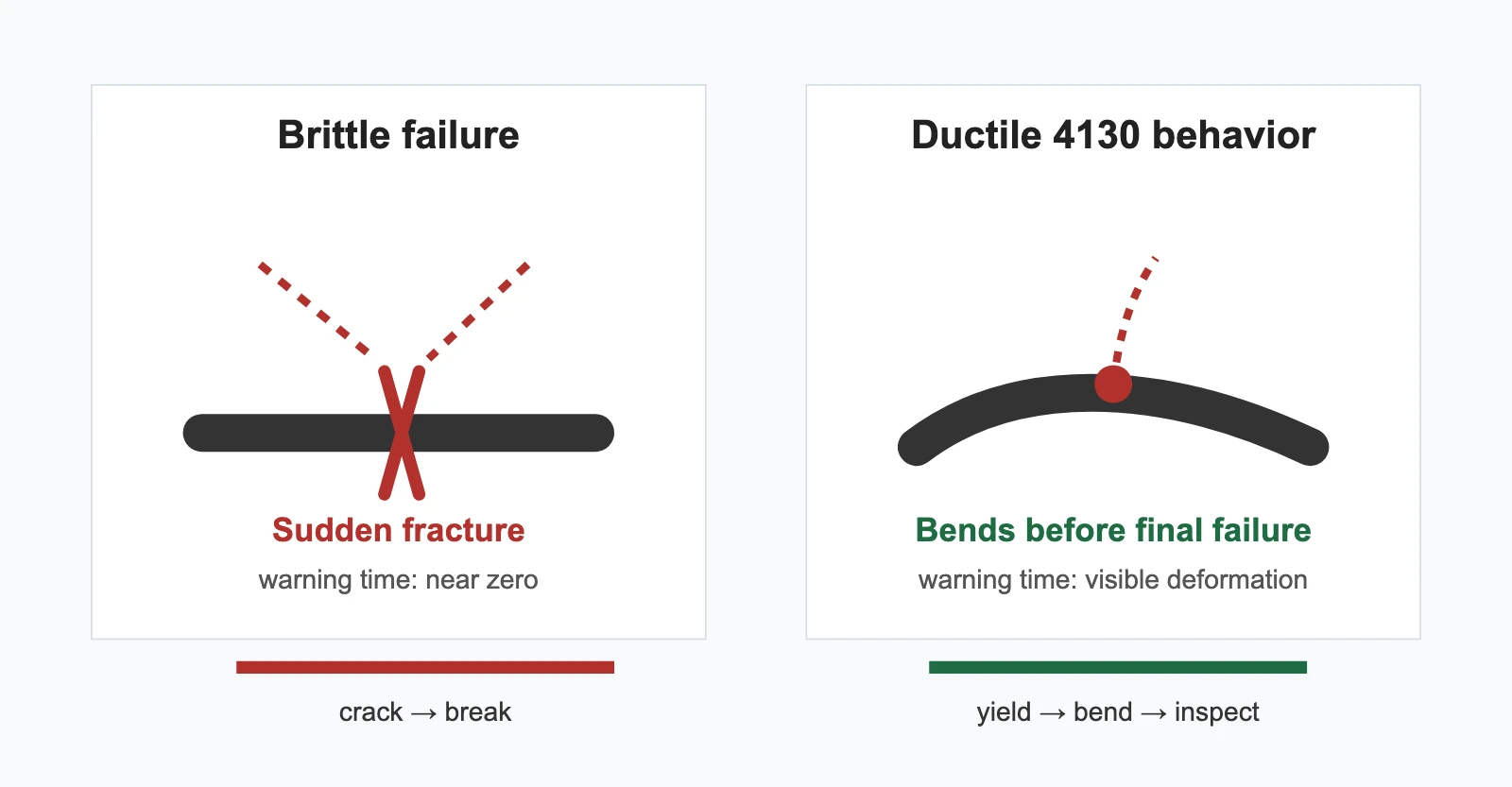
This is also why the community discussion above steers away from the highest-strength (250,000 psi) heat-treat condition for chassis and suspension parts — that condition trades away the ductility that makes 4130’s failure mode predictable in the first place.
Weldability — With a Real Caveat Competitors Don’t Mention
4130’s lower carbon content compared to tool steels means it resists embrittlement in the heat-affected zone during TIG or oxy-acetylene welding, which is exactly why off-road fabricators can weld a rod end’s threaded bung directly into a DOM steel tube to build a custom suspension link. This is a genuine practical advantage over higher-carbon alloys.
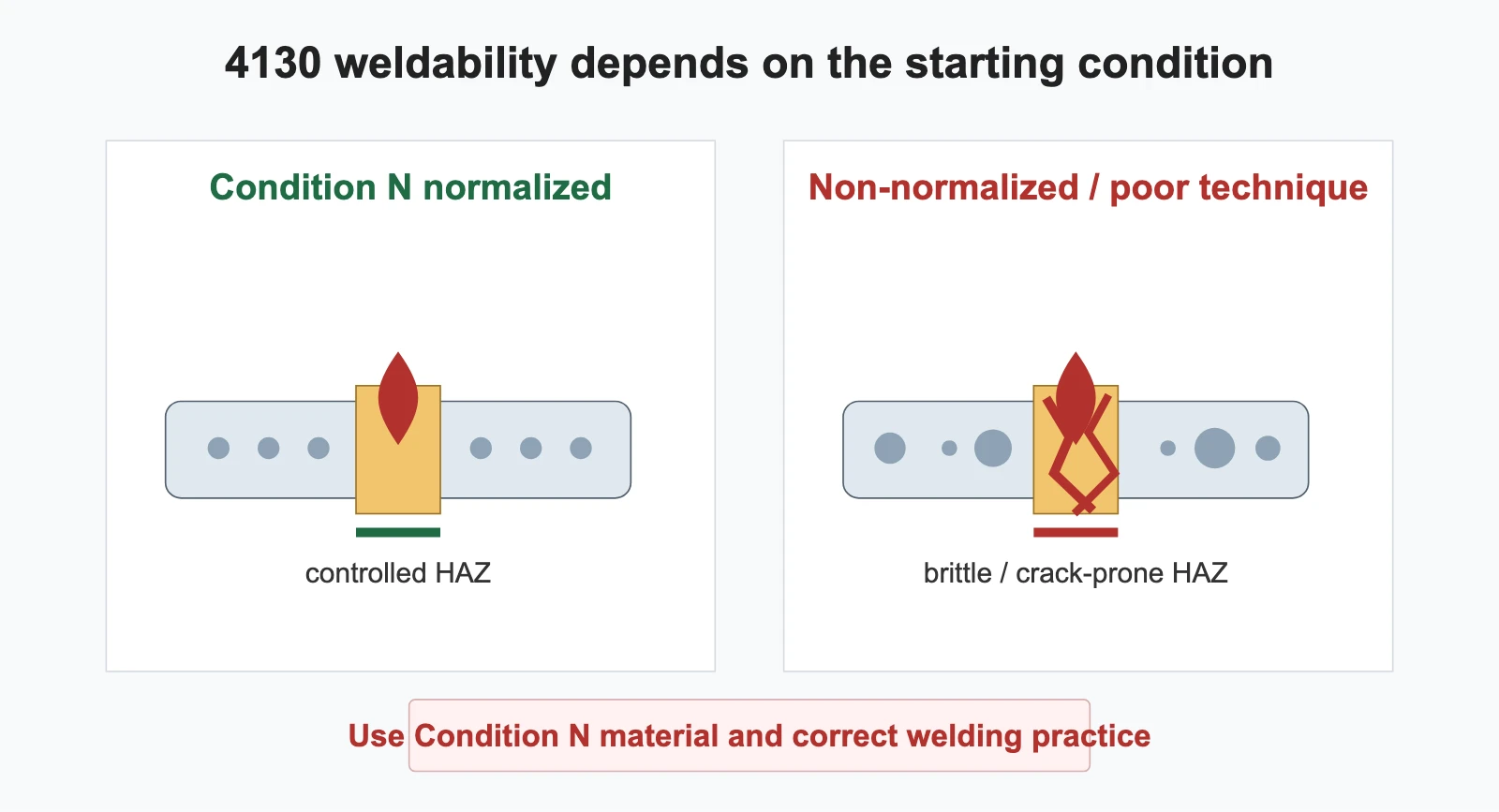
But it comes with a real limitation that most rod-end marketing skips: 4130 has to be in its normalized condition (often marked “Condition N” on certified tube stock) to weld safely, using an appropriate low-carbon filler rod, with attention to preheat and post-weld cooling rate. A long-running forum discussion among chassis fabricators recounts several historical oval-track chassis failures attributed to non-normalized chromoly tubing or improper welding technique — cited as cautionary discussion among builders, not an official accident investigation, but the underlying engineering point holds: welded incorrectly, chromoly can be more dangerous than plain carbon steel, not less. If you’re having a rod end bung welded into a link, confirm the fabricator is using normalized stock and correct technique — the material’s advantage depends on it.
Static Load Ratings: Where Chromoly Sits in the Product Line
Material grade alone doesn’t determine a rod end’s rated capacity — construction (2-piece vs. 3-piece), body size, and liner all factor in. But looking at one supplier’s full product line side by side shows where chromoly typically lands relative to other materials at a comparable size:
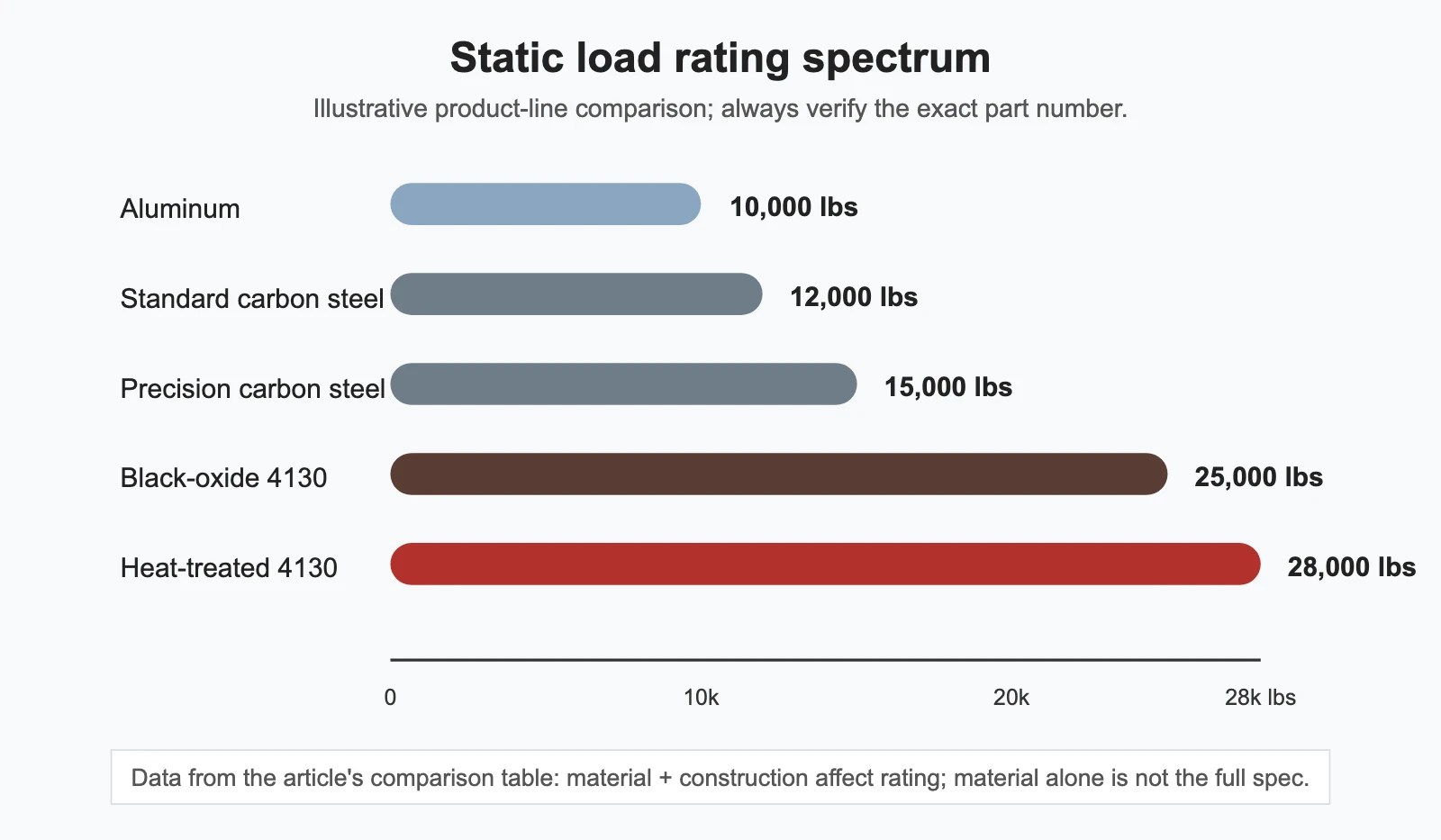
| Rod End Type | Body Material | Construction | Static Load Rating |
|---|---|---|---|
| Standard | Carbon steel | 2-piece | 12,000 lbs |
| Precision | Carbon steel | 3-piece, PTFE-lined | 15,000 lbs |
| Aluminum | 7075-T6 aluminum | 3-piece, PTFE-lined | 10,000 lbs |
| Pro-1 | Black-oxide 4130 chromoly | 2-piece | 25,000 lbs |
| Chromoly | Heat-treated 4130 chromoly | 3-piece, Kevlar race + PTFE liner | 28,000 lbs |
Source: one manufacturer’s published buyer’s guide for a single product line — this is illustrative of the spread between materials, not a universal spec. Always check the load rating on the specific part number you’re buying.
The Piece Most Guides Skip: Misalignment, Not Just Material, Kills Rod Ends
Even a correctly specified 4130 chromoly rod end can fail prematurely if it’s forced beyond its designed misalignment angle. When a joint articulates past its rated angle, the load path shifts from clean axial/radial loading into bending load on the shank or mounting tabs — a load case the joint wasn’t designed for, regardless of how strong the body material is. This is a mounting-geometry problem, not a material problem, and it’s worth checking before assuming a failed rod end means you need a stronger material.
The Bottom Line
4130 chromoly wins in off-road racing suspension not because of one impressive number, but because of how three properties stack together for this specific use case: fatigue resistance under repeated cyclic loading, a ductile (bend-before-break) failure mode when properly heat-treated, and weldability that lets fabricators build custom links — provided the material is normalized and welded correctly. Get any one of those wrong (wrong heat-treat state, wrong welding technique, or a joint mounted past its misalignment rating) and the material advantage disappears.
Related reading: Chromoly (4130) vs. Carbon Steel: Which Is Right for Your Build? · Aluminum Rod Ends: Pros, Cons, and Weight-Saving Benefits · How Heat Treatment Impacts Rod End Tensile Strength