

Where Can You Buy Heim Joints?
You can buy heim joints from local parts stores, motorsport retailers, industrial distributors, online marketplaces, or factory-direct suppliers. The right channel depends on urgency, quantity, documentation needs, custom sizing, inspection requirements, and whether the joint is safety-critical.
What Does “Heim” Mean?
“Heim” comes from the Heim bearing, a trade-name origin that became generic workshop language for spherical rod ends. In practical use, heim joint, rod end, rose joint, and spherical rod end often describe the same self-aligning linkage component.
Zero-Backlash Precision: Why Robotics Require High-Tolerance Spherical Bearings
Robotics require high-tolerance spherical bearings because backlash becomes positioning error at the tool, gripper, or actuator. Zero-backlash performance depends on controlled ball-race fit, rigid mounting, stable materials, clean lubrication strategy, and inspection through repeated motion cycles.
Heavy-Duty Tie Rod Ends: Scaling Up for 1-Ton Axle Conversions
Heavy-duty tie rod ends for 1-ton axle conversions are chosen for larger studs, sealed service life, impact durability, and street-friendly steering behavior. They trade away some articulation and custom adjustability compared with heims but are often stronger for dual-purpose steering.
Swivel Rod Ends: Precise Motion Control for Robotics and Aerospace
Swivel rod ends support precise multi-axis motion in robotics and aerospace linkages where a joint must carry load while self-aligning. The key requirements are low play, smooth articulation, traceable materials, corrosion control, and tolerance stability under repeated cycles.
Track Rod Ends: Terminology and Sizing for the UK and Australia
In the UK and Australia, “track rod end” usually means a steering tie rod end, not every rod end bearing. Correct sizing still requires thread diameter, pitch, hand, taper or bore style, stud length, and vehicle fitment rather than relying on terminology alone.
Wholesale Sourcing: How to Choose a Rod End Supplier for OEM Production
Choosing a wholesale rod end supplier for OEM production means verifying repeatability, capacity, material control, inspection reports, packaging, communication, and engineering support. The cheapest quote is less important than whether the supplier can hold the same specification across production batches.
Spherical Plain Bearings vs. Rod Ends: Mechanical Differences
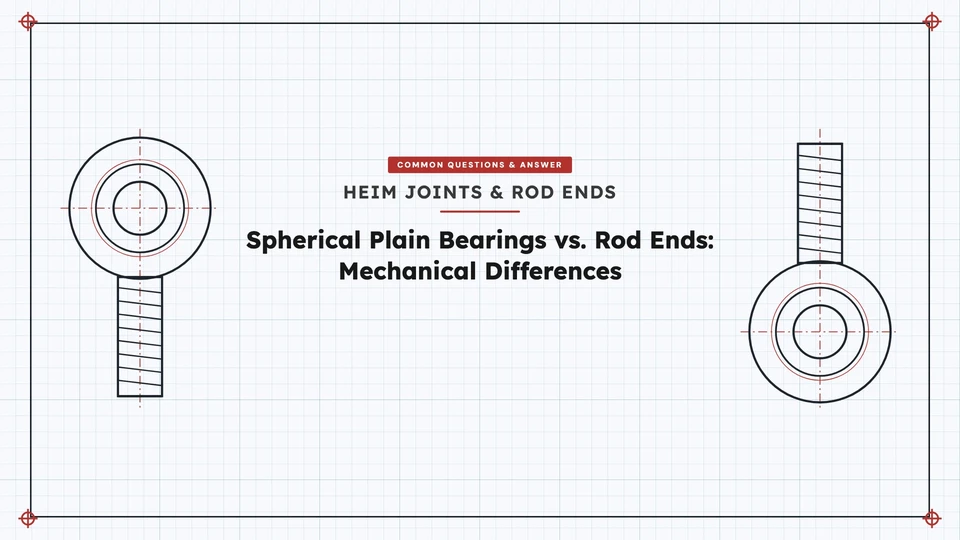
Spherical plain bearings are bearing inserts that fit into a housing, while rod ends combine a spherical bearing with a threaded housing for linkage adjustment. The right choice depends on whether the design needs compact pivot support or an adjustable link end.
Clevis Rod Ends: Best Applications for Industrial and Hydraulic Linkages
Clevis rod ends fit industrial and hydraulic linkages where a forked end captures a pin and carries load through a defined pivot. They suit cylinders, actuators, gates, and equipment controls, but are not the same as spherical rod ends when misalignment is required.
Angled Heim Joints: Solving Clearance Issues With Offset Shanks
Angled heim joints and offset shanks solve clearance problems by moving the joint centerline away from interference. They should be used carefully because offset also increases bending leverage on the shank, so bracket alignment, spacer stack, and load direction matter.
BMW & MINI Performance: Swapping Trailing Arm Bushings for Spherical Joints
BMW and MINI trailing arm spherical joints replace rubber compliance with precise geometry control. The benefit is sharper alignment under load and better track feedback; the trade-off is more noise, vibration, maintenance attention, and reduced isolation for daily street use.
Upgrading Cheap Agricultural Links: Where the Stock Turnbuckle Falls Short
Cheap agricultural turnbuckles and stock links often fall short through loose threads, soft hardware, poor corrosion protection, and imprecise adjustment. Upgrading to correctly sized rod ends improves control only when load rating, thread engagement, sealing, and implement geometry are matched.