
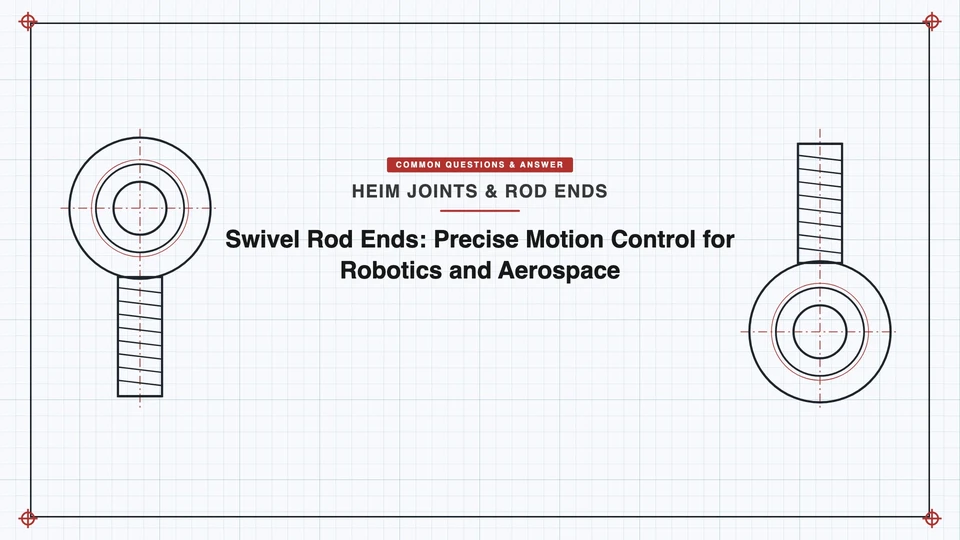
A swivel rod end transmits force while allowing controlled angular movement between connected components — combining a spherical bearing interface with a threaded or mounted rod connection to deliver smooth articulation, misalignment compensation, and repeatable motion. That combination is what makes them essential in both high-performance robotics and aerospace systems, even though those two fields have very different demands.
How a Swivel Rod End Works
A typical swivel rod end has three functional parts:
- Outer housing — provides structural support and the attachment interface.
- Spherical ball or bearing — allows rotation and angular movement across multiple axes.
- Rod attachment interface — transfers tension and compression loads between the connected components.
The spherical design lets the joint absorb small alignment errors while still transferring motion accurately — which is exactly why it’s preferred over a rigid connection in systems where binding, wear, or unwanted stress from misalignment would otherwise be a problem.
Role in Robotics
Swivel rod ends show up in robotic systems for several reasons at once: multi-axis articulation for robotic arms, linkages, and end-effectors; high repeatability that holds accurate positioning across many motion cycles; compact packaging where space and weight are constrained; and reduced backlash, which directly improves precision in servo-driven mechanisms. Common applications include industrial robot joints, pick-and-place mechanisms, automation fixtures, sensor positioning systems, and lightweight robotic platforms.
Role in Aerospace
Aerospace systems rely on rod ends because they combine low-friction movement with high load capability and durability in a compact package. Applications include flight-control linkages, flap/spoiler/rudder mechanisms, landing gear assemblies, rotorcraft control systems, and general actuation systems. Aerospace-grade rod ends are typically manufactured from high-strength steels, corrosion-resistant alloys, or specialized bearing materials, and applications in this space often need to meet demanding aviation-specific standards — verify the specific standard your application requires directly with your supplier rather than assuming a general-purpose rod end qualifies.
For the material-durability side of robotics applications specifically (corrosion resistance in automation environments), see Industrial Automation: Corrosion-Resistant Linkages for Robotics. For the precision-tolerance side — why some robotics applications need zero-backlash, high-tolerance bearings specifically — see Zero-Backlash Precision: Why Robotics Require High-Tolerance Spherical Bearings.
Related reading: Industrial Automation: Corrosion-Resistant Linkages for Robotics · Zero-Backlash Precision: Why Robotics Require High-Tolerance Spherical Bearings