
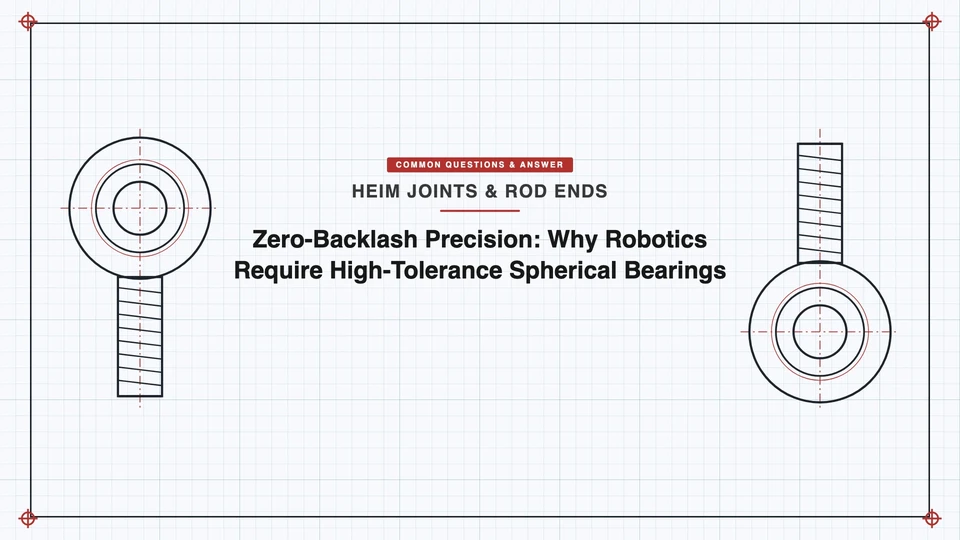
Spherical bearings aren’t inherently zero-backlash — that’s a design outcome, not a built-in property of the bearing type. What a spherical bearing does provide is self-alignment and load capacity; whether a specific joint achieves true zero-backlash depends on the bearing’s clearance, preload, mating tolerances, and how the whole assembly is engineered. NASA’s own engineering guidance is explicit on this point: spherical plain bearings are frequently used without preload, with intentional clearance, in applications that don’t require high precision. Precision robotics is exactly where that clearance stops being acceptable.
Why Backlash Is a Real Problem in Robotics
Backlash is unwanted lost motion between components. When a robotic joint changes direction, that clearance lets one part move slightly before the opposing surfaces actually re-engage. For a hand tool, that’s barely noticeable. For a robot doing precision assembly, machining, inspection, or semiconductor handling, that same small amount of play translates into reduced positioning accuracy, worse repeatability, vibration and oscillation, more correction work for the control loop, and tool-center-point error that compounds every time the joint reverses direction.
The effect gets worse the further downstream you are from the error. A tiny angular error at a joint close to the robot’s base gets multiplied by the length of every link between that joint and the end effector — a fraction of a degree at a proximal joint can turn into a meaningfully larger linear displacement by the time it reaches the tool tip.
Why Spherical Bearings Get Used Here at All
A spherical plain bearing’s convex inner ring against a matching concave outer ring lets it carry substantial load while still accommodating angular misalignment — valuable in robotic joints, linkages, actuators, and end-effectors where the load path isn’t perfectly aligned through the full range of motion. That’s the reason spherical bearings show up in precision mechanisms in the first place: the geometry itself is well-suited to the problem.
Tolerance Is What Makes Precision Possible
A bearing is only as precise as everything it interfaces with. Manufacturing tolerance affects the spherical profile’s accuracy, radial and axial clearance, runout, surface finish, bore and shaft dimensions, housing geometry, concentricity, and contact pressure — all of which have to be controlled together, not individually. ISO 12240-2 (dimensions and tolerances for angular-contact radial spherical plain bearings) is a concrete example of how tightly this geometry can be — and needs to be — standardized for demanding applications.
Preload: The Step That Actually Removes the Gap
Tolerance control alone gets a bearing close to zero clearance, but preload is what actually closes the remaining microscopic gap. Preload intentionally removes internal clearance by forcing the bearing’s elements or the mating surfaces into continuous contact, rather than leaving them free to float within a tolerance band. In precision robotic mechanisms, a properly preloaded bearing system increases stiffness and reduces lost motion directly — which is why preloaded bearing assemblies are consistently associated with the high rigidity and high positioning accuracy precision robotics actually needs.
The Actual Takeaway
Specifying "a spherical bearing" for a precision robotic joint isn’t enough on its own — the bearing type, its clearance class, whether it’s preloaded, and the tolerances of everything it mounts into all have to be engineered together to actually achieve zero-backlash behavior. The self-alignment capability is what makes a spherical bearing the right starting point; controlled tolerance and preload are what turn that starting point into the precision the application actually needs.
Related reading: Swivel Rod Ends: Precise Motion Control for Robotics and Aerospace · Industrial Automation: Corrosion-Resistant Linkages for Robotics