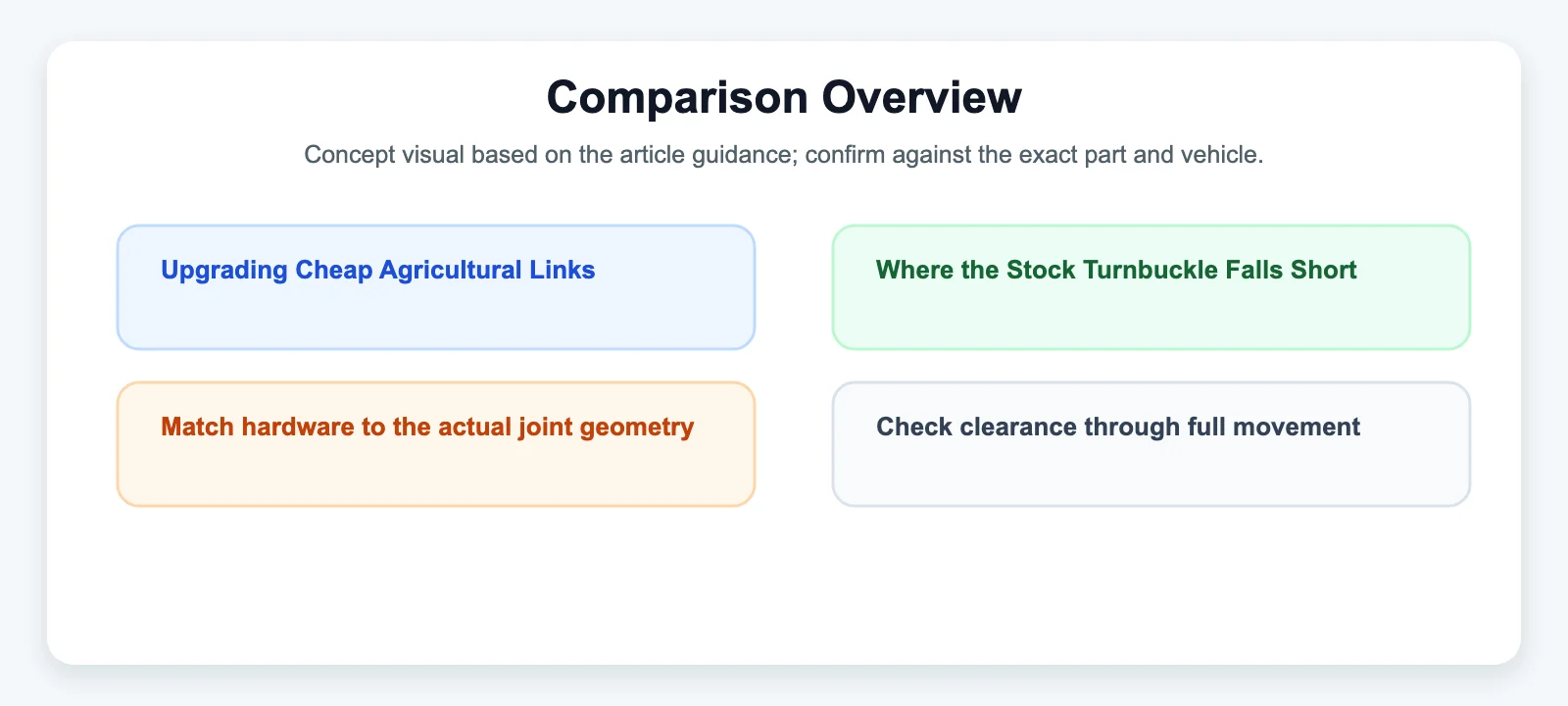
Stock 3-point hitch top links and lower link turnbuckles are a common point of frustration on working tractors — they rust and seize, bend under high draft loads, and get harder to adjust the moment an implement is actually attached. There are four distinct upgrade paths, including Heim joint conversions, and which one makes sense depends on how often you’re adjusting and how much load the link sees.
Hydraulic Top Link and Side Link: The Full Upgrade
This replaces the manual turnbuckle-style top link entirely, letting you adjust length dynamically from the tractor seat through hydraulic remotes. It matters most for box blades, rear blades, brush hogs, and tillers — anything where the ground angle needs real-time adjustment rather than a one-time setting. When selecting one, look for dual pilot-operated check valves (these prevent fluid drift under heavy load), the correct category match (Cat 0, 1, or 2), and a retracted/extended stroke length that actually fits your implement’s range of motion.
Quick-Adjust or Ratchet Top Links
This replaces a threaded turnbuckle that needs a tommy bar or wrench to adjust. A ratchet handle or Acme-thread crank gives you mechanical advantage, so you can adjust length even under load instead of fighting a seized or rusted thread. Look for heavy-duty forged steel ends, a grease zerk fitting for maintenance, and confirm pin size compatibility — 3/4" typically pairs with Cat 1, 1" with Cat 2.
Telescopic Sway Stabilizer Links
This replaces stock check chains or turnbuckle-style sway chains. A pin-lock system inside sliding square tubing secures the lower lift arms quickly, eliminating side-to-side implement slop without having to fight rusty turnbuckle threads every time. Look for heavy-gauge square steel tubing with corrosion-resistant zinc plating and reliable drop-pins.
Heavy-Duty Forged Top Links
This replaces thin-walled or stamped factory links that bend under heavy loads — subsoilers and heavy post-hole diggers are where this shows up most. High-tensile forged steel with heat-treated ball eyes resists bending, thread stripping, and eyelet deformation in a way a stamped factory link can’t.
The Category Match Is Where Selection Goes Wrong Most Often
Across all four upgrade paths, the detail that trips people up isn’t the upgrade type — it’s matching the correct hitch category (Cat 0, Cat 1, Cat 2) and the corresponding pin diameter to your specific tractor and implement. A stronger, better-built link in the wrong category size doesn’t fit any better than the cheap one it’s replacing.
Related reading:Agricultural Machinery: Tractor Linkage Strength vs. Precision · Lawn Mowers & Garden Tractors: Affordable Rod End Solutions for Sloppy Steering