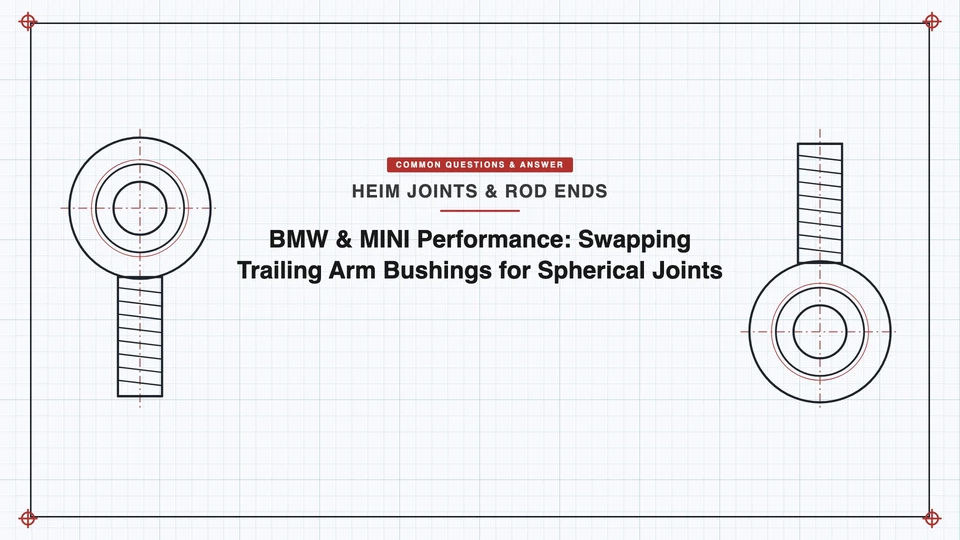
Swapping a BMW or MINI’s rubber trailing arm bushings for spherical joints (often called monoballs) is a common track and autocross modification, and the goal is straightforward: remove the rubber’s flex so the rear suspension geometry stays consistent under hard cornering, braking, and acceleration instead of moving around underneath the car.
What Actually Changes
The factory rubber bushing is a deliberate compromise between comfort and handling — it’s quiet, absorbs harsh impacts, and lasts a long time, but it flexes under load, which lets toe and camber shift slightly under acceleration, braking, and cornering. Over time, that flex can also produce a vague, less connected rear-end feel as the rubber ages.
A spherical joint replaces that flexible element with a bearing that still allows articulation but almost no unwanted deflection. The biggest improvement most people notice isn’t raw grip — it’s consistency: the car behaves the same lap after lap because the suspension arm isn’t moving around on soft rubber anymore.
Where This Modification Is Common
- BMW E36 / E46 / Z4 / E9x — rear trailing arm bushing (RTAB) upgrades are especially common on these chassis. The E46 in particular benefits, since a worn RTAB on this chassis can produce a noticeable rear-steer effect under load.
- MINI R-series and F-series — these respond well to reduced suspension compliance for track and autocross use, with spherical solutions used specifically to improve geometry retention under hard driving.
Rubber vs. Polyurethane vs. Spherical
| Handling | Comfort | Noise/vibration | Best use | |
|---|---|---|---|---|
| OEM rubber | Good | Excellent | Lowest | Daily driving |
| Polyurethane | Better | Medium | Medium | Street performance |
| Spherical joint | Best | Lowest | Highest | Track / serious performance |
Polyurethane is a middle-ground upgrade, but some polyurethane bushing designs can introduce binding, since the suspension arm still needs to articulate through its full travel and polyurethane doesn’t allow the same free angular movement a spherical bearing does.
The Downsides Worth Knowing Before You Commit
- More NVH. Road texture, tire noise, differential and suspension sounds, and sharper impacts over potholes all become more noticeable. A car that felt refined on rubber will feel closer to a race car afterward.
- More maintenance over time. Spherical bearings wear, and how long they last depends on weather exposure, road conditions, and how much track use they see — a high-quality sealed bearing lasts considerably longer than a cheap open design.
- Harder installation. Most kits require removing the trailing arm, pressing out the factory bushing, and a proper realignment afterward — a hydraulic press or specialized tools are often necessary, which pushes this toward a shop job for most owners rather than a driveway swap.
Is It Worth Doing?
Makes sense if you: track the car regularly, run sticky tires, have coilovers installed, want sharper handling, or have already noticed rear-end movement under hard driving.
Probably isn’t worth it if you: mostly commute, prefer OEM comfort, drive on rough roads regularly, or have a low-mileage car with bushings that are still in good condition.
A common middle ground among enthusiasts: keep OEM rubber in the comfort-critical mounting points and use spherical joints only at the high-load suspension points, then follow up with an alignment adjustment afterward.
For the broader tradeoff between spherical joints and rubber bushings in general track applications, see Precision Geometry: Heims vs. Rubber Bushings for Track Use.
Related reading: Precision Geometry: Heims vs. Rubber Bushings for Track Use