
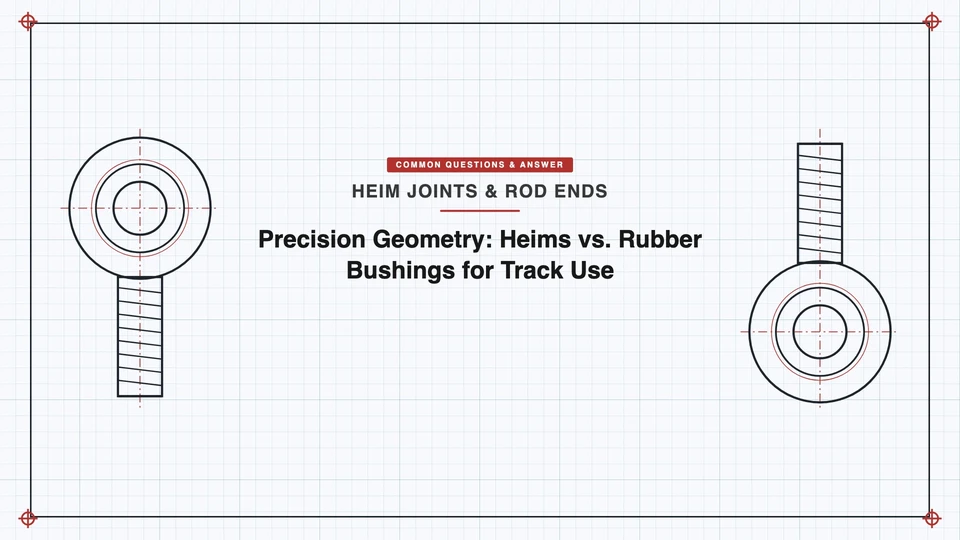
Both a heim joint and a rubber bushing do the same basic job — letting a suspension link pivot at its mounting point. The difference that matters on a track car is what happens to that pivot under load: a heim joint holds its geometry essentially unchanged; a rubber bushing deforms, and that deformation moves your alignment exactly when cornering forces are highest. For a dedicated track build, that’s usually reason enough to put heims at the geometry-critical pivots — while accepting real trade-offs in noise, ride harshness, and maintenance that a street car wouldn’t have to live with.
Why Rubber Bushings Move Your Alignment Under Load

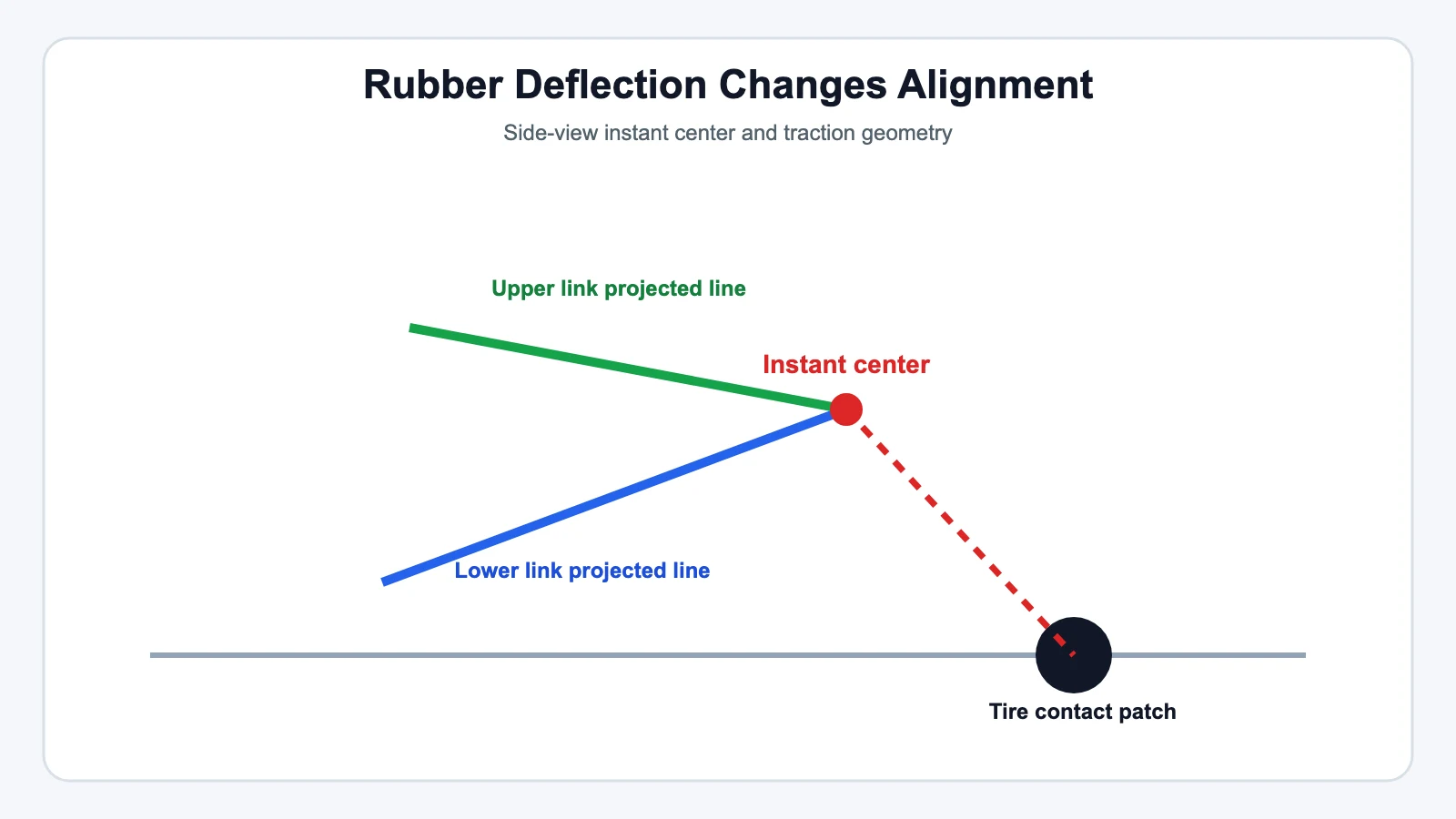
A rubber bushing is vulcanized between an inner and outer sleeve, and it’s designed to twist and compress as the suspension moves. That compliance is deliberate — it’s what gives a stock car its ride quality — but it isn’t free. Under the sustained lateral and braking loads a track car generates, the bushing deforms enough to change the suspension’s actual geometry in real time:
- Under hard braking, a lower control arm‘s rear bushing can flex backward, producing dynamic toe-out right when you need the car tracking straight.
- Mid-corner, high lateral load compresses the bushing enough to reduce the negative camber you set at the shop, shrinking the tire’s contact patch at the exact moment you need maximum grip.
Engineering literature on suspension kinematics identifies rubber-bushing deformation specifically as a source of unplanned alignment change under load — it isn’t a fringe concern, it’s a documented characteristic of compliant mounts. A heim joint’s metal-on-metal (or PTFE-lined) ball-and-race design doesn’t have this failure mode: there’s essentially no elastic deflection to speak of, so the alignment you dial in at the shop is the alignment the tire sees mid-corner.
What "Precision Geometry" Actually Buys You on Track

Zero compliance means two things in practice:
- Repeatable setup. If you change camber or toe between sessions, that change is the change you get on track — not that change plus an unknown amount of load-dependent drift. For anyone chasing consistent lap times across a session, that repeatability matters as much as the raw grip.
- Direct feedback. Without rubber absorbing small movements before they reach the chassis, a heim-equipped suspension transmits tire slip and surface feel to the driver more directly — useful information at the limit, at the cost of also transmitting every bit of road noise and impact harshness.
The Trade-Offs You’re Accepting
None of this makes rubber "inferior" — it’s an engineered compromise, not a shortcut. A rubber bushing gives you vibration isolation, quiet operation, and long service life with essentially no maintenance. A heim joint gives up all three of those in exchange for geometric precision:
- Noise and harshness. No cushioning layer means road impacts and driveline vibration transmit directly into the chassis and steering.
- Contamination exposure. An exposed spherical bearing takes on dirt, water, and grit far more readily than a sealed rubber bushing, which accelerates wear on the liner.
- Maintenance and inspection. Heim joints need regular checks for radial play, and a worn one needs full replacement — there’s no re-greasing a shot liner back to spec.
Real-world durability experience is genuinely mixed, and it’s worth reporting honestly rather than picking a side. A long-running discussion on the NAXJA (North American Xtreme Jeep Association) forum shows the split: several users report a well-maintained heim outlasting a rubber or polyurethane bushing by a wide margin, while others in the same thread report the opposite — heims replaced under warranty multiple times, or polyurethane bushings holding up for years without issue. The most useful takeaway from that thread isn’t a verdict either way — it’s that heim longevity depends heavily on the specific joint’s construction quality and how well it’s maintained, not on the fact that it’s a heim. A cheap, unsealed rod end can wear out faster than a quality rubber bushing; a quality PTFE-lined, properly maintained heim can outlast one by years.
You Don’t Have to Convert Every Pivot
The consistent recommendation across multiple technical sources — and the practical answer for anyone running a car on both track days and public roads — is selective replacement, not a wholesale swap. Put heims where geometry retention matters most:
- Lower control arm inner pivots (camber/toe stability under load)
- Sway bar end links (eliminates the flex that softens bar engagement)
- Toe links and trailing-arm pivots on the rear (unwanted rear toe change is especially destabilizing)
And leave rubber or polyurethane where isolation still earns its keep — subframe bushings, engine/drivetrain mounts, or any location where NVH matters more than the last few tenths of geometric precision.
Heim Joints vs. Rubber Bushings: Track-Focused Comparison
| Heim Joint (Spherical Bearing) | Rubber Bushing | |
|---|---|---|
| Deflection under load | Essentially none | Compresses and twists |
| Toe/camber stability under braking and cornering | Excellent | Degrades under high load |
| Suspension articulation | Free, no torsional resistance | Acts as a secondary spring; can bind at angle |
| Driver feedback | Direct and immediate | Filtered, slight delay |
| NVH | High — transmits road noise and impact | Low — absorbs and isolates |
| Maintenance | Requires regular inspection; wears with exposure | Low, until age/heat degrades the rubber |
| Best fit | Geometry-critical pivots on a dedicated track/race car | Daily-driven and dual-purpose cars; isolation-priority mounts |
Doing It Right, Not Just Doing It
Swapping to a heim joint is only as good as the installation. It needs a correctly sized high-misalignment spacer where the geometry requires extra swing, proper thread engagement, and — where the mounting allows — double-shear support rather than a single cantilevered bolt. A heim that binds partway through its travel, or one that’s undersized for the load path, will fail faster than the rubber bushing it replaced. Precision geometry is a property of a correctly specified and installed joint, not an automatic upgrade that comes in the box.
Related reading:Johnny Joint vs. Heim Joint vs. Builder Bushing · Precision Response: Why Heims Beat Standard Ball Joints in Steering · Heim Joint vs. Johnny Joint: Which Is Better for Rock Crawling? · Heim Joint vs. Tie Rod End: Street Performance vs. Off-Road Articulation · BMW & MINI Performance: Swapping Trailing Arm Bushings for Spherical Joints