
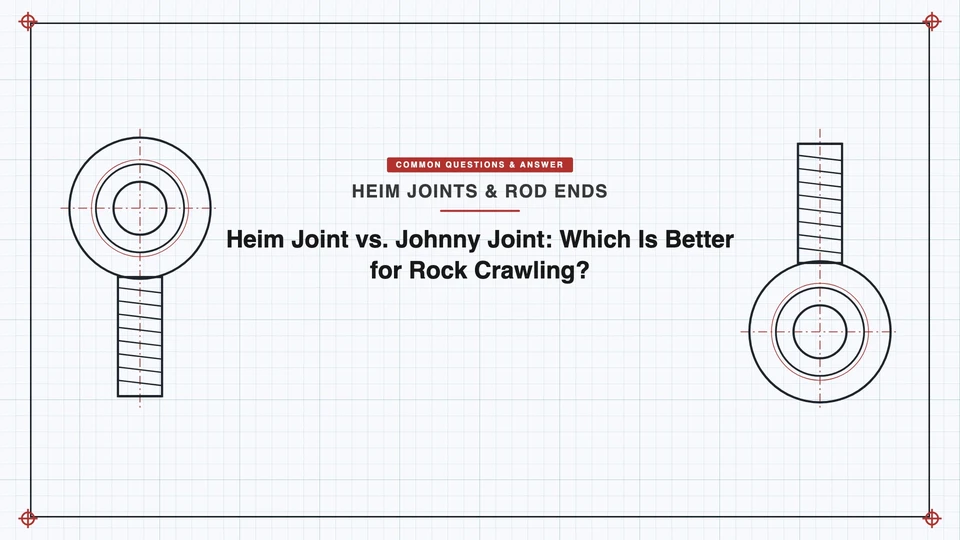
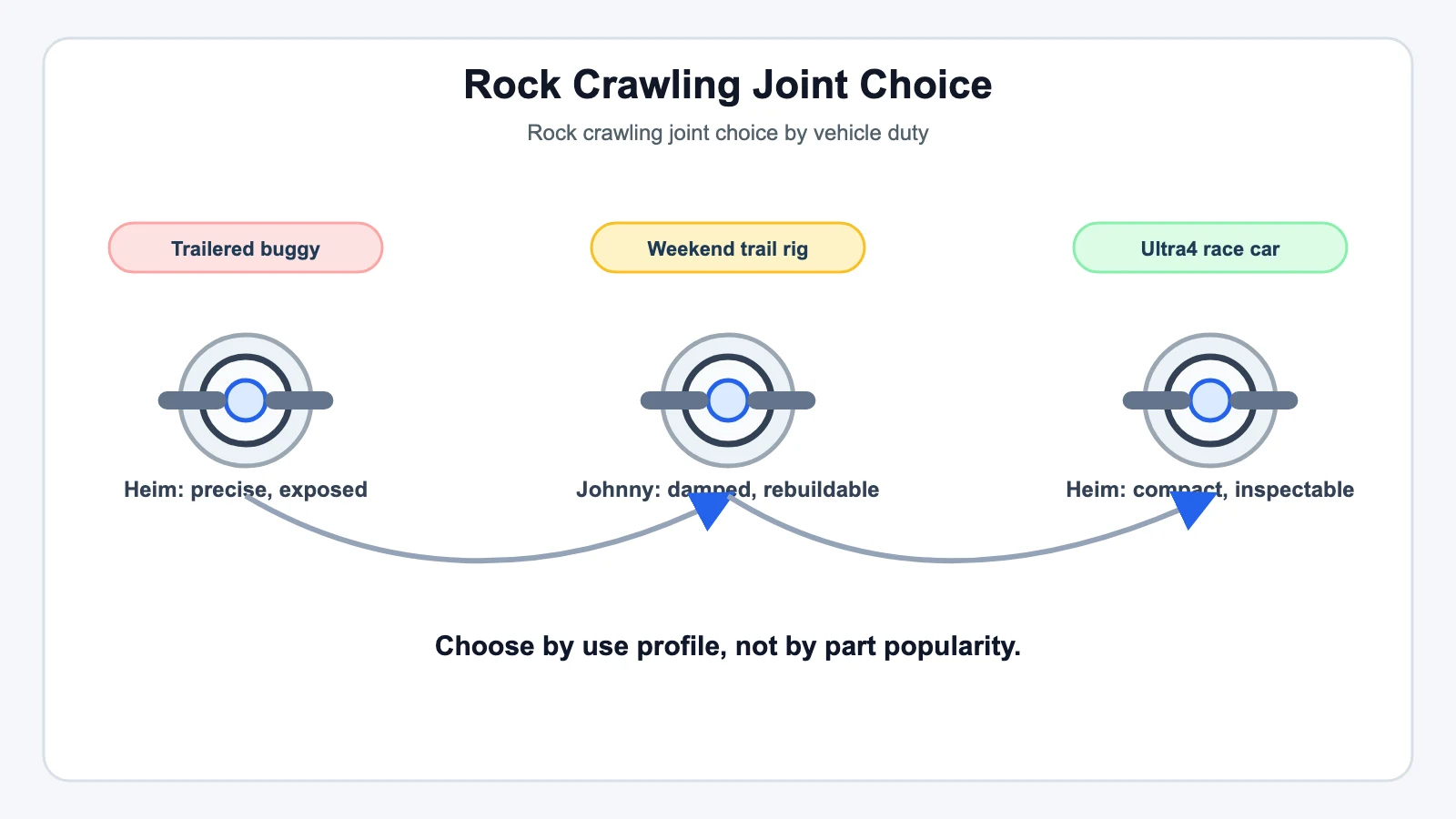
Neither wins outright — the honest answer depends on whether your rig is trailered to the rock or driven there. For a dedicated, trailer-only rock buggy chasing maximum articulation, a Heim joint (rod end) is the more common choice. For a Jeep or truck that has to drive to the trailhead and back, a Johnny Joint‘s built-in dampening and rebuildable design usually make more sense. This page breaks down that decision by actual rock-crawling use case — not just the general "which part is which" comparison.
The Real Trade-off: Articulation Precision vs. Ride Dampening
A Heim joint is a metal ball rotating directly against a liner (bare metal-on-metal or PTFE-lined) inside a rigid housing. There’s no cushioning layer, so every bit of suspension movement, road noise, and rock-strike shock transfers straight through to the chassis. What you get in exchange is a near-zero-slop pivot: the geometry you designed into your 4-link stays exactly as designed, at any angle within the joint’s rated range.
A Johnny Joint captures a steel ball between two polyurethane bushings inside a housing, retained by a snap ring. That polymer layer absorbs some of the shock and road noise before it reaches the frame — at the cost of a small amount of elastic give under load, since the poly compresses and recovers rather than acting as a pure rigid pivot.
Neither design is automatically wrong for rock crawling. Johnny Joints generally suit trail-driven, dual-purpose rigs; Heim joints are often selected for dedicated competition builds that need greater misalignment. Choose based on the actual geometry, maintenance needs, and intended use.
Decision Framework: Match the Joint to How the Rig Gets Used
| Rig type | Recommended joint | Why |
|---|---|---|
| Trailered, dedicated rock buggy (competition or hardcore trail-only) | Heim joint | Maximum articulation and zero-deflection geometry matter more than ride comfort when the vehicle never sees pavement |
| Daily-driven or weekend trail rig (drives to the trailhead, sees highway miles) | Johnny Joint | Dampens road noise and vibration on the drive in; still gives significant flex on the trail; rebuildable when it wears |
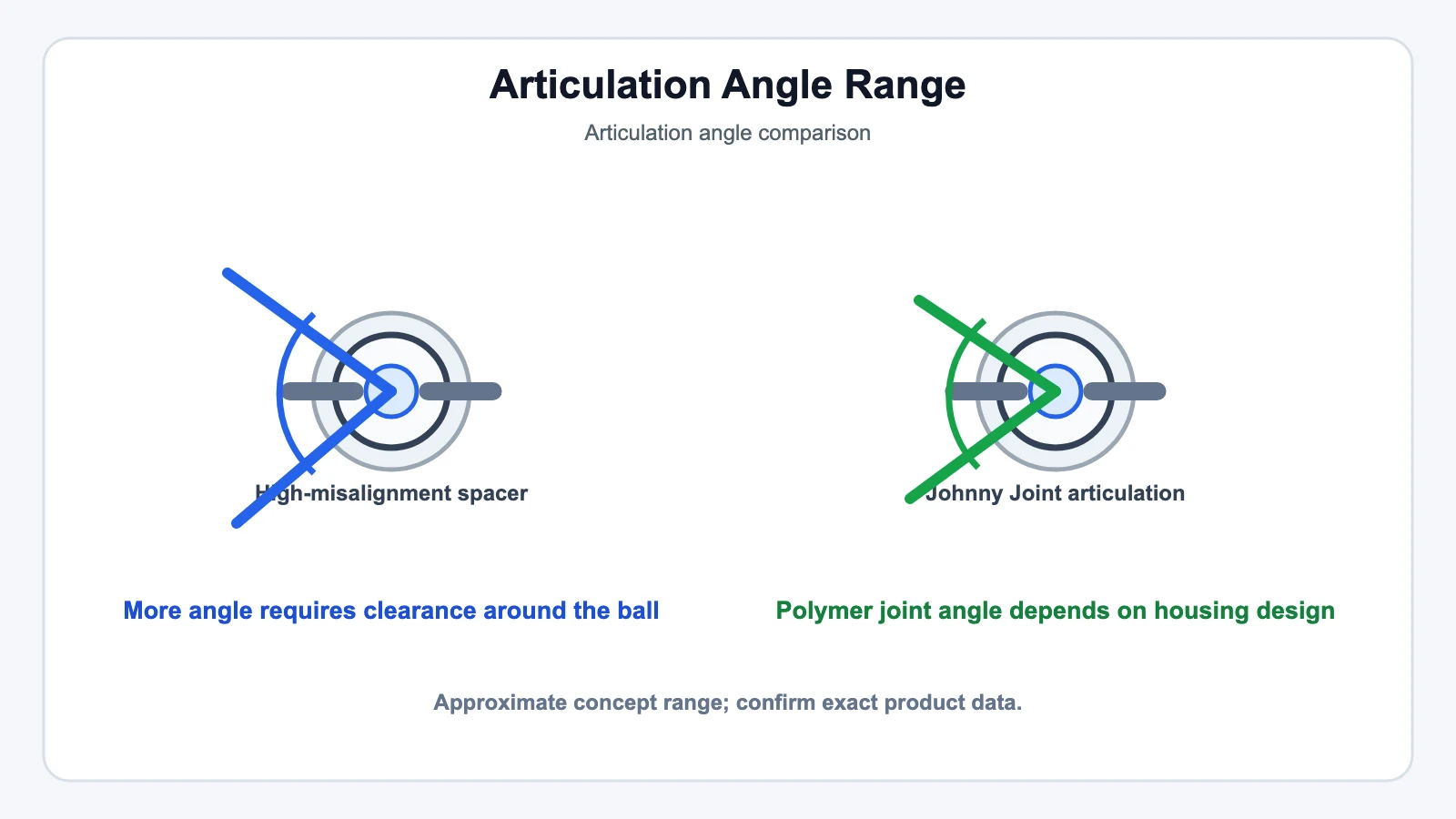
| Ultra4/race-style rig with extreme wheel travel and long-arm control arms | Heim joint, sized generously | Long-arm builds push angular misalignment toward the high end of what either joint can handle; Heim’s higher rated angle (with a misalignment spacer) gives more margin |
This lines up with what experienced fabricators actually report: the deciding factor isn’t which joint is "stronger" in the abstract, it’s whether the vehicle has to be comfortable and quiet on the way to the trail.
Misalignment Angle: The Number Everyone Asks About
Maximum misalignment varies by joint size, housing geometry, and spacer choice. Check the rated angle for the exact part number you plan to use instead of relying on a generic figure.
The Failure Mode Nobody’s Comparison Table Mentions
Most write-ups (including comparison pages elsewhere on the internet) repeat the same line: "Johnny Joints are more durable, Heims wear faster in dirt." That’s true often enough to be useful — but it’s not the whole story, and treating it as an absolute rule can bite you.
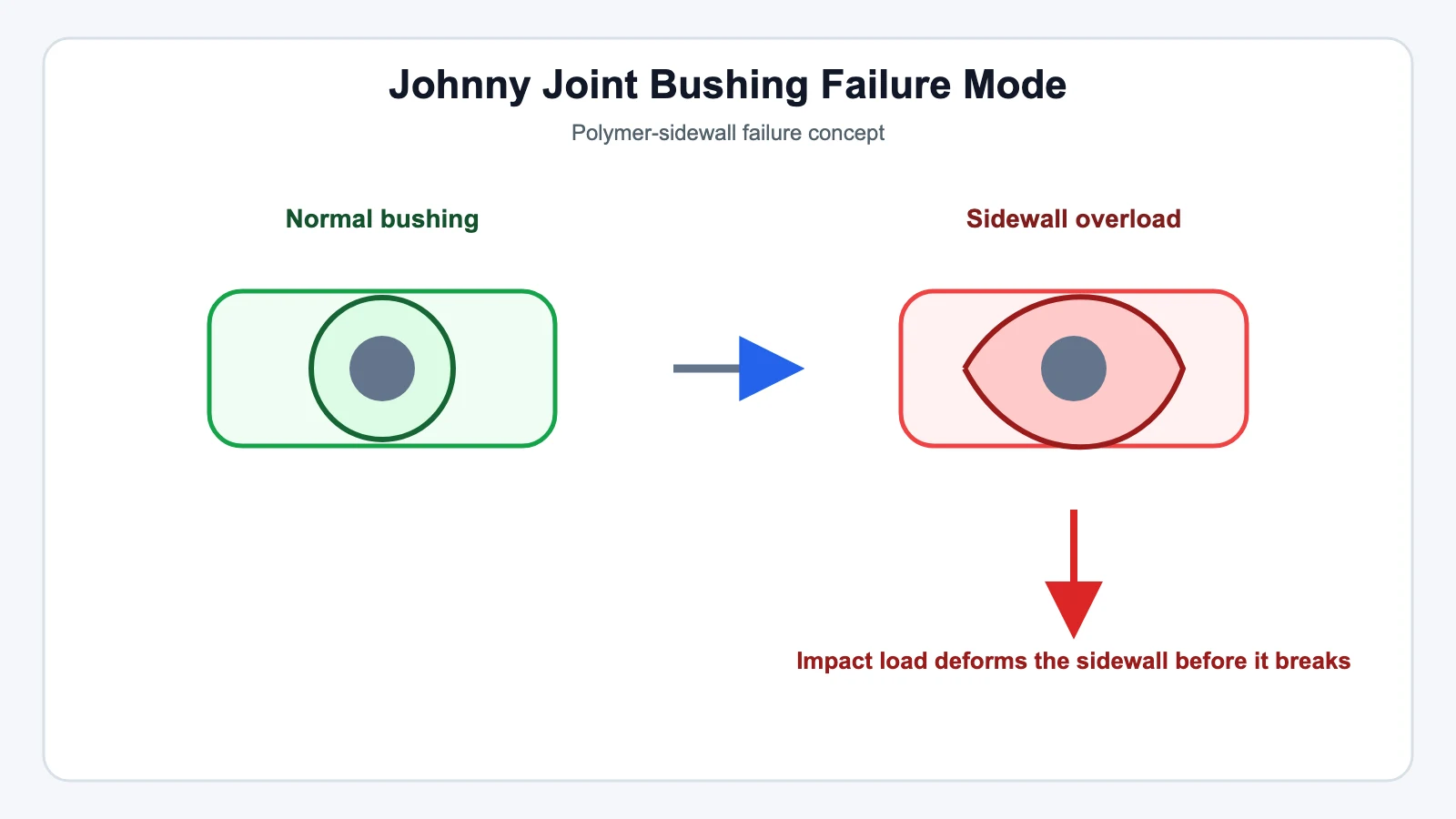
A recurring thread on Hardline Crawlers (a rock-crawling forum) has multiple independent users reporting the same failure on Johnny Joints under hard, repeated impact: the polyurethane bushing/housing sidewall bows out and eventually blows out entirely. One user described replacing all four joints on his rig after noticing the same bulging on each one; another switched permanently to Heim joints after that failure and reported no issues since. This is community-reported experience, not a documented failure rate from a manufacturer — but it’s a real, mechanically explainable failure mode (sustained impact loading a polymer bushing that a solid metal Heim doesn’t have), and it’s worth knowing before you assume "Johnny Joint = automatically tougher for rock crawling."
The practical takeaway: Heim’s known weakness is contamination-driven wear (dirt and grit accelerating liner wear), and Johnny Joint’s known weakness is sidewall/bushing failure under sustained hard impact. Which one you’ll actually run into depends more on your terrain (dusty/sandy vs. rock-strike-heavy) than on a blanket durability ranking.
Where to Go Next
This page is the general rock-crawling comparison. Two related questions go deeper on specific angles that this page only touches on:
- If ride comfort and cabin noise on the drive to the trail are your main concern, see our vibration-dampening deep dive for the actual mechanism behind why a Johnny Joint rides quieter.
- If long-term maintenance cost and whether you can rebuild the joint yourself matter more than the initial decision, see our rebuildability breakdown, which covers the design reason a Johnny Joint can be serviced and a Heim usually can’t.
For the full structural, material, and cost comparison across Heim joints, Johnny Joints, and builder bushings (not rock-crawling-specific), see Johnny Joint vs. Heim Joint vs. Builder Bushing.
Related reading:Vibration Dampening: Does a Johnny Joint Outperform a Heim? · Rebuildability: Why Johnny Joints Are Serviceable and Heims Are Replaced · Johnny Joint vs. Heim Joint vs. Builder Bushing (full comparison, syzrodends.com) · Rock Crawler & Ultra4 Steering: Choosing Between Mechanical, Hydro-Assist, and Full Hydraulic