
For the general "which one should I run" comparison, see Heim Joint vs. Johnny Joint: Which Is Better for Rock Crawling? — this page assumes you already know the basic difference and want the mechanism behind the vibration/NVH gap specifically.
Yes — for noise, vibration, and harshness (NVH), a Johnny Joint outperforms a Heim joint, and the reason comes down to what sits between the ball and the housing. This isn’t a marginal difference: it’s the single biggest reason daily-driven or trail-plus-street rigs tend to run Johnny Joints while dedicated race/competition builds tolerate a Heim’s harsher ride.
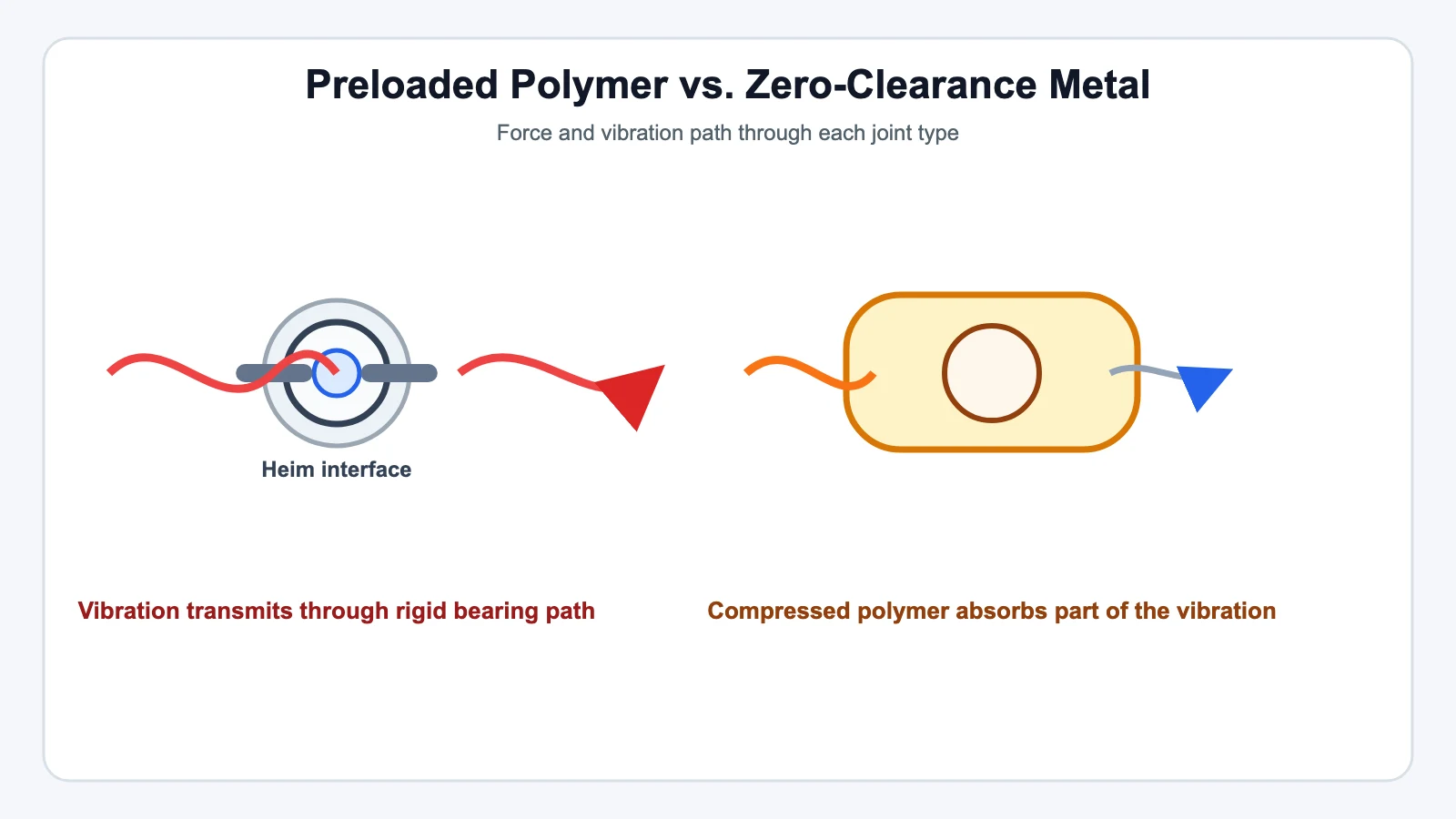
The Mechanism: Preloaded Polymer vs. Zero-Clearance Metal

A Heim joint’s ball rotates against its liner — bare metal-on-metal, or metal against a thin PTFE composite layer — with near-zero friction and, critically, no elastic buffering. There’s no spring-back, no compression-and-recover behavior. Force goes in one side and comes out the other essentially undamped. That’s what gives a Heim its precision: the joint behaves like a frictionless pivot, so suspension geometry stays exactly where you built it, at any load.
A Johnny Joint works on a different principle. The steel ball is captured between two polyurethane bushings under intentional preload. As the joint articulates or absorbs a shock, those polyurethane cups compress and then recover — that compression cycle is doing real mechanical work, absorbing energy before it reaches the frame. The joint behaves more like a very stiff bushing that happens to allow rotation, rather than a true frictionless pivot.
That’s the entire explanation for the NVH gap: one design has an elastic layer between the load path and the chassis, the other doesn’t.
What This Actually Transmits Into the Cabin
With a Heim joint in the link, road input reaches the chassis largely unfiltered — tire imbalance, driveline harmonics, gear noise, sharp rock-strike impacts, and high-frequency vibration all pass through with little attenuation. With a Johnny Joint in the same position, the polyurethane layer knocks down a meaningful portion of that input before it ever reaches the frame rail.
| Vibration source | Heim joint | Johnny Joint |
|---|---|---|
| Tire imbalance / road hum | Transmitted directly | Partially absorbed |
| Sharp impacts (rock strikes, potholes) | Transmitted directly | Partially absorbed |
| Driveline/gear noise | Transmitted directly | Partially absorbed |
| Steering/suspension precision under load | Highest — zero deflection | Slightly reduced — polymer compresses under load |
That last row is the trade-off worth understanding before assuming "Johnny Joint = strictly better." The same elastic compression that damps vibration is, mechanically, a small amount of deflection under load — which is exactly what a Heim joint is designed to eliminate. For a link where you need the geometry to hold rigid under hard cornering or a hard rock strike, that elasticity is a real (if small) cost, not a free upgrade.
No One Has Published a Number for This
There is no broadly applicable quantitative comparison showing how much vibration one joint type reduces versus the other. Avoid claims of a specific decibel or vibration advantage unless the test used comparable joints, loads, and operating conditions. Choose based on the required articulation, compliance, load, noise, and maintenance needs.
The Practical Middle Ground
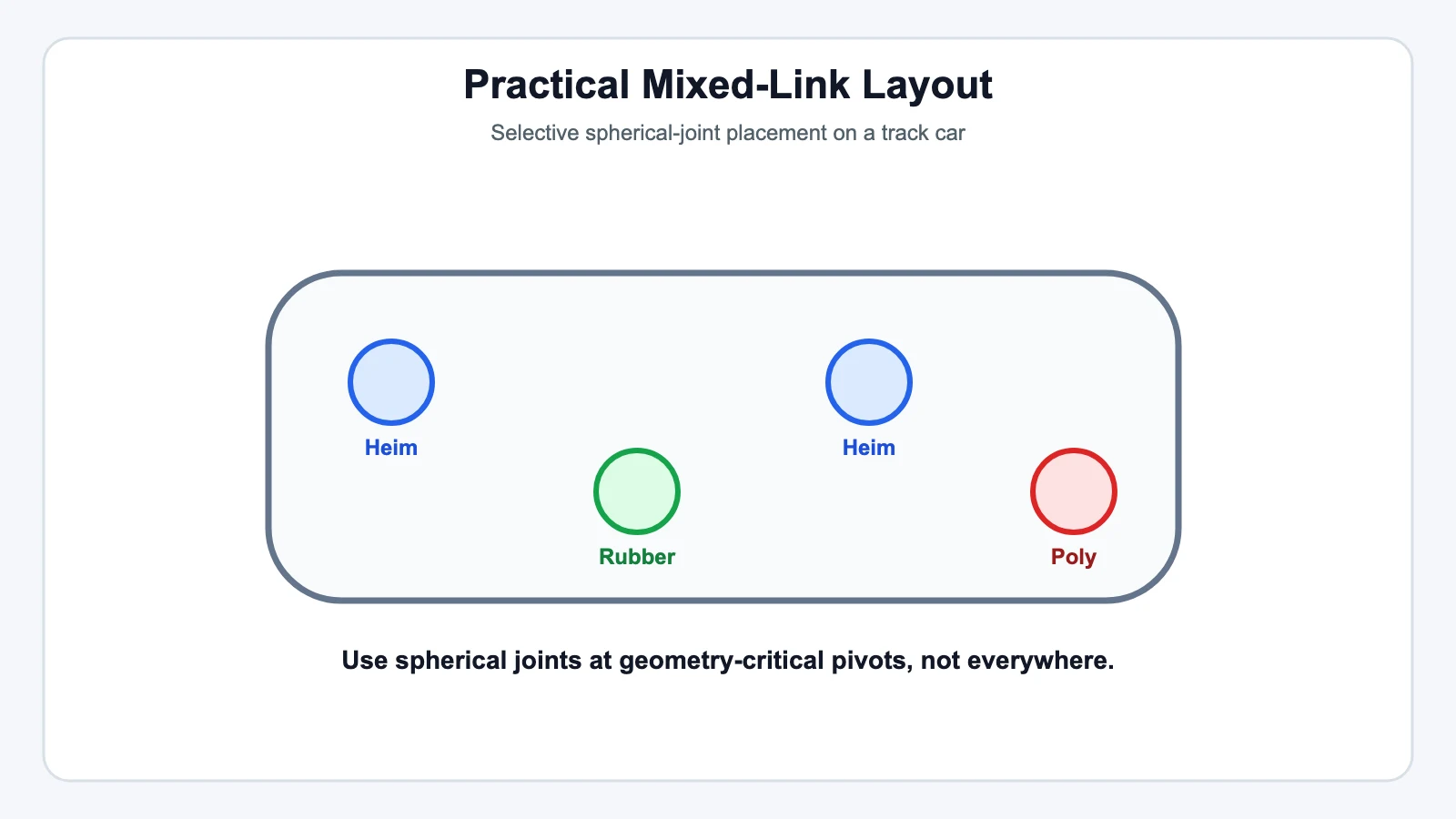
If cabin noise matters more than anything else, neither joint is actually the quietest option — a conventional rubber suspension bushing beats both a Heim and a Johnny Joint on pure NVH, at the cost of far less precision and lower load capacity. A common compromise seen in real 4-link builds: run a Johnny Joint at the axle end of a link (where impact loading is highest) and a rubber bushing at the frame end (where isolating the chassis from noise matters most), reserving Heim joints for links where geometry precision is the priority and ride comfort isn’t a factor.
Related reading: Heim Joint vs. Johnny Joint: Which Is Better for Rock Crawling? · Rebuildability: Why Johnny Joints Are Serviceable and Heims Are Replaced · Johnny Joint vs. Heim Joint vs. Builder Bushing (full comparison, syzrodends.com)