
For the general "which one should I run" comparison, see Heim Joint vs. Johnny Joint: Which Is Better for Rock Crawling? — this page assumes you already know the basic difference and want the design reason behind the serviceability gap, plus what it actually costs over time.
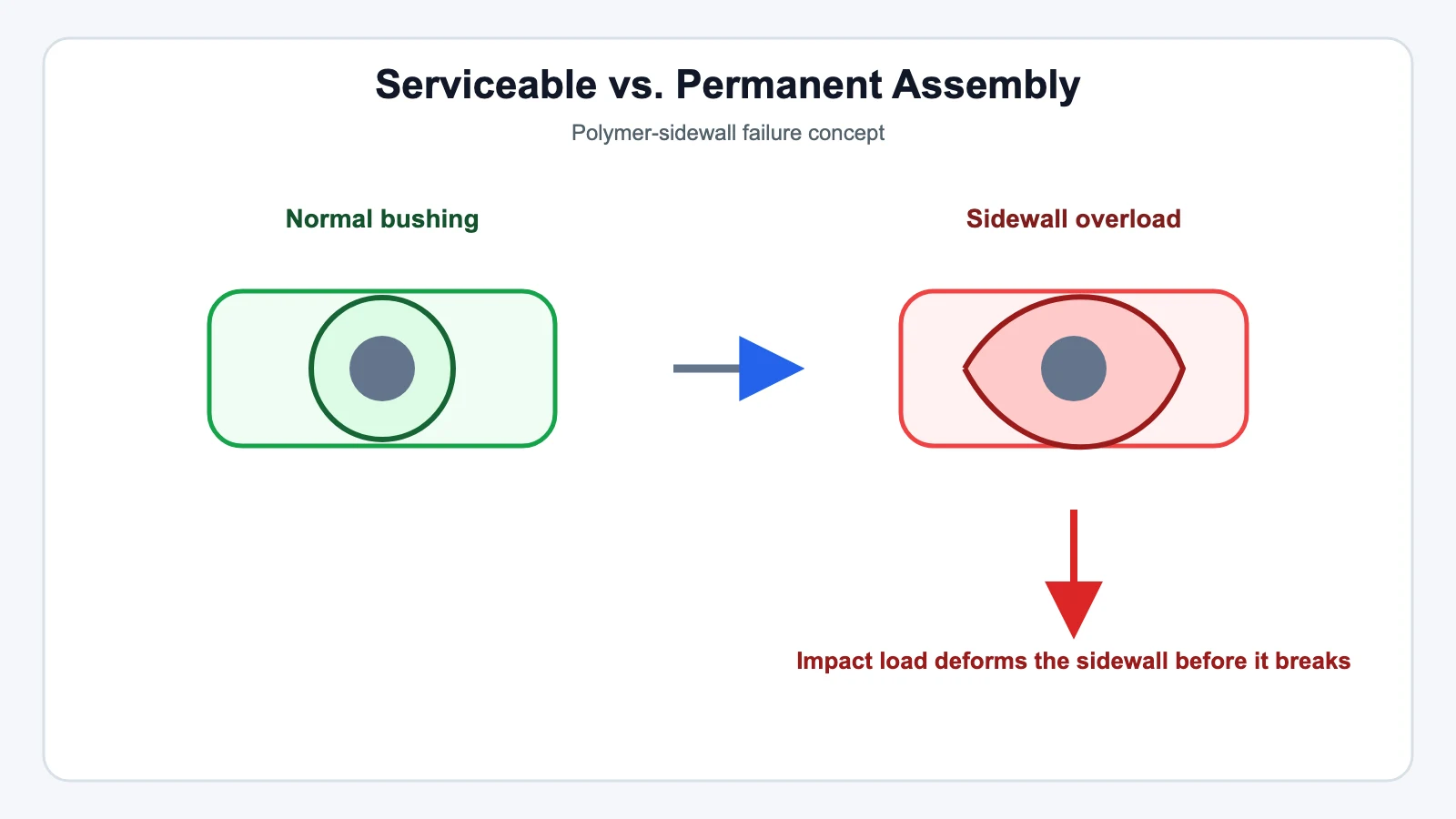
A Johnny Joint is rebuildable and a Heim joint (conventional rod end) normally isn’t, and the reason is how each one is physically assembled — not an arbitrary manufacturing choice. Once you understand the assembly difference, the total-cost-of-ownership picture follows directly from it.
The Assembly Difference That Decides Everything
A Johnny Joint is built as a modular stack: a steel ball sits between two polyurethane bushing halves inside a tubular housing, and the whole assembly is held together by a snap ring. Remove the snap ring and the ball-and-bushing assembly slides out intact — the housing itself is never damaged in the process. The polyurethane bushings are the intended wear part; when they develop play, you replace just the bushings (plus the washers and snap ring in a rebuild kit) and reuse the precision-machined steel housing and ball.
A conventional Heim joint (spherical rod end) is built by swaging: the housing is mechanically folded or pressed around the ball and its liner during manufacturing, permanently closing the housing around the bearing surface to create a single sealed unit. There’s no snap ring, no removable retainer — the housing and the bearing race are the same physical piece of metal by the time it leaves the factory. Once the internal clearance grows beyond tolerance, there’s no non-destructive way to open that housing and replace just the worn liner. The standard repair path is to remove the whole rod end and install a new one.
That’s the entire explanation for the serviceability gap: one design was engineered around a field-replaceable wear component from the start; the other wasn’t.
"Heims Are Never Rebuildable" Isn’t Quite Right
It’s worth being precise instead of absolute here. Specialty rebuildable rod ends do exist — RideTech’s R-Joint XL is one example cited in industry write-ups — built specifically with a serviceable internal bearing rather than a swaged one. The accurate statement is: a conventional Heim joint isn’t designed around field-replaceable internal wear components, not that rebuilding a spherical rod end is physically impossible in every case. If you’re specifying parts for a build where long-term serviceability matters, that’s a question worth asking a supplier directly rather than assuming every rod end on the market behaves the same way.
The Total Cost of Ownership, Worked Through
RockJock 4×4 lists the cited Johnny Joint and rebuild-kit prices. Prices vary by part and supplier, so check current pricing before using the comparison to make a purchase decision.
| Johnny Joint | Heim joint | |
|---|---|---|
| Initial purchase | $70–130 | $45–80 |
| Cycle 1 service | Rebuild kit: $20–60 | Full replacement: $45–80 |
| Cycle 2 service | Rebuild kit: $20–60 | Full replacement: $45–80 |
| Running total after 2 service cycles | ~$110–250 | ~$135–240 |
| Labor if done DIY | Low — snap ring pliers + a Johnny Joint tool | Low — typically just a wrench and a press or vise |
| Labor if sent to a shop | Shop labor cited around $100/hr, which can erase the parts-cost advantage on a single joint | Comparable shop time to swap a rod end |
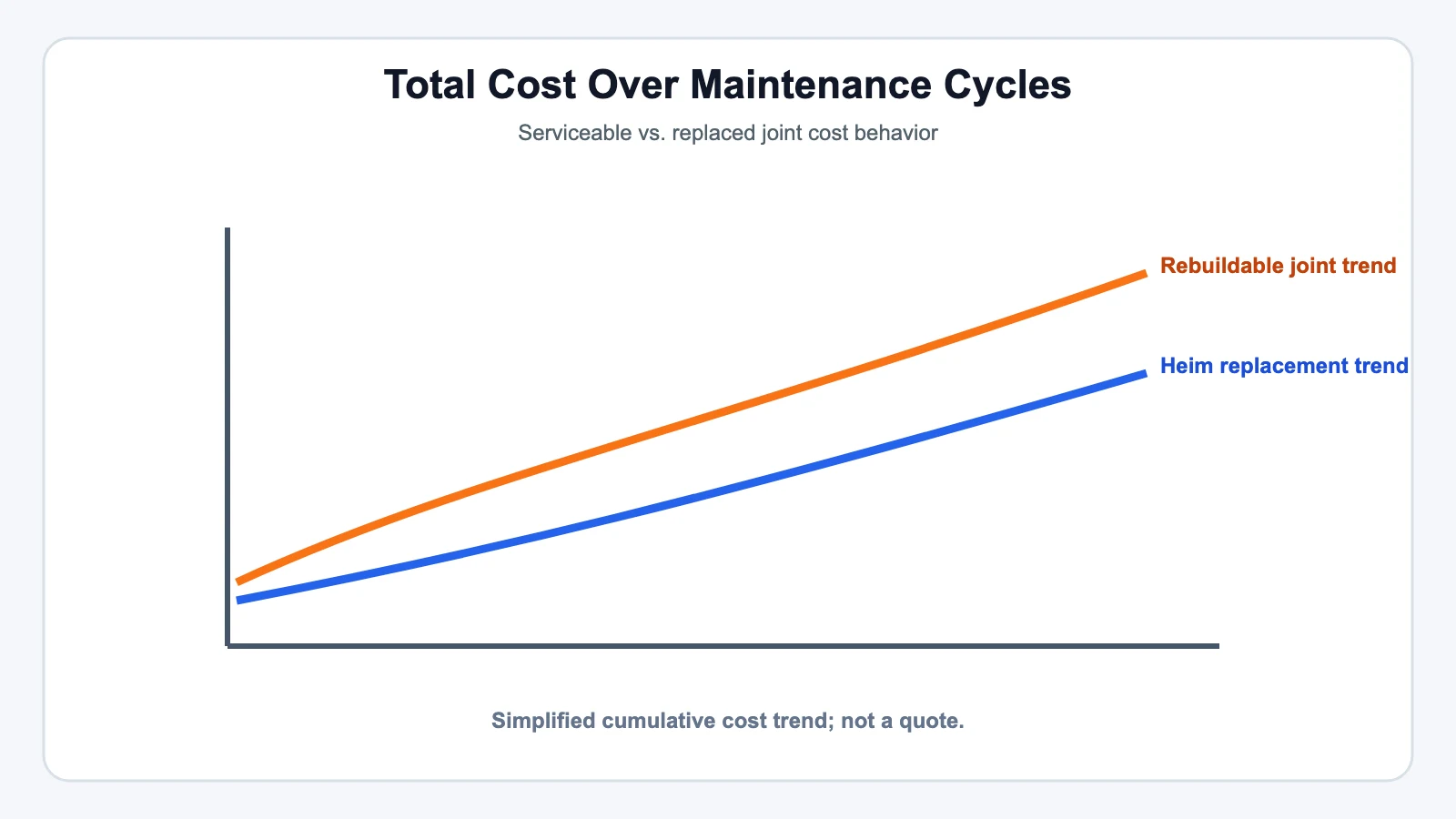
Two things stand out from this: first, the Johnny Joint’s higher purchase price is largely offset by cheaper subsequent service, so the total cost over multiple wear cycles converges rather than staying far apart. Second, the rebuildability advantage is a labor-cost story as much as a parts-cost story — if you’re doing the rebuild yourself with basic tools, Johnny Joint’s cost advantage compounds with each cycle; if every service trip goes to a shop at an hourly labor rate, some of that advantage gets eaten by the time spent on each rebuild versus a straight swap.
There is no fixed mileage or calendar interval for servicing either joint type. Terrain, contamination, and use determine wear; follow the part manufacturer’s guidance and inspect for play or damage.
When Rebuildability Actually Matters
The economics above favor Johnny Joint most clearly when two things are both true: the joint sees frequent wear (contaminated, high-impact off-road use) and someone doing the rebuild has the tools and is comfortable doing it themselves. If a joint rarely needs service, or if every service event goes through a paid shop, the cost gap narrows and the decision comes back to the other factors covered in the general comparison — articulation, vibration isolation, and precision.
For the full step-by-step process of actually rebuilding a Johnny Joint (tools, an 19-step teardown and reassembly sequence), see How To Rebuild a Johnny Joint. For the base purchase-price and structural comparison this page’s cost figures are drawn from, see Johnny Joint vs. Heim Joint vs. Builder Bushing.
Related reading: Heim Joint vs. Johnny Joint: Which Is Better for Rock Crawling? · Vibration Dampening: Does a Johnny Joint Outperform a Heim? · How To Rebuild a Johnny Joint (syzrodends.com) · Johnny Joint vs. Heim Joint vs. Builder Bushing (syzrodends.com)