
For most builds, no. Titanium spherical bearing and heim joint designs earn their premium in a narrow set of cases — weight-critical racing, corrosive environments, and strict aerospace weight budgets — and for nearly everything else, a well-specified chromoly joint delivers equal or better real-world performance for a fraction of the cost.
What Titanium Actually Buys You
The case for titanium rests on strength-to-weight, not absolute strength. That distinction matters: some high-strength steels exceed titanium alloys in raw tensile strength. Titanium’s advantage is doing comparable structural work at meaningfully less weight — which is only valuable if weight at that specific pivot point is something you can measure the benefit of.
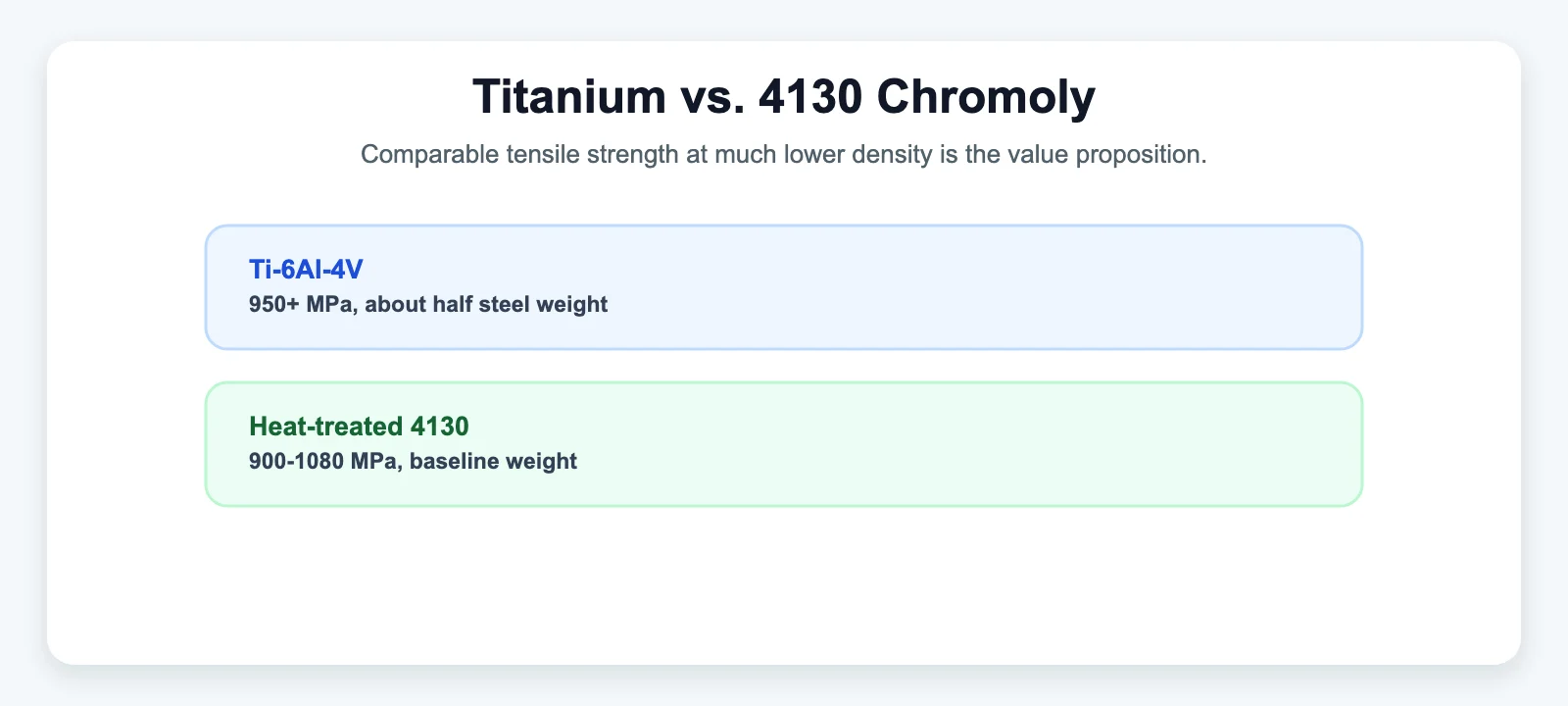
Per SYZ’s own materials selection guide, aerospace-grade titanium alloys such as Ti-6Al-4V typically exceed 950 MPa ultimate tensile strength after heat treatment, at roughly half the weight of steel. For comparison, properly heat-treated 4130 chromoly — the material most performance rod ends are built from — runs 900–1080 MPa, at baseline steel weight. Put side by side, titanium isn’t dramatically stronger than top-tier heat-treated chromoly; it’s comparably strong at about half the mass. That’s the entire value proposition in one sentence.
(Note: an earlier SYZ page states titanium rod ends run "33% lighter" than steel equivalents — a different figure from the "roughly half" cited in the current materials guide. Both are genuine SYZ-published figures from different years and likely reflect different product lines or measurement contexts; this article uses the more recent, MPa-anchored figure as the primary reference rather than forcing the two into agreement.)
Titanium also brings genuine corrosion resistance — its oxide layer resists degradation without relying on plating that eventually wears through — which matters specifically in marine or chemically aggressive environments, separate from the weight argument entirely.
Where the Premium Pays Off
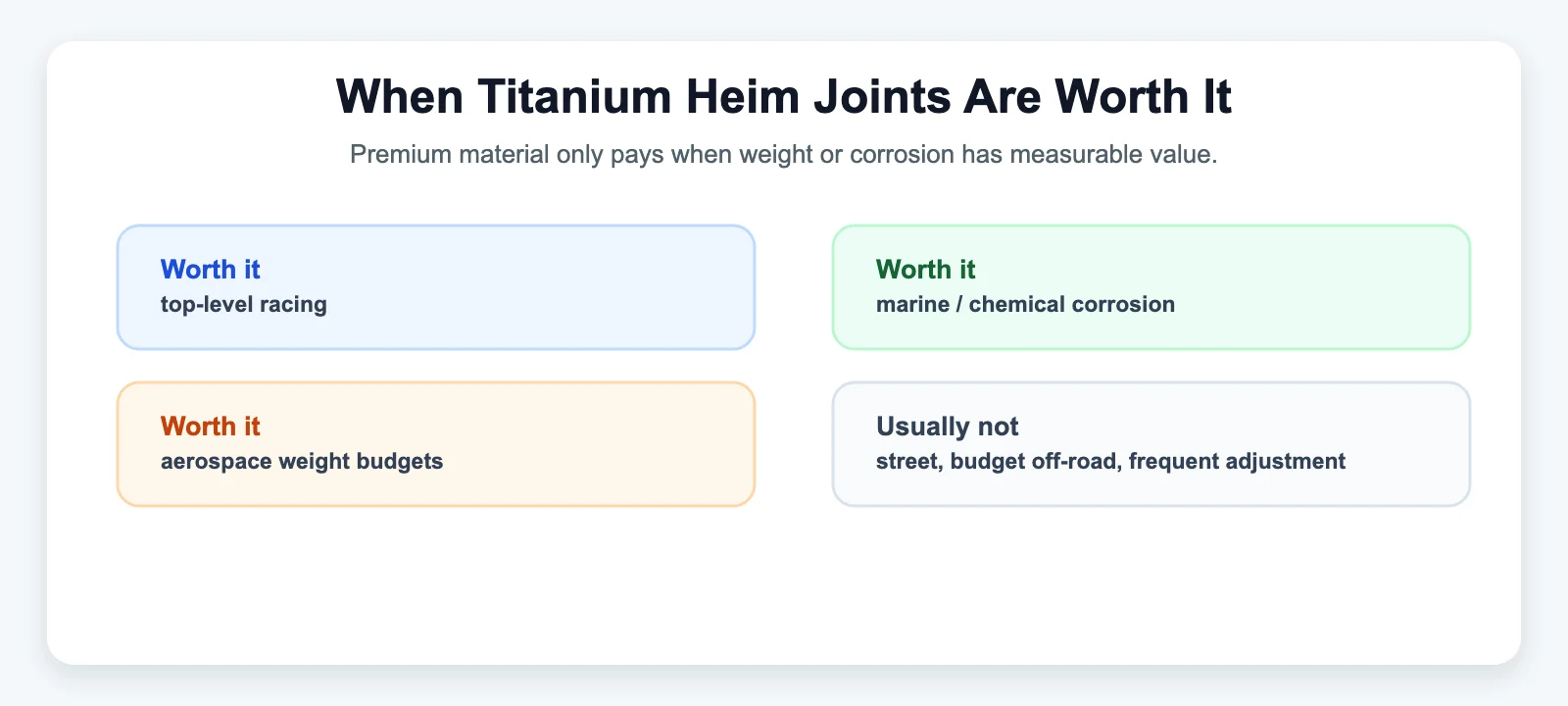
- Weight-critical competitive racing — sprint cars, drag racing, top-tier time-attack, open-wheel programs, where shedding unsprung mass at multiple suspension pivot points produces a measurable, repeatable performance gain.
- Corrosive service environments — marine racing or industrial settings where salt or chemical exposure would otherwise force frequent replacement of a plated steel joint.
- Aerospace and strict weight-budget projects — aircraft or specialized lightweight vehicles where every gram is accounted for and titanium’s strength-per-weight is the deciding factor, not a nice-to-have.
Where It Usually Isn’t Worth It
- Street and daily-driven vehicles — the PTFE or Kevlar liner inside the joint wears out from dirt and grime long before the body material would ever fail, on titanium or steel alike. Paying a large premium for a body material that isn’t the limiting factor in service life doesn’t make financial sense.
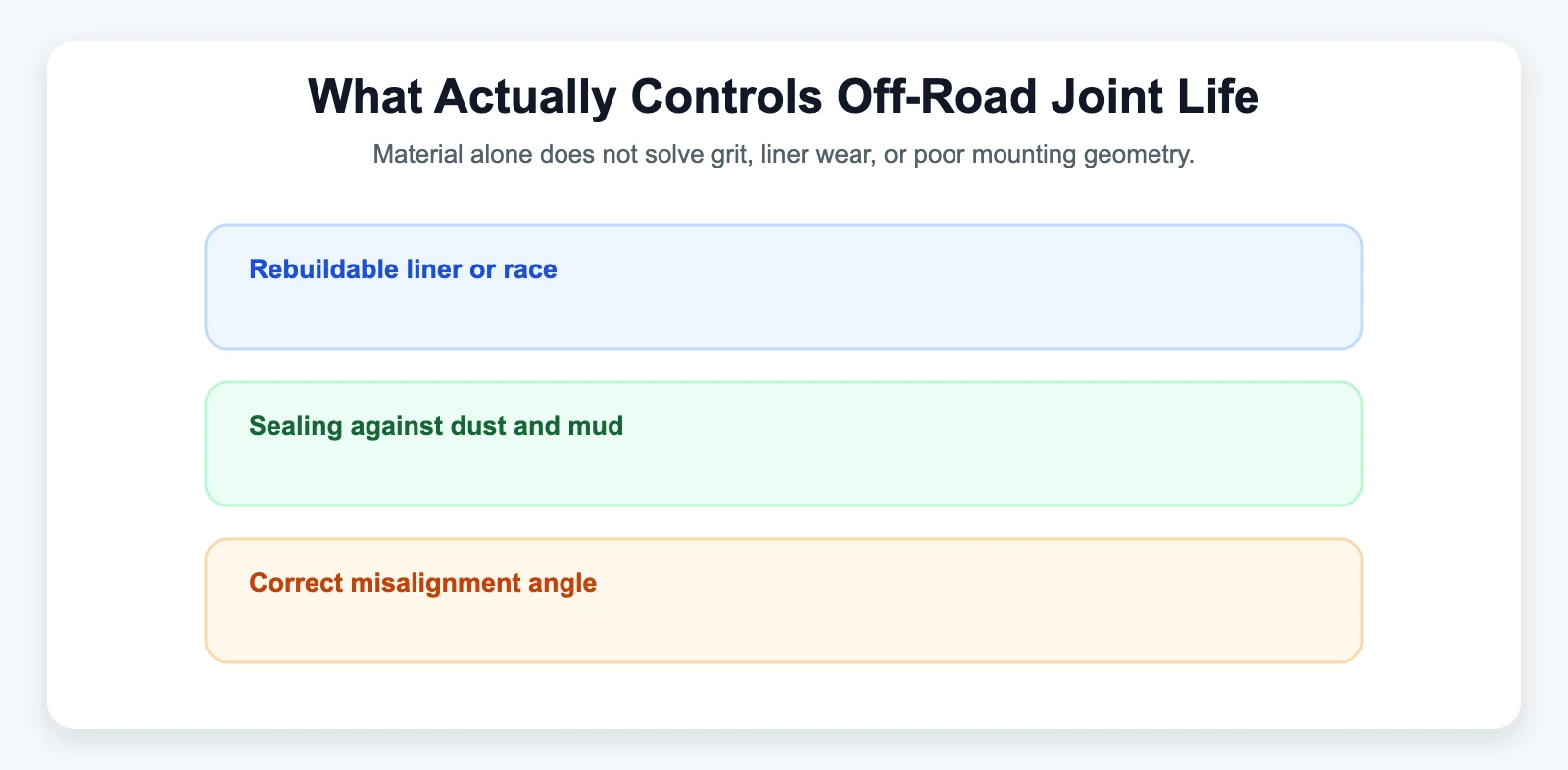
- Budget or moderately-built off-road rigs — hard impact loads and rock strikes favor absolute toughness and ductility, and heat-treated chromoly generally handles abusive shock loading at least as well as titanium, at a fraction of the price. Real-world off-road forum discussion (a 74-comment thread among rock-buggy builders debating "what do expensive heims actually get you") consistently points to rebuildability, sealing against dirt, and correct mounting geometry as what actually determines joint life — not whether the body is titanium.
- Applications requiring frequent adjustment — titanium threads are prone to galling (cold-welding) under load or when dry. If you’re regularly adjusting alignment or ride height, that’s a maintenance liability a steel joint doesn’t have.
The Off-Road Insight Most Comparisons Miss
If your goal in considering titanium is "make my off-road rig last longer and need less maintenance," titanium is solving a problem you probably don’t have. The forum consensus among experienced builders is that joint longevity in off-road use comes down to whether the liner is rebuildable (brass or PTFE race that can be serviced vs. a sealed one-time unit), how well the joint is sealed against grit, and whether it’s mounted correctly for the actual misalignment angle it sees — none of which titanium changes. A titanium body on a poorly sealed, incorrectly mounted joint fails the same way a steel one does; it just costs more when it does.
Cost Comparison (Illustrative, Not Quoted Pricing)
| Heat-Treated Chromoly (4130) | Titanium (Ti-6Al-4V) | |
|---|---|---|
| Tensile strength | 900–1080 MPa | 950+ MPa |
| Weight vs. steel | Baseline | ~1/2 |
| Corrosion resistance | Requires plating | Excellent, no plating needed |
| Galling risk | Low | High — requires anti-seize |
| Typical SYZ availability | Standard catalog series | Custom CNC-machined only |

Titanium heim-joint pricing varies widely by supplier, size, and order volume. Compare current quotes for matching specifications rather than using a general price ratio as a planning figure.
Sourcing Note
Titanium rod ends aren’t a stocked catalog item the way carbon steel, chromoly, stainless, and aluminum typically are — they’re produced as custom CNC-machined parts, alongside other premium alloys like 17-4PH stainless, following spec review, material/heat-treat verification, and a sample before volume production. If your project genuinely needs titanium, budget lead time for that process rather than expecting off-the-shelf availability.
The Bottom Line
Ask one question before paying the titanium premium: is weight at this specific joint something you can measure the benefit of, or is it a corrosive environment that would otherwise eat a steel part? If yes to either, titanium earns its cost. If the honest answer is "I just want the toughest, longest-lasting joint for my rig," that’s a chromoly joint with a rebuildable liner and correct installation — not a material upgrade.
Related reading: Chromoly (4130) vs. Carbon Steel: Which Is Right for Your Build? · Why Off-Road Racing Prefers 4130 Chromoly Rod Ends · Aluminum Rod Ends: Pros, Cons, and Weight-Saving Benefits · When Should You Choose Stainless Steel Rod Ends?