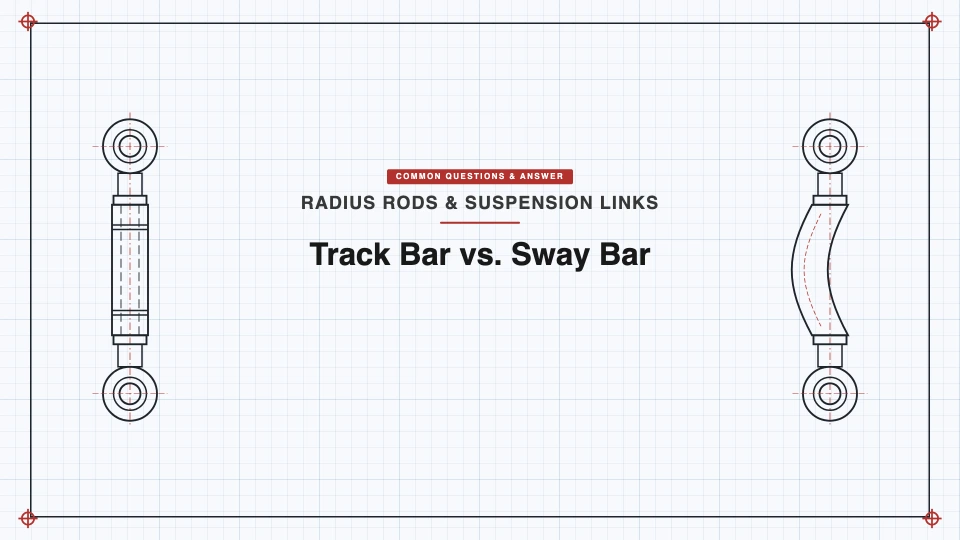
A track bar and a sway bar are genuinely different solid-axle suspension links and anti-roll components controlling completely different kinds of motion — they're not interchangeable, and most heavy-duty solid-axle vehicles need both. A track bar (also called a Panhard bar) stops the axle from shifting side-to-side relative to the frame. A sway bar (anti-roll bar) stops the vehicle body from leaning during a turn. One controls axle position; the other controls body roll.
The Core Difference at a Glance
| Track Bar (Panhard Bar) | Sway Bar (Anti-Roll Bar) | |
|---|---|---|
| What it controls | Lateral (side-to-side) position of the axle relative to the frame | Body roll (lean) during cornering |
| Structure | Single rigid bar, one end at the frame, one end at the axle | U-shaped torsion bar connecting left and right suspension via sway bar links |
| Failure symptom | Axle "wandering" or shifting; in severe cases, violent steering oscillation ("death wobble") | Increased body lean in corners; clunking/rattling over bumps from worn links or bushings |
| Can one replace the other? | No | No |
Neither part can substitute for the other — a vehicle can have a perfect sway bar and still have a dangerously loose track bar, or vice versa. As one supplier resource puts it plainly: many heavy-duty trucks and vans need both parts working correctly to be safe.
How to Tell Which One Is the Problem
The fastest diagnostic question is: is it a shift, or is it a roll?
- If the vehicle feels like the rear (or front) end is shifting or wandering under you — especially over bumps or mid-corner — suspect the track bar.
- If the vehicle leans more than it used to when cornering, but doesn't feel like it's shifting position, suspect the sway bar or its end links.
- Clunking or rattling specifically over bumps, without a steering-wander feeling, points toward worn sway bar links or bushings rather than the track bar.
- A sudden, violent side-to-side shake of the steering wheel — distinct from ordinary body lean — is a track bar/steering-system issue and a safety concern; see Can a Bad Track Bar Cause Death Wobble? for the full diagnostic path.
This shift-vs-roll framework isn't universal terminology, but it's a genuinely useful way to narrow down which system is at fault before you start pulling parts.
One Term You'll See That Isn't Quite Right
You'll sometimes see track bars and sway bars described as controlling "yaw" vs. "roll." That's imprecise. What a track bar actually resists is lateral translation — the axle sliding sideways — not a rotational yaw movement. "Roll" is the accurate term for what a sway bar resists. If you see "yaw" used this way in a forum post or video, read it as shorthand for "sideways axle movement," not as a strict engineering term.
Why Off-Roaders Disconnect Sway Bars but Never Track Bars
On extreme off-road terrain, disconnecting the sway bar is a common technique to gain additional suspension articulation — without the sway bar fighting the suspension, each wheel can travel further independently. The track bar is a different story: disconnecting it removes the only thing holding the axle centered under the vehicle, which is a genuine safety issue, not just a ride-quality one. If a technique calls for disconnecting a link before a hard trail, confirm which link it actually is before you do it.
Maintenance Interval
At least one aftermarket parts supplier recommends inspecting track bar bushings roughly every 12,500 miles (20,000 km). That's a single vendor's suggested interval, not an industry-wide standard or a factory service spec — treat it as a reasonable check-in point to build into your own maintenance routine, not a number to cite as an official requirement.
Related reading: Panhard Bar vs. Track Bar: Is There a Real Difference? · What Is a Panhard Bar? · What Is a Track Bar (Panhard Bar) and What Does It Do? · Can a Bad Track Bar Cause Death Wobble?