
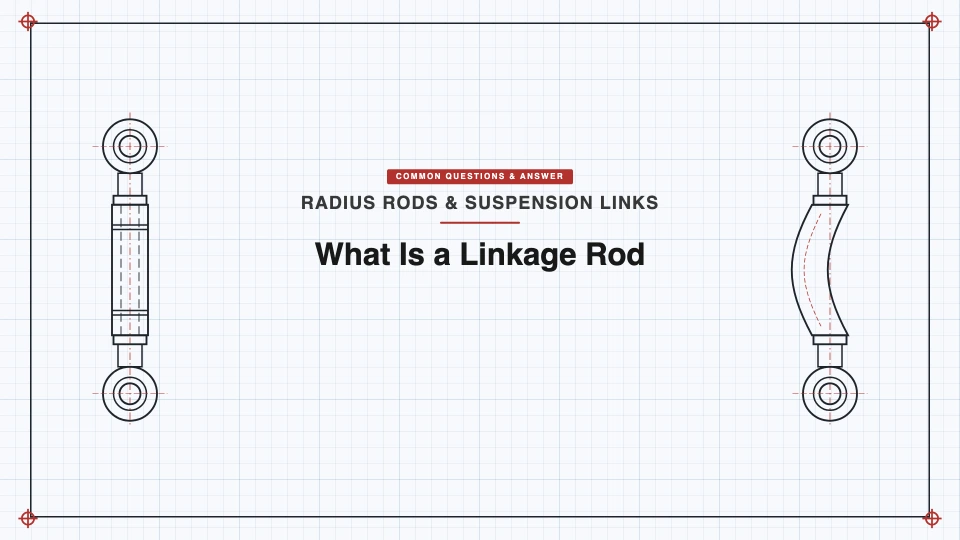
A custom linkage rod is a rigid bar that connects two moving parts in a mechanical system to transmit motion or force between them. Both ends typically terminate in a hinged connection — a ball joint (Heim joint), a clevis, or a bushing — which lets the rod pivot through an arc while still resisting the push and pull loads running along its length. The exact shape and size vary enormously by application, because "linkage rod" describes a function, not one specific part.
Why This Term Covers So Many Different Parts
In UTV suspension work, a 7075 billet aluminum radius rod is one specialized version of a linkage rod built for a defined vehicle platform.
Unlike "tie rod" or "sway bar link," which point to a specific, recognizable part in a specific system, "linkage rod" is a generic mechanical term. It shows up across radio-control model actuators, snowplow hardware, aircraft brake and actuator systems, construction equipment, engine connecting rods, and automotive steering and suspension linkages — and the part looks different in each one. What they all share is the function: a rigid connector transmitting motion or force between two points that each move independently. If you're researching a specific linkage rod, the vehicle or machine it's on matters more than the generic term does.
The Two Ends: How a Linkage Rod Attaches
Linkage rods generally use one of two housing configurations at each end:
- Eye-type (closed loop): a solid ring that a ball stud, bushing, or pin passes through, forming a closed connection point.
- Fork-type (clevis/open): an open, forked end that clamps around a mating tab or bracket and is pinned through, rather than passing something through a closed ring.
In off-road suspension and steering applications specifically, the hinged end is most often a rod end (Heim joint) or rose joint — a ball housed in a spherical bearing race, which is where "linkage rod" and "rod end" terminology overlap. See our explainer on the Panhard bar for a worked example of a suspension linkage rod with joints at both ends.
Push-Pull: The Load a Linkage Rod Is Built to Handle
A linkage rod's core mechanical job is push-pull: it has to resist both tension (being pulled apart) and compression (being pushed together) along its axis, since the two points it connects move independently and can load the rod in either direction depending on where each end is in its travel. This is different from a cable or a chain, which can only pull, not push — a linkage rod's rigidity is what lets it do both.
Adjustable Length: Threaded Ends and Turnbuckle Sleeves
Many linkage rods are built with threaded ends or a turnbuckle-style center sleeve, so the overall length can be fine-tuned after installation — useful for aligning a mechanism, setting preload, or dialing in travel distance. This isn't universal (fixed-length rods are common where no adjustment is needed), but it's common enough in adjustable suspension and steering hardware that it's worth checking for on any linkage rod you're specifying. A few RC-model and actuator manufacturers list very specific dimensions for their adjustable rods (for example, one aftermarket RC linkage rod is listed at roughly 305 mm length with a 2.6 mm diameter) — that's a third-party consumer-hobby product spec, not an industry standard, and it's included here only to illustrate what an adjustable end looks like in practice, not as a reference measurement for any other application.
Where Linkage Rods Show Up
| Industry / application | Example use |
|---|---|
| Automotive steering & suspension | Tie rods, drag links, sway bar links, panhard/track bars |
| Automotive drivetrain | Shift linkage, throttle linkage |
| Engine internals | Connecting rods (piston to crankshaft) |
| Aviation | Control surface and actuator linkages |
| Industrial / robotics | Actuator linkages, robotic arm joints |
| Agricultural & implement (snowplows, etc.) | Blade angle and lift linkages |
This spread is why a generic web search for "linkage rod" surfaces radio-control hobby parts, snowplow hardware, and aircraft components side by side with automotive suspension parts — they're all legitimately using the same term for the same basic function, just in very different machines.
Linkage Rod, Rod End, and Heim Joint: How the Terms Relate
"Linkage rod" describes the whole assembly (the rigid bar plus its end connections). "Rod end" and "Heim joint" (also called a rose joint) describe one specific type of end connection — a ball housed in a spherical bearing — that's commonly used on linkage rods in suspension and steering applications where the rod needs to articulate through an angle as the suspension moves, not just pivot in one plane. If what you're actually trying to identify is a specific off-road suspension component, our Panhard bar and track bar explainers cover two of the most common linkage rods on solid-axle vehicles, both of which typically use rod-end (Heim joint) hardware at one or both ends.
Related reading: What Is a Panhard Bar? · What Is a Track Bar (Panhard Bar) and What Does It Do? · What Is a Trailing Arm?