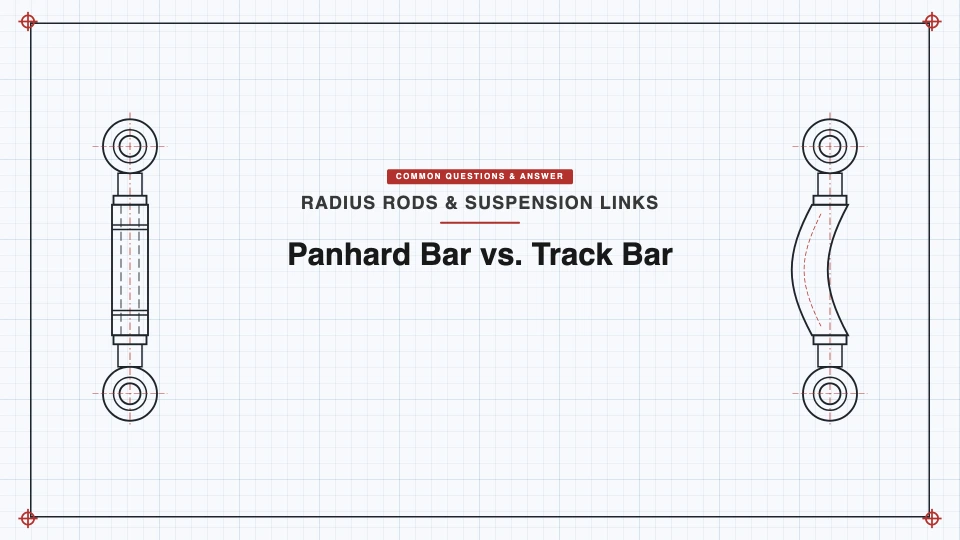
No — a Panhard bar and a track bar are the same part. Both terms describe a rigid link running from the vehicle's frame to the opposite side of a solid axle, controlling the axle's side-to-side position while letting the suspension move freely up and down. The two names come from different corners of the automotive world, not from two different designs.
Where Each Name Comes From
"Panhard rod" (or Panhard bar) traces back to the French Panhard et Levassor automobile company, credited with the design in the early 20th century. It's the term you'll hear most in racing, muscle car, and European-vehicle contexts. "Track bar" (or trac bar) is the term American 4×4 manufacturers and off-road communities — Jeep, Ford, Ram in particular — settled on, especially for solid-front-axle trucks and SUVs. Neither name describes a functional difference; they're regional and industry dialects for identical hardware. As one long-running off-road forum thread put it bluntly: "Track Bar is stock car racing parlance for Panhard Bar. They are one in the same."
Same Structure, Same Function
Both names refer to track-bar and Panhard-rod style links built as a single rigid bar with a pivoting joint (bushing or rod end) at each end — one end bolted to the frame, the other bolted to the axle on the opposite side of the vehicle. That layout is what stops the axle from walking laterally under cornering load while still allowing vertical suspension travel.
The Geometry Limit Applies to Both
Because the bar pivots from two fixed points, the axle doesn't move in a straight vertical line — it travels along a shallow arc whose radius equals the bar's length. This is a property of the design itself, not of which name you use for it, and it's the main reason some builds upgrade to a Watt's linkage instead (see the comparison table below).
Same Part, Different Names Depending on Position
On the same vehicle, you might hear "front track bar" (common on solid-front-axle Jeeps, Rams, and Ford Super Duty trucks) and "rear panhard bar" (more common on performance-car rear suspensions) — but it's the identical type of component doing the identical job at a different axle. Front and rear units are typically not interchangeable with each other even on the same vehicle, since their mounting geometry and angle are designed for their specific location.
Don't Confuse It With These Other Parts
Because a Panhard bar/track bar shares a job description ("keeps the axle located") with a few other suspension parts, it's easy to conflate them. They're not the same:
| Part | What it actually controls | Moves like |
|---|---|---|
| Panhard bar / Track bar | Lateral (side-to-side) position of the axle relative to the frame | Single rigid link, arcs slightly with suspension travel |
| Watt's linkage | Same lateral job as a Panhard bar, but keeps the axle moving in a true vertical line instead of an arc | Two equal-length arms plus a central pivot |
| Sway bar (anti-roll bar) | Body roll during cornering — a completely different axis of motion | U-shaped torsion bar connecting left and right suspension |
| Traction bar | Axle wrap/rotation under acceleration (longitudinal torque), not lateral position | Bar mounted along the length of the axle housing |
A full breakdown of the track bar vs. sway bar distinction — including why vehicles need both — is covered separately in Track Bar vs. Sway Bar: What's the Difference?.
Why a Lift or Lowering Kit Changes the Math
A Panhard bar/track bar is a fixed length. Change the vehicle's ride height and the bar's resting angle changes with it, which pulls the axle off-center relative to the frame. An adjustable (threaded, extend/retract) version exists specifically to correct that — you lengthen or shorten the bar after a height change to re-center the axle. This is the single most common reason lifted or lowered solid-axle vehicles need an adjustable bar rather than a factory fixed-length one; see Why You Need an Adjustable Track Bar/Panhard Bar After a Lift for the full explanation.
When It's Worn
A worn or loose bar of either name produces the same symptoms — wandering or vague steering, uneven tire wear, and in more severe cases a violent steering oscillation known as "death wobble." That's a full diagnostic topic on its own, covered in Can a Bad Track Bar Cause Death Wobble?
Related reading: What Is a Panhard Bar? · Track Bar vs. Sway Bar: What's the Difference? · What Is a Track Bar (Panhard Bar) and What Does It Do? · Are Track Bars/Panhard Bars Necessary?