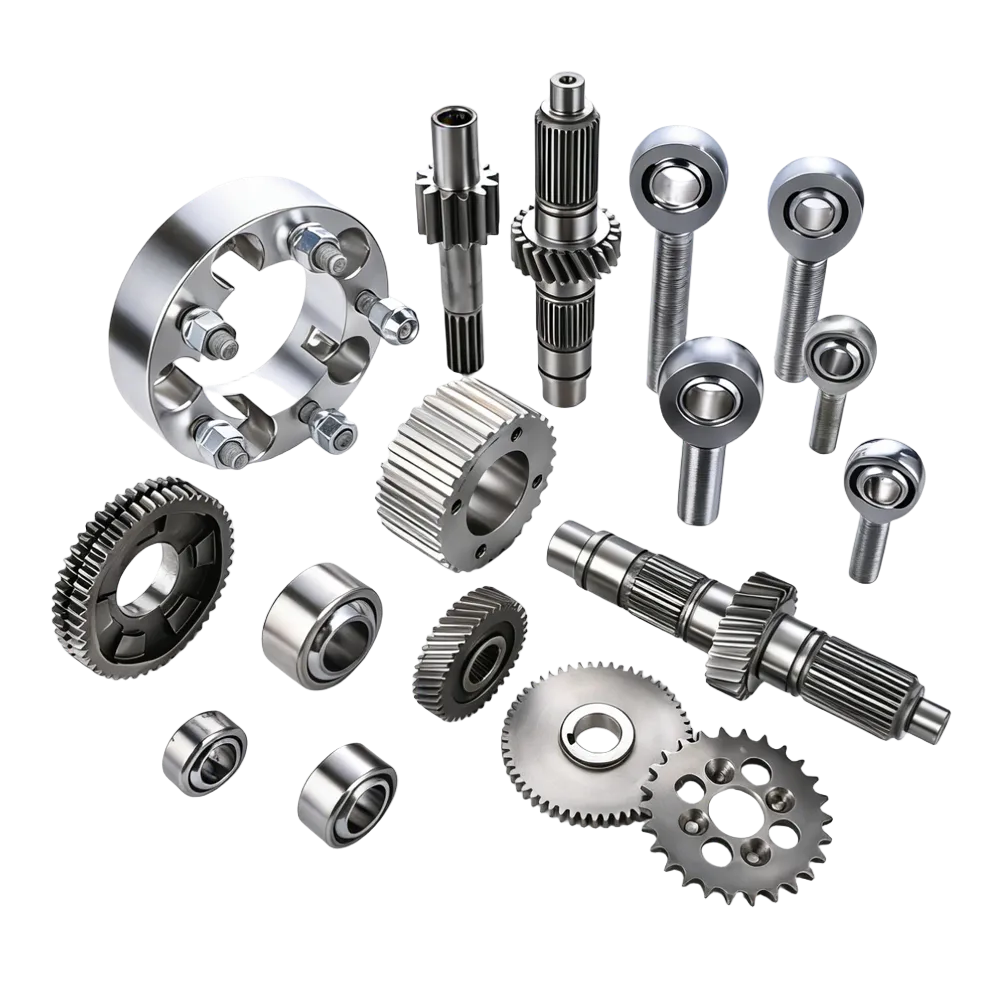
Most cars have two or four ball joints, all in the front suspension, connecting the control arms to the steering knuckles — the exact count depends on suspension design, and the joints themselves come in several distinct types and non-interchangeable sizes.
How Many
| Front suspension design | Ball joints per side | Total (front) |
|---|---|---|
| MacPherson strut (most modern sedans, crossovers, compact cars) | 1 (lower only — the strut itself acts as the upper pivot) | 2 |
| Double-wishbone / short-long arm (SLA) (trucks, SUVs, many performance cars) | 2 (upper + lower) | 4 |
| Multi-link or specialty designs | Varies — can be 2, 4, or more | Varies |
Rear suspensions almost always use rubber or polyurethane bushings instead of ball joints — a genuine rear ball joint shows up mainly on a small number of high-performance or specialized multi-link rear setups, not as a general rule.
Where They Are
Every ball joint sits between a control arm and the steering knuckle (the part the wheel hub bolts to). On a double-wishbone setup, the chain runs:
Upper control arm → upper ball joint → steering knuckle ← lower ball joint ← lower control arm
On a MacPherson-strut vehicle, the single ball joint is typically at the outer end of the lower control arm, near the bottom of the steering knuckle — the strut assembly handles the upper pivot role instead of a second ball joint. Either way, the joint's job is the same: let the knuckle pivot for steering while moving up and down with the suspension, without binding.
Common mix-up: tie-rod ends also use a ball-and-socket design, but they're part of the steering linkage, not the suspension — mechanics generally don't count them as "ball joints" even though the joint mechanism is similar.
Types and Sizes
By position and load role:
- Upper vs. lower — which one exists (or both) depends on the suspension design above.
- Load-carrying vs. follower (non-load-carrying) — one joint typically carries most of the suspension's static load while the other mainly resists lateral/steering forces; which one is load-carrying depends on the suspension type, not a fixed rule across all vehicles.
By mounting method:
- Press-in — housing is pressed into a machined bore in the control arm or knuckle with an interference fit; replacement requires a ball joint press.
- Bolt-in — secured with bolts through a flange; no press needed.
- Riveted — common on some factory control arms; the rivets have to be drilled or ground out before a bolt-in replacement can go in.
- Integral — built permanently into the control arm casting; there's no separate joint to press out, so a worn integral ball joint means replacing the whole control arm.
Sizes are not universal. Stud diameter, taper angle, mounting-bore diameter, and overall ball/socket geometry all have to match the specific vehicle — even two vehicles that use the same general suspension layout can require completely different ball joints. There's no substitute for matching the part to the exact make, model, and position (upper/lower, left/right) rather than assuming "the same suspension type" means "the same part."
Related reading: How Many Ball Joints Does a Car Have? · Where Is a Ball Joint Located? · What Are the Two Types of Ball Joints? · Ball Joint vs. Heim Joint vs. Spherical Bearing vs. Bearing: How They're Actually Related · Press-Fit vs. Bolt-On Ball Joints: Does It Determine Whether You Need a Press?
This page is an overview — for a deeper look at any single piece (exact joint count and load role for a specific suspension type, precise mounting-point diagrams by vehicle category, or the engineering difference between load-carrying and follower joints), see the three linked articles above.