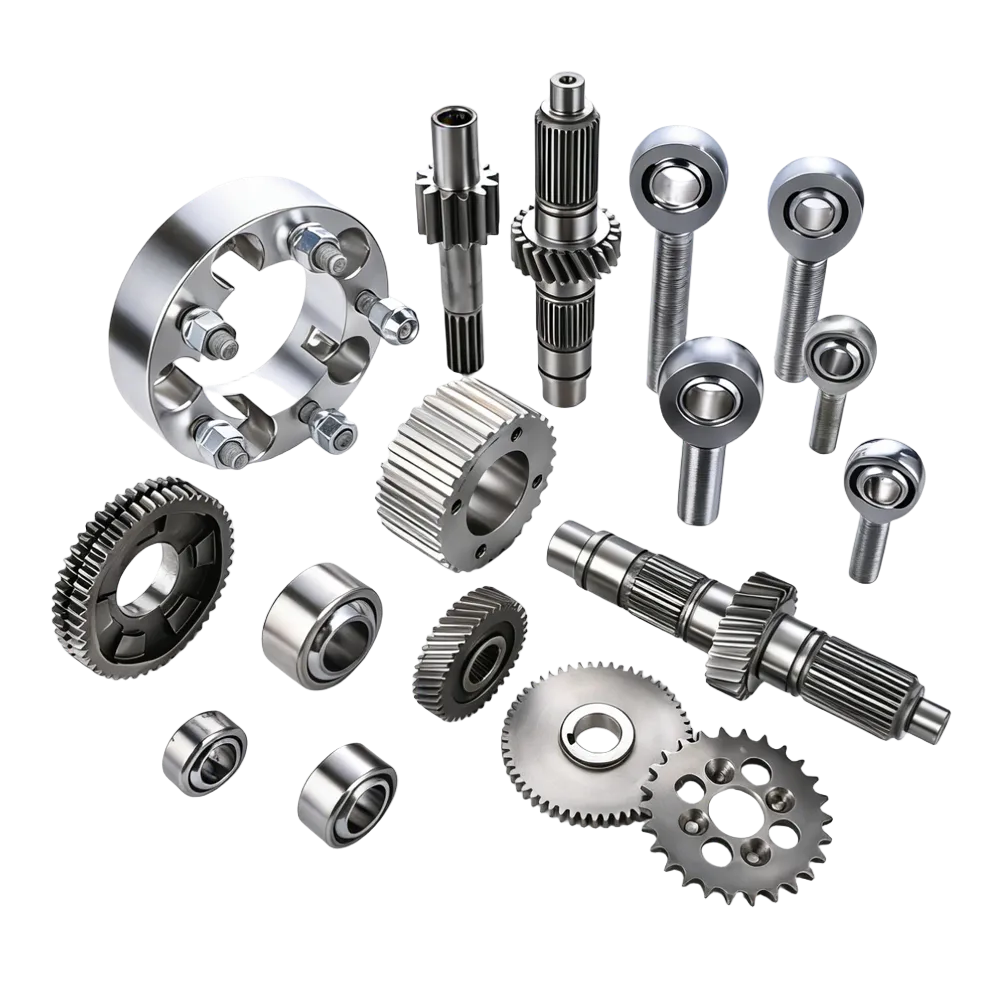

All four are members of the same family — parts that let two connected components move relative to each other instead of locking rigidly together. Where they split is how much misalignment they allow, how well they're sealed, and whether that motion is a full spin or a limited angular wobble. A ball joint is a sealed, low-maintenance version built for automotive suspension loads. A heim joint (rod end) and a spherical bearing (uniball) are both closer cousins — arguably the same core component — built for tighter tolerances at the cost of sealing. "Bearing" is the umbrella term that includes all three, plus an entirely different category (rolling-element bearings) that isn't built for angular movement at all.
The Family Tree
Not everything called a "bearing" does the same job. The split that actually matters:
- Bearings built for continuous rotation, one axis only — wheel bearings, most bearings inside a transmission or pulley. These spin freely around a single axis and generally can't tolerate angular misalignment; that's not what they're designed for.
- Bearings built for limited angular movement, multiple axes — ball joints, heim joints, and spherical bearings all fall here. None of them are meant to spin continuously; they're meant to pivot and tilt through a limited range as a linkage articulates.
That second group is where the confusion usually starts, because ball joint, heim joint, and spherical bearing all describe roughly the same physical idea — a ball riding inside a matching socket — implemented three different ways.
The Three Ball-and-Socket Variants, Side by Side
| Ball joint | Heim joint (rod end) | Spherical bearing (uniball) | |
|---|---|---|---|
| What it is | Ball stud captured in a sealed, cushioned socket | Ball with a through-hole, seated in a housing with a threaded shank attached | Bare ball-and-race pair (inner race/outer race) — no shank, no rod-end housing |
| How it mounts | Stud presses/bolts into a knuckle or arm | Threaded shank screws into an A-arm or link, locked with a jam nut | A bolt passes straight through the center bore; the outer race presses into a housing you machine or buy separately |
| Sealing | Rubber boot, grease-packed | Usually exposed — metal-on-metal or PTFE liner, no boot | Usually exposed, same as heim joint |
| Play / precision | Some built-in compliance (rubber/nylon-lined socket, by design) | Very low — that's the point | Very low — same bearing principle as a heim joint |
| Adjustability | None — fixed length | High — thread in/out to change link length | None on its own — length adjustment has to be built into the surrounding structure |
| Typical home | OEM suspension, daily-driven vehicles | Race/off-road linkages, adjustable control arms | Race/off-road A-arms and control arms, often where you want the bearing's angular range without a separate threaded shank |
The row that trips people up is heim joint vs. spherical bearing: they're frequently the same bearing internally — a ball captured between an inner and outer race — just packaged differently. A heim joint bundles that bearing into a rod-end body with a threaded shank, so it screws directly into a link. A spherical bearing (uniball) is the bearing on its own, meant to be pressed into a housing you've already designed, with a straight bolt running through it rather than a threaded shank doing the mounting. If you've seen a "ball joint delete" kit that swaps a factory ball joint for a uniball setup, that's this exact substitution — trading the ball joint's sealed compliance for the spherical bearing's tighter, adjustable-elsewhere geometry.
SYZ Machine's own breakdown of spherical bearing motion covers the mechanics here in more depth than fits in a comparison table — including the ISO 12240-4 load figures (axial load capacity typically runs 10–15% of radial capacity) and the radial clearance tolerances (as tight as 0.0000"–0.0005") that determine how "zero-play" a given bearing actually is: Understanding Articulation and Spherical Bearing Motion.
Why Ball Joints Stay Sealed and Heims/Sphericals Don't
This is the trade-off underneath every other difference in the table above. A ball joint's rubber boot and cushioned socket exist to keep road grit and water out and to absorb some shock — at the cost of a small amount of built-in play. A heim joint or spherical bearing skips that cushioning specifically to eliminate the play, which means there's rarely a boot design that can seal the joint without also restricting the angle it needs to swing through. That's a deliberate trade, not an oversight: you're choosing precision over sealing, and the maintenance schedule (grease/inspect regularly) reflects that choice.
For a full comparison of how that trade-off plays out in real steering feel and real off-road failure modes — not just the structural difference — see two deeper pieces already covering ball joint vs. heim joint specifically:
- Precision Response: Why Heims Beat Standard Ball Joints in Steering — the steering-feel and angular-range comparison, with a full trade-off table.
- ATV/UTV A-Arms: Why Standard Ball Joints Fail — and Where Heim Joints Actually Help — the three specific ways OEM ball joints fail under long-travel suspension geometry, and what a heim joint does and doesn't fix.
One More Naming Wrinkle: Heim Joint Has Five Names
Separately from the functional comparison above, the term "heim joint" itself is one of five interchangeable names for the same part — rod end, heim joint, Rose joint, spherical rod end, and rod end bearing are all the same physical component, with the differences being regional/historical rather than mechanical: What's the Difference Between Rod End, Heim Joint, Rose Joint?
Which One a Given Job Actually Needs
- Daily-driven vehicle, OEM-style suspension: ball joint. Sealing and low maintenance win over precision the vehicle doesn't need.
- Steering or suspension link that needs to be length-adjustable (toe, caster, bump-steer correction): heim joint. The threaded shank is what makes it adjustable in the first place.
- A-arm or control arm pivot where you've already engineered the housing and just need the bearing's angular range, or you're building a fixed-length link: spherical bearing/uniball.
- Anything that just needs to spin — a wheel, a pulley, a shaft: that's a rolling-element bearing, not any of the three above. If a part needs continuous rotation rather than a limited swing, none of ball/heim/spherical bearing is the right category to begin with.
SYZ Machine builds both sides of this comparison — sealed ball joints for OEM-style applications and custom rod ends/spherical bearings (shank size, misalignment rating, and liner material matched to the application) for the precision side. The right call depends on what the geometry and duty cycle actually demand, not on which one sounds tougher.
Related reading: What Is the Difference Between a Heim Joint and a Ball Joint? · Extended, Adjustable, and "Ball Joint Delete" Setups: What They're For · What's the Best Brand or Material for Ball Joints, and Are They Covered Under Warranty?