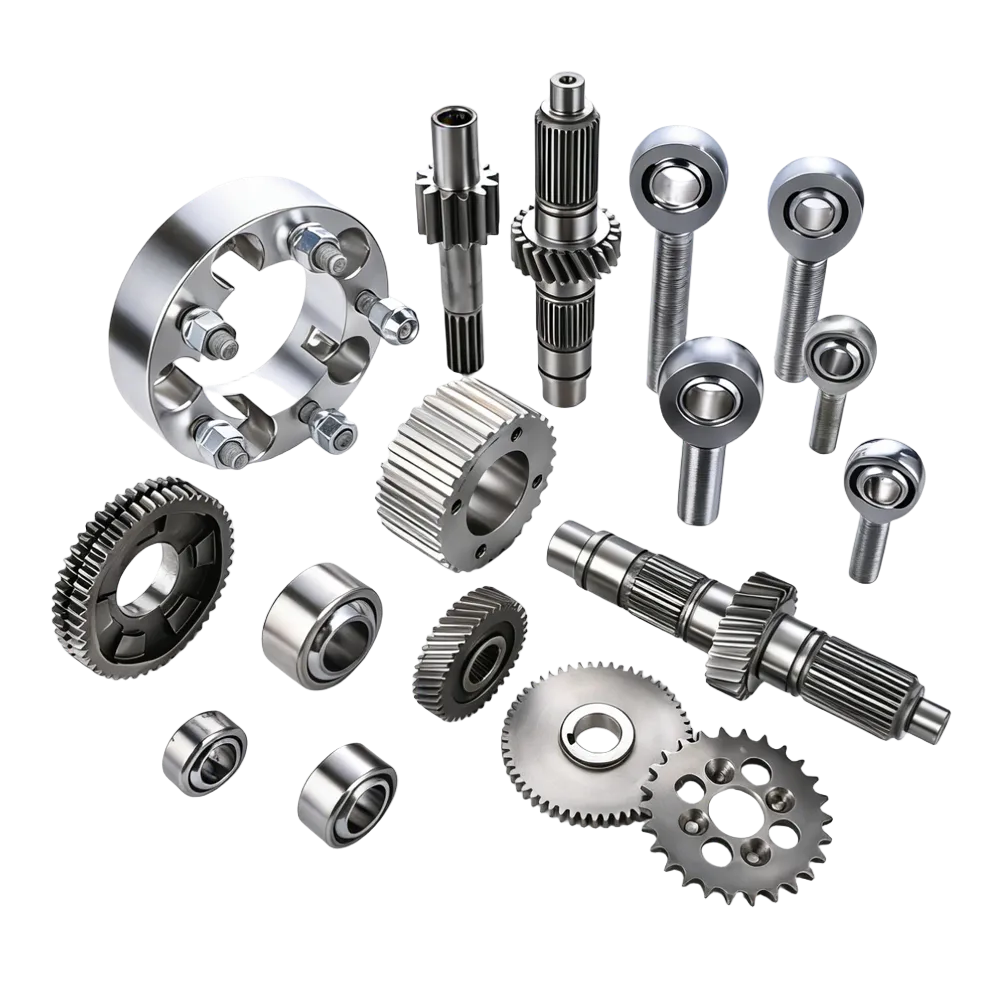
A ball joint is a ball-and-socket connector in a vehicle's suspension that links the control arm to the steering knuckle — the part the wheel hub attaches to. A hardened steel ball on a stud sits inside a socket lined with a low-friction bearing surface, sealed by a grease-packed rubber boot. It works like the hip or shoulder joint in the human body: the ball can swivel in multiple directions inside the socket at once, rather than being locked to a single axis of motion.
Why a Ball-and-Socket Design, Not a Hinge
This is the part of "how does it work" that most explanations skip: a ball joint exists because a simple hinge can't do the job. Every front wheel has to do two things simultaneously that pull in different directions — move up and down as the suspension absorbs bumps, and pivot left and right when the steering wheel turns. A hinge only rotates around one fixed axis, so it can accommodate one of those motions but not both at the same time; try to force a hinge to do both and it binds or breaks.
A ball riding inside a matching socket doesn't have that limitation. Because the ball's surface is uniformly curved in every direction, the stud can tilt, swivel, and rotate through a range of angles simultaneously — vertical suspension travel and horizontal steering input happen at the same joint, at the same moment, without one motion fighting the other. That's the entire reason the ball-and-socket geometry exists here instead of a cheaper, simpler hinge: it's the only shape that lets one connector carry vehicle load while permitting motion in more than one direction at once.
What's Inside
- Ball stud — a hardened steel shaft with a spherical ball machined onto one end.
- Socket/housing — a metal (sometimes polymer-lined) cup shaped to match the ball, allowing it to pivot without binding.
- Grease — packed inside the socket to reduce friction as the ball moves.
- Rubber boot — seals the joint, keeping grease in and dirt, water, and road grit out.
When It Wears Out
As the ball and socket wear against each other, clearance (play) develops between them, which typically shows up as clunking noises, vague or wandering steering, a vibrating steering wheel, or uneven tire wear. In the worst case, enough wear lets the ball separate from the socket entirely, which is a steering-system safety failure, not a comfort issue — that risk is why ball joints are inspected on a schedule rather than left until they announce themselves.
Related reading: What Is a Ball Joint on a Car? · Ball Joint vs. Heim Joint vs. Spherical Bearing vs. Bearing: How They're Actually Related · How Many Ball Joints Does a Car Have, Where Are They, and What Types/Sizes Exist?
This page focuses on the mechanism — for construction details, how upper and lower ball joints split load-carrying duty, and how suspension type changes which joint does what, see What Is a Ball Joint on a Car?