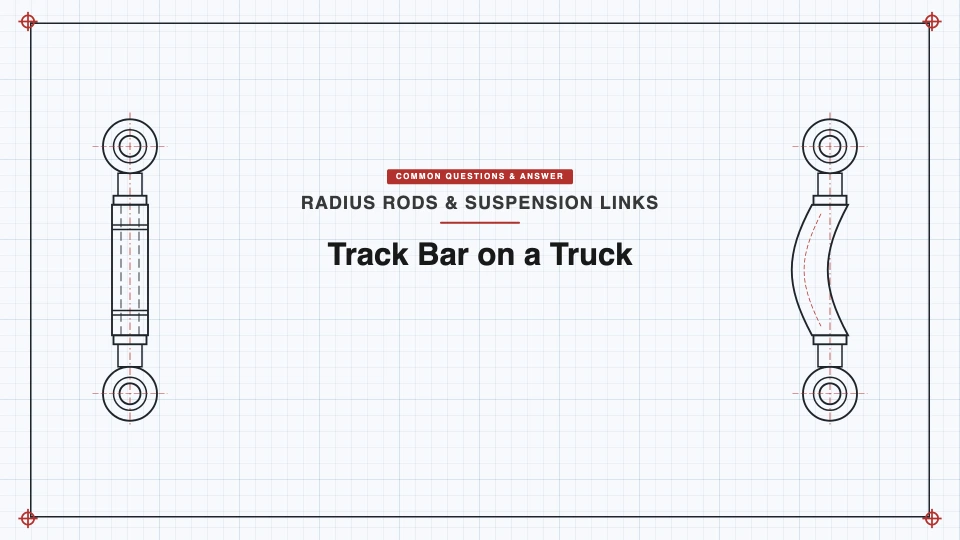
A track bar on a truck is a rigid link connecting the frame on one side to the solid axle on the other, holding the axle centered side-to-side while still letting it move up and down with the suspension. In replacement and custom applications, track rod or radius rod assemblies use the same basic two-pivot layout. It's also called a panhard bar, panhard rod, or track rod — same part, different name depending on who's talking about it.
Where It's Mounted and Why Trucks Need One
The track bar bolts to a bracket on the frame at one end and a bracket on the axle housing at the other, on opposite sides of the truck. You'll find it mainly on trucks, SUVs, and Jeeps running a solid front or rear axle on coil springs — especially three-link and four-link non-triangulated suspension setups, where nothing else in the suspension geometry is doing the job of keeping the axle centered. It also shows up on some leaf-spring front axle applications, where it's there to control bumpsteer rather than to provide the primary lateral location the leaf springs already handle.
What It Does — and What It Doesn't Do
The track bar's only job is lateral: it stops the axle from shifting side-to-side under cornering or off-camber load. It has no role in absorbing vertical bump load (that's the springs and shocks) and no role in resisting body roll (that's a sway bar, a different part entirely, doing a different job). Because both of the track bar's end joints pivot, the axle end doesn't travel in a perfectly straight vertical line — it swings through a shallow arc as the suspension moves, a geometry trade-off the part accepts in exchange for being simple and inexpensive.
Common Failure Symptoms — and When to Check It
| Symptom | What it means |
|---|---|
| Loose or wandering steering | Play has developed in the track bar's bushings, bolts, or mounting bracket, letting the axle shift more than it should |
| Clunking over bumps or through corners | The bar or its joints are moving with detectable slack instead of pivoting cleanly |
| Uneven or accelerated tire wear | The axle isn't staying centered the way it's supposed to, changing contact patch behavior |
| Visible axle offset after a lift | A fixed-length track bar wasn't corrected for the new ride height (see below) |
| Death wobble (violent high-speed shaking of the front end) | The most severe symptom — usually a sign the track bar has significant play, though it's rarely the only worn part involved |
If you're seeing any of these, don't assume which one it is without checking — several other front-end parts wear alongside a track bar and can produce similar symptoms.
Why a Lifted Truck Needs an Adjustable Track Bar
A track bar is a fixed length. Lift the truck's ride height and the bar's resting angle changes — since its two mounting points are no longer at the relative height they were designed for, the axle gets pulled off-center under the frame. An adjustable (threaded, extend/retract) track bar corrects this: after the lift, you lengthen the bar to re-center the axle. This is the standard reason lifted trucks and Jeeps replace the factory fixed-length bar, not an upgrade for its own sake.
Track Bar vs. Traction Bar: A Different Part With a Similar Name
These two get confused because the names sound alike, but they solve opposite problems. A track bar is mounted roughly horizontally, side to side, and controls the axle's lateral position. A traction bar (also called a ladder bar) is mounted lengthwise, front to back, and controls axle wrap — the twisting the axle housing does under hard acceleration or braking as the axle tries to rotate inside its springs. One doesn't substitute for the other, and a truck can need either, both, or neither depending on its suspension type and how it's used. This distinction gets less coverage in general search results than it deserves — it's worth knowing the difference before you go shopping for either part.
Safety Note: Don't Disconnect It Off-Road
Some off-road drivers disconnect their front sway bar on the trail to gain extra wheel articulation, since the sway bar's only job is resisting body roll — losing it temporarily doesn't compromise axle location. A track bar is a different situation: disconnecting it removes the axle's only lateral location device, so the axle is free to shift side-to-side with nothing controlling it. That's not a trade-off worth making for extra flex; unlike a sway bar, a track bar isn't designed to be a disconnect-and-reconnect part.
Related reading: What Is a Panhard Bar? Function, Geometry, and When You Need One · What Is a Track Bar (Panhard Bar), and What Does It Do? · Panhard Bar vs. Track Bar: Is There a Real Difference? · Can You Drive With a Bad or Broken Track Bar? · Can a Bad Track Bar Cause Death Wobble?