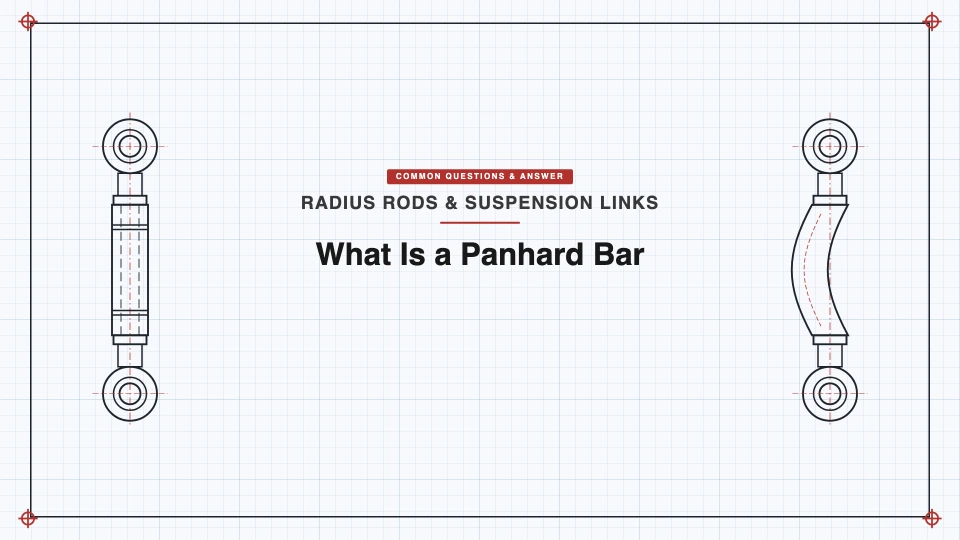
A Panhard bar (also called a Panhard rod, track bar, or track rod) is a rigid link that runs from the vehicle's frame to the opposite side of a solid axle. Its only job is to stop the axle from sliding sideways relative to the chassis during cornering or off-camber travel — while still letting the suspension move up and down freely.
Why a Live Axle Needs One
A solid (live) axle riding on coil springs has a problem a leaf-spring axle doesn't: coil springs are excellent at absorbing vertical load but do almost nothing to locate the axle laterally. Without a separate lateral link, the axle would walk side-to-side under cornering load. The Panhard bar is that lateral link — it's the reason coil-sprung solid-axle trucks and Jeeps can use soft, compliant springs for ride quality without turning the rear (or front) axle into a pendulum.
How It's Built
The Panhard bar itself is simple: a straight, rigid bar or tube, mounted horizontally (or close to it), with a bushing or rod-end joint at each end. One end bolts to a bracket on the frame; the other bolts to a bracket on the axle, on the opposite side of the vehicle. Both ends need to pivot — the bar swings through a small arc every time the suspension compresses or extends — so the joint quality at each end (bushing vs. rod end, bore tolerance, material) directly determines how much slop develops over the bar's service life.
The Geometry Trade-off You Can't Design Around
Because the bar is a fixed length pivoting from two fixed points, the axle doesn't travel in a straight vertical line — it travels along a shallow arc whose radius equals the length of the bar. As the suspension compresses or droops toward its limits, that arc produces a small amount of side-to-side axle movement, even with a perfectly built bar. Longer bars produce a flatter arc and less lateral shift for the same amount of wheel travel; shorter bars produce more. (One retailer's writeup measured this shift at roughly 0.05–0.17 in. on a Mustang application — that number is specific to that car and that bar length, not a universal spec, but it's a useful illustration of how small the effect is under normal street travel.)
This isn't a flaw to be "fixed" — it's the trade-off you accept in exchange for a single, simple, inexpensive part. The alternative that removes the arc entirely is a Watt's linkage, which uses two equal-length arms and a central pivot to keep the axle moving in a true vertical line. It solves the geometry problem completely, at the cost of more mass, more mounting points, and more complexity — which is why most vehicles ship with a Panhard bar and only performance-oriented builds upgrade to a Watt's linkage.
The Angle Most Write-ups Skip: Roll Center
The Panhard bar's mounting height doesn't just locate the axle — it sets the suspension's roll center height. Move the bar's mounting points up or down and you change how the vehicle transfers weight through a corner, independent of anything you do to springs or sway bars. This is the piece of the puzzle that's easy to get wrong when lifting or lowering a vehicle without also correcting or relocating the Panhard bar mounts, and it's worth understanding before you assume "any bar of the right length" is a drop-in fix.
Why a Lift or Lowering Kit Changes Everything
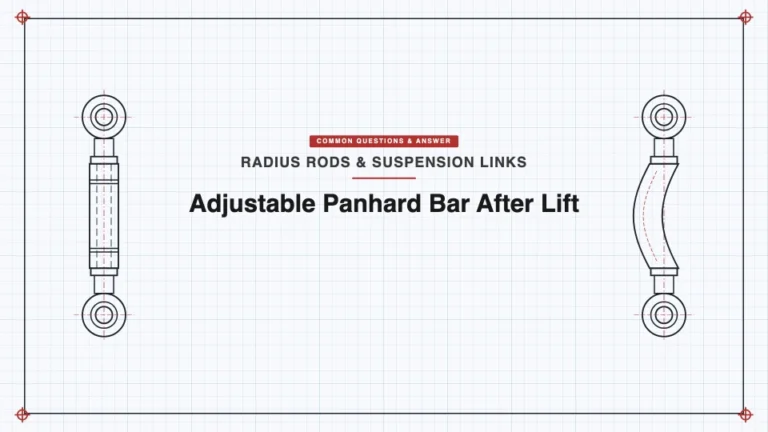
A Panhard bar is a fixed length. Raise or lower the vehicle's ride height and the bar's resting angle changes — which pulls the axle off-center relative to the frame, since the bar's two mounting points are no longer at the same relative height they were designed for. An adjustable (threaded, extend/retract) Panhard bar exists specifically to correct this: after a height change, you lengthen or shorten the bar to re-center the axle under the chassis. This is the single most common reason off-road and lifted-truck owners replace a factory fixed-length bar with an adjustable one — it's not an upgrade for its own sake, it's a correction for a geometry change you already made elsewhere.
Where You'll Find One
| Axle type / vehicle category | Panhard bar likely present? |
|---|---|
| Solid front axle, coil-sprung (Jeep Wrangler/Gladiator, many 4×4/off-road trucks) | Yes — standard equipment |
| Solid rear axle, coil-sprung (many trucks, later Mustang three-link rear suspensions) | Yes |
| Solid axle, leaf-sprung | Usually no — leaf springs provide enough lateral rigidity on their own |
| Independent front/rear suspension | No — there's no solid axle to locate |
What to Ask About Before You Buy One
Every Panhard bar does the same job on paper; they don't hold up the same way in practice. The two variables that matter most are the tube (wall thickness and material — a seamless DOM tube resists bending and fatigue differently than a stamped or thin-wall equivalent) and the end joints (a greaseable rod end holds tighter tolerances over years of use than a rubber bushing, but wears differently and needs periodic service). If you are comparing custom radius rods and suspension links, tube spec and joint type are the first details to confirm; if a supplier can't identify them, that's a fair question to keep asking before you commit — especially for a part whose whole job is to control precise lateral position.
Related reading: Panhard Bar vs. Track Bar: Is There a Real Difference? · Track Bar vs. Sway Bar: What's the Difference? · Are Track Bars/Panhard Bars Necessary? · Why You Need an Adjustable Panhard Bar After a Lift