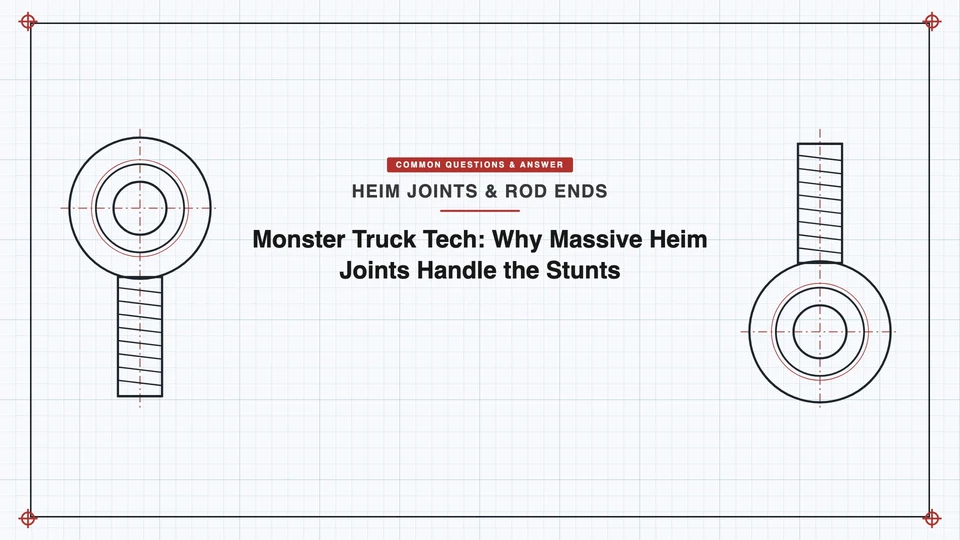
When a monster truck comes down from a 30-foot jump, the entire landing load transfers through the suspension in a fraction of a second. A standard rubber or polyurethane bushing would deform and fail almost instantly under that kind of shock — which is why monster truck suspension and steering links use heavy-duty heim joints (spherical rod ends) instead, scaled up well beyond what you’d see on a street vehicle or even a typical off-road truck.
Why Not a Rubber Bushing?
A rubber or polyurethane bushing absorbs some shock by flexing, but that flex is exactly the problem at this scale. Under repeated landings measured in multiples of the vehicle’s own weight, a bushing this size would compress, tear, or lose its shape almost immediately — and once it does, the suspension geometry it was supposed to hold in place starts drifting. A heim joint solves this differently: instead of absorbing shock through material flex, it transmits force through a rigid ball-and-race interface that holds essentially zero linear play, while still allowing the joint to pivot and self-align as the suspension link rotates through its travel. The shock absorption itself is the shocks’ job, not the joint’s — the heim joint’s role is to keep the axle and links located exactly where the geometry needs them, landing after landing, without adding compliance the suspension designer didn’t account for.
That rigidity also means the suspension geometry stays predictable — a bushing that’s flexed and worn unevenly changes how the truck handles over time, while a properly maintained heim joint doesn’t. And because the joint is a separate, replaceable, threaded component, a team can adjust suspension link length for geometry tuning between events, something a bonded rubber bushing can’t do at all.
What "Massive" Actually Means Here
It’s worth separating two different things researchers and builders mean by "massive heim joint" in this context, because they’re not the same claim:
What’s actually available at retail, verified against real product listings: off-road and mud-truck suppliers sell heim joints in shank sizes up through roughly 1.25 in. (for example, a "Monster Heim kit" sold with a 1.25 in. shank, and 7/8 in.-bore kits aimed at mud truck and mega truck builds). SYZ Machine’s own product line includes a 1.75 in. heim joint explicitly built for off-road and monster-truck-style suspension applications, alongside 1.25 in. and 1.5 in. kits for the same market. These are real, purchasable parts aimed at heavy off-road and show-truck builds — not the same thing as professional touring-series equipment.
Do not use unverified load or misalignment figures for professional Monster Jam-class trucks. Size a joint using the actual mounting geometry, expected loads, and the selected part manufacturer’s published rating.
Materials: What’s Typically Used at This Duty Level
Heavy-duty off-road heim joints in this size class are commonly built from heat-treated 4130 chromoly steel bodies, with a hardened, precision-ground ball (bearing steel, often hard-chrome plated to resist galling) and a PTFE-based liner between ball and race for self-lubrication. This is a description of common industry practice at this duty level, not a verified specification pulled from a specific monster truck team’s build sheet — different builders and series may use different exact material and coating combinations.
Where Heim Joints Sit in the Suspension
The load path through a typical four-link suspension setup runs from the tire, through the axle, through the suspension links, through the heim joint at each end of those links, into the chassis. During a hard landing, each joint has to accept the angular movement of the link as the axle articulates, while transmitting the load between axle and frame without binding — which is the specific job a spherical bearing does and a fixed pin joint doesn’t.
A joint failing here is generally considered preferable to failing elsewhere. If something has to give under an extreme, out-of-spec impact, a bent or sheared rod end that’s designed to be pulled and replaced is a far cheaper and faster fix mid-event than a cracked axle housing or a bent chassis rail — which is part of why teams treat these as a serviceable wear item and inspect them between runs rather than assuming they’re a lifetime part.
The Trade-Off
Heim joints aren’t a free upgrade over a bushing — they transmit more vibration and impact harshness directly to the chassis (since they don’t flex the way rubber does), and an exposed spherical bearing needs periodic inspection and eventual replacement in a way a sealed bushing doesn’t. For a build that doesn’t see monster-truck-scale impact loads, that trade-off usually isn’t worth it. For a build that does, the zero-play, adjustable, inspectable joint is the only practical option — which is exactly why it shows up at this end of the vehicle spectrum and not lower down it.
Related reading: Heavy Duty 1.75" Heim Joint for Off-Road & Monster Truck Suspension (product) · Why Off-Road Racing Prefers 4130 Chromoly Rod Ends · Understanding Misalignment Angle and Why It Matters · Single Shear vs. Double Shear Mounting Explained