
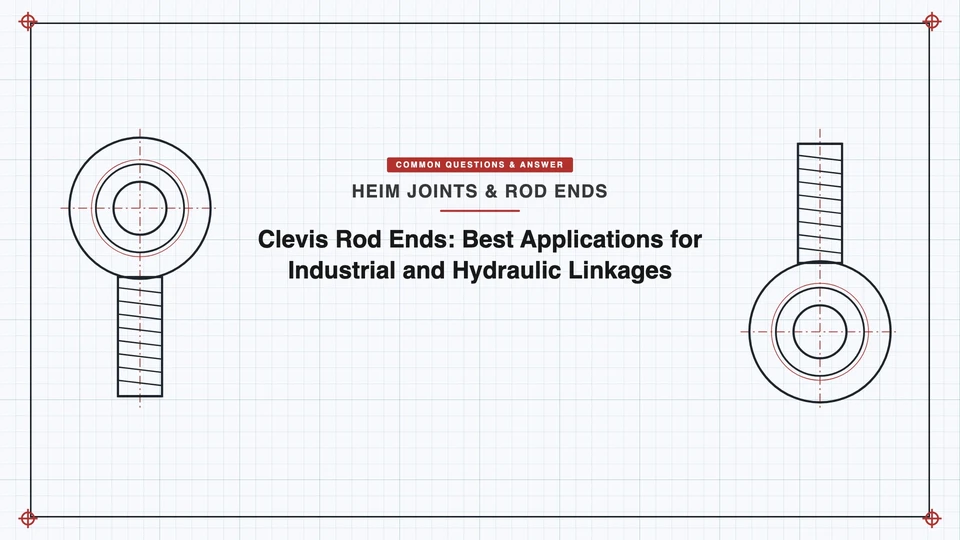
A clevis rod end is a forked connector with a cross-pin that lets a rod, actuator, or hydraulic cylinder assembly pivot relative to whatever it’s driving. Its main advantage is simple, robust single-axis articulation — it’s the right tool when motion happens primarily in one plane, not the multi-axis kind a spherical rod end is built for.
Where a Clevis Rod End Works Well
| Application | Why it fits |
|---|---|
| Hydraulic cylinders | Connects the cylinder rod to levers, brackets, buckets, or arms while allowing pivoting motion |
| Construction equipment | Excavator, loader, and crane linkages with high loads and repeated pivoting |
| Agricultural machinery | Tractors, implements, and harvesters where a straightforward pinned connection is all that’s needed |
| Industrial automation | Connecting pneumatic or hydraulic actuators to machine levers, gates, clamps, or positioning mechanisms |
| Control linkages | Brake, throttle, valve, and clutch rods where motion is predominantly planar |
| Material handling equipment | Lifting, tilting, and positioning mechanisms subject to frequent cycling |
| Industrial machinery | Tensioners, press mechanisms, tooling, and adjustment arms |
Clevis vs. Spherical Rod End: The Decision That Actually Matters
A clevis is the right choice when the connection only needs controlled rotation around a single pin axis. It’s simple, strong, easy to inspect, and easy to disconnect — pull the pin and it’s apart, no pressing or special tooling required.
A spherical rod end (a Heim joint) is the right choice when the linkage needs to accommodate multi-axis angular misalignment — motion that isn’t confined to a single plane. Using a basic clevis where meaningful side-to-side misalignment exists is the mistake to avoid: a clevis’s single pin axis has no way to absorb that lateral movement, so it gets forced into the surrounding structure instead, introducing binding and unplanned load into the linkage or the components on either end of it.
The practical rule: if you can draw the connection’s motion as a simple arc in one plane, a clevis is the simpler, more robust, easier-to-service choice. If the motion needs to accommodate misalignment in more than one direction, that’s a spherical rod end’s job, not a clevis forced to do something it wasn’t built for.
Related reading: Spherical Plain Bearings vs. Rod Ends: Mechanical Differences · Understanding Articulation and Spherical Bearing Motion