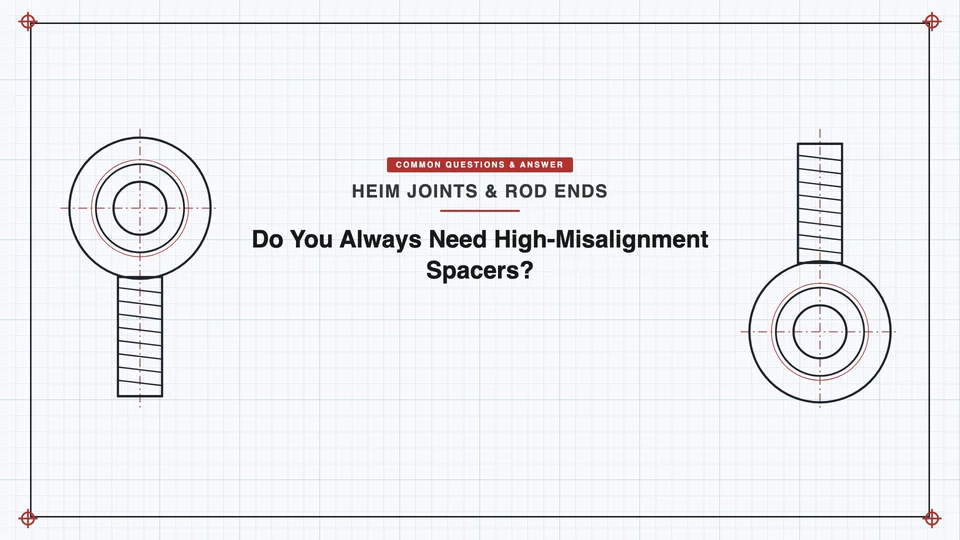
No. Whether you need a high-misalignment spacer comes down to two questions: how much articulation angle your application actually uses, and whether the joint is mounted in single shear or double shear. Get those two answers first — adding the spacer without checking them either wastes money on a part you didn’t need, or worse, leaves you short on bolt shear strength for no articulation benefit.
When You Actually Need One
High-misalignment spacers exist for one job: letting a rod end’s ball rotate through a wider cone before the shank contacts the housing or bracket and binds. You need that extra range when:
- The application genuinely sweeps through a large angle — long-travel off-road suspension, rock-crawler linkages, and steering geometry where the joint’s mounting point moves relative to its arc (see How to Fix Bump Steer Using High-Misalignment Spacers for one specific case of this).
- The joint is mounted in single shear — through a stock bracket with a vertical bolt rather than a fabricated double-shear bracket. Builders on the NAXJA off-road forum working on track bar installs converged on this exact rule: run the joint through a stock single-shear hole and "yes you need the mis-alignment spacers"; run the same joint in a proper double-shear bracket and "you really don’t need them" — because the bracket geometry itself already gives the ball room to rotate without hitting anything.
- You’re already seeing binding — the shank contacting the housing before the suspension or steering reaches full travel is the clearest sign a standard spacer (or no spacer) isn’t enough.
When You Don’t Need One
Plenty of rod-end applications never approach the angles where this matters:
- Low-angle, single-plane motion — throttle linkages, shift linkages, sway bar end links, and flat drag-race suspension setups typically operate within 8–15° of movement, well inside what a standard rod end or a standard (non-high-misalignment) spacer handles.
- Double-shear mounts with adequate clearance already — as above, a horizontal-bolt bracket that captures the joint on both sides often doesn’t bind even without spacers, particularly on parts like track bars that stay close to centered through most of their travel.
- You need maximum bolt shear strength more than you need the extra angle — this is the trade-off most easily missed, covered below.
The Trade-off Nobody Mentions First: Angle vs. Bolt Strength
A standard misalignment spacer sits on top of the rod end’s spherical bearing and keeps the original bolt hole size. A high-misalignment spacer works differently — it inserts into the bearing’s bore, which necessarily steps the bolt hole down to a smaller diameter. A 3/4" bore rod end paired with a high-misalignment spacer commonly drops to a 5/8" or 1/2" bolt.
That’s the real cost of extra articulation: a smaller bolt carrying the same load. One supplier’s spacer line spec sheet shows this pattern consistently across sizes — every listed high-misalignment spacer has a bolt-hole ID smaller than its bearing OD, by design, not as a side effect. If your application needs maximum bolt shear strength more than it needs the extra few degrees of swing, a standard spacer (or no spacer at all) that preserves the full bolt diameter is the better call.
One documented real-world comparison — a Barnes4WD writeup measuring the same 7/8"–3/4" heim joint under three configurations — puts a number on how much this actually changes:
| Configuration | Misalignment angle achieved |
|---|---|
| No spacer | 5.5° |
| Standard misalignment spacer | 12.2° |
| High-misalignment spacer (steps bolt down to 5/8") | 28.5° |
These numbers are specific to that one product and bolt size, not a universal spec — the actual angle gain on any given rod end depends on its bearing geometry, the spacer’s design, and the bolt size you step down to. Treat it as an illustration of scale, not a number to design around. A separate AI-synthesized estimate puts the general range at roughly 10–12° (no spacer / standard spacer) up to 25–35°+ with a high-misalignment spacer — consistent in direction with the Barnes4WD numbers, but that’s a rounded industry-wide approximation, not a spec from any one manufacturer either.
"Not Required" Doesn’t Mean "Don’t Bother"
If you’re genuinely unsure whether your application needs the extra angle, adding a spacer is generally a low-risk move rather than a risky one — provided the resulting bolt size still has adequate shear capacity for the load. On a Drag Racing Suspension forum thread discussing a parallel 4-link setup, the consensus on running spacers when not strictly necessary was: "Not required but it can’t hurt to have a spacer either side to allow for some clearance." The failure mode to actually worry about isn’t over-specifying a spacer you didn’t need — it’s under-specifying the bolt that a high-misalignment spacer forces you into.
Quick Decision Reference
| Your situation | Spacer needed? |
|---|---|
| Long-travel suspension, rock crawler, or steering linkage sweeping through a wide angle | High-misalignment spacer likely needed |
| Joint mounted single-shear through a stock bracket | High-misalignment spacer likely needed |
| Throttle linkage, shift linkage, sway bar end link, flat drag setup | Standard spacer or none — angle is too small to matter |
| Double-shear bracket with a part like a track bar that stays near-centered | Often unnecessary — verify by checking for binding at full travel |
| Application needs maximum bolt shear strength over extra articulation | Skip the high-misalignment spacer; use a standard spacer that preserves bolt diameter |
| Unsure, and bolt size still has margin | Adding one is low-risk, not a design mistake |
Related reading: How to Fix Bump Steer Using High-Misalignment Spacers · What is a "high misalignment" rod end? · High-Misalignment Limit: When to Use Bent Links Instead of Spacers