
Heat treatment can move a spherical bearing or rod end’s tensile strength by well over 100%, but the number that matters more than "how much stronger" is where that strength actually needs to hold. A rod end almost never fails by the shank material simply pulling apart in the middle — it fails at a stress concentration: a thread root, a fillet, a cross-hole. That distinction changes how "better heat treatment" should actually be evaluated, and it’s the piece most generic explanations of quenching and tempering skip.
The Three-Step Process
For a hardenable alloy steel rod end, heat treatment for strength almost always follows the same sequence:
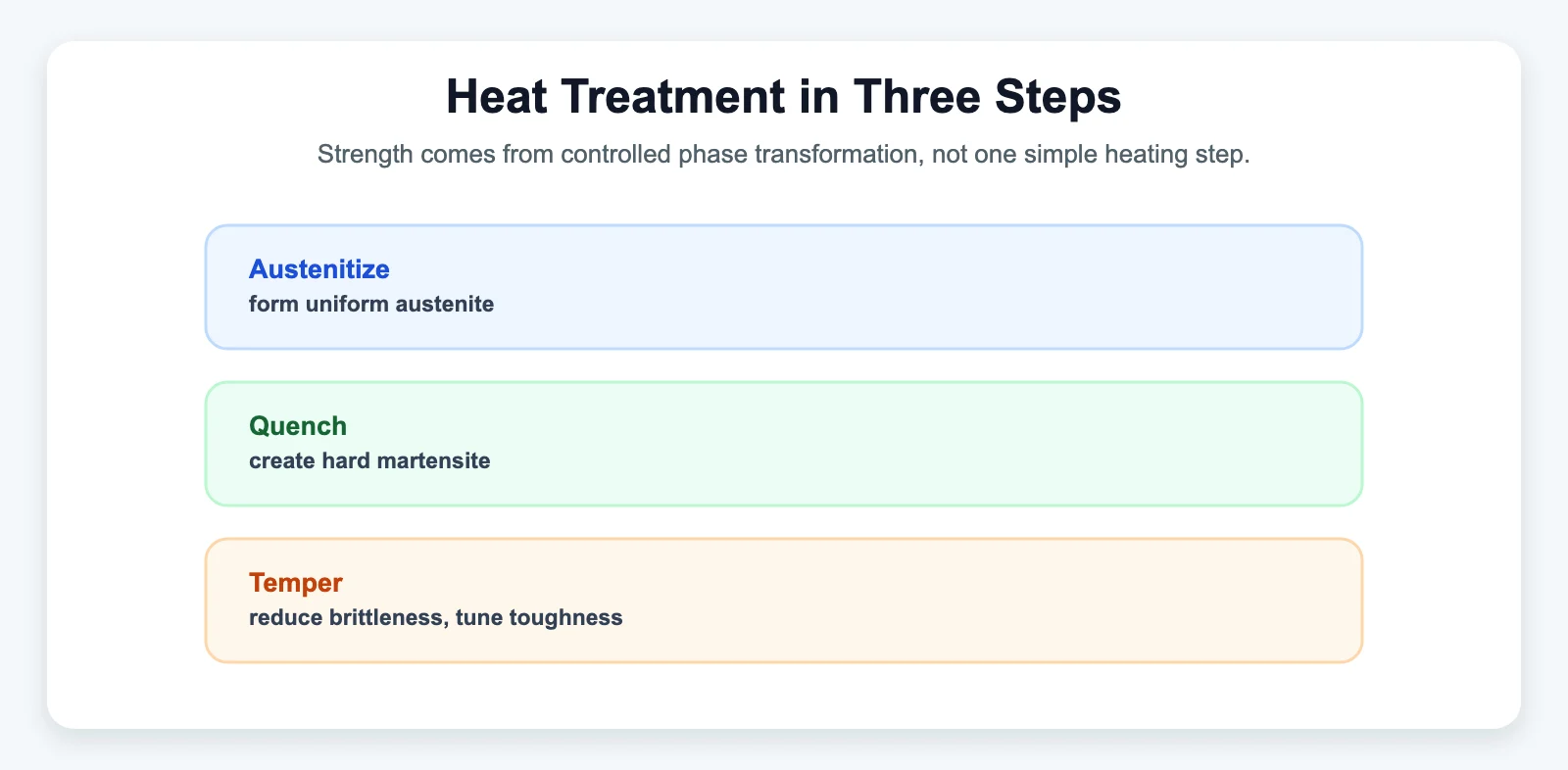
- Austenitizing — heating the steel above its critical transformation temperature, which dissolves carbon and alloying elements into a uniform austenite phase.
- Quenching — rapid cooling (typically in water or oil) that transforms austenite into martensite, a hard, high-strength but brittle microstructure with significant internal residual stress.
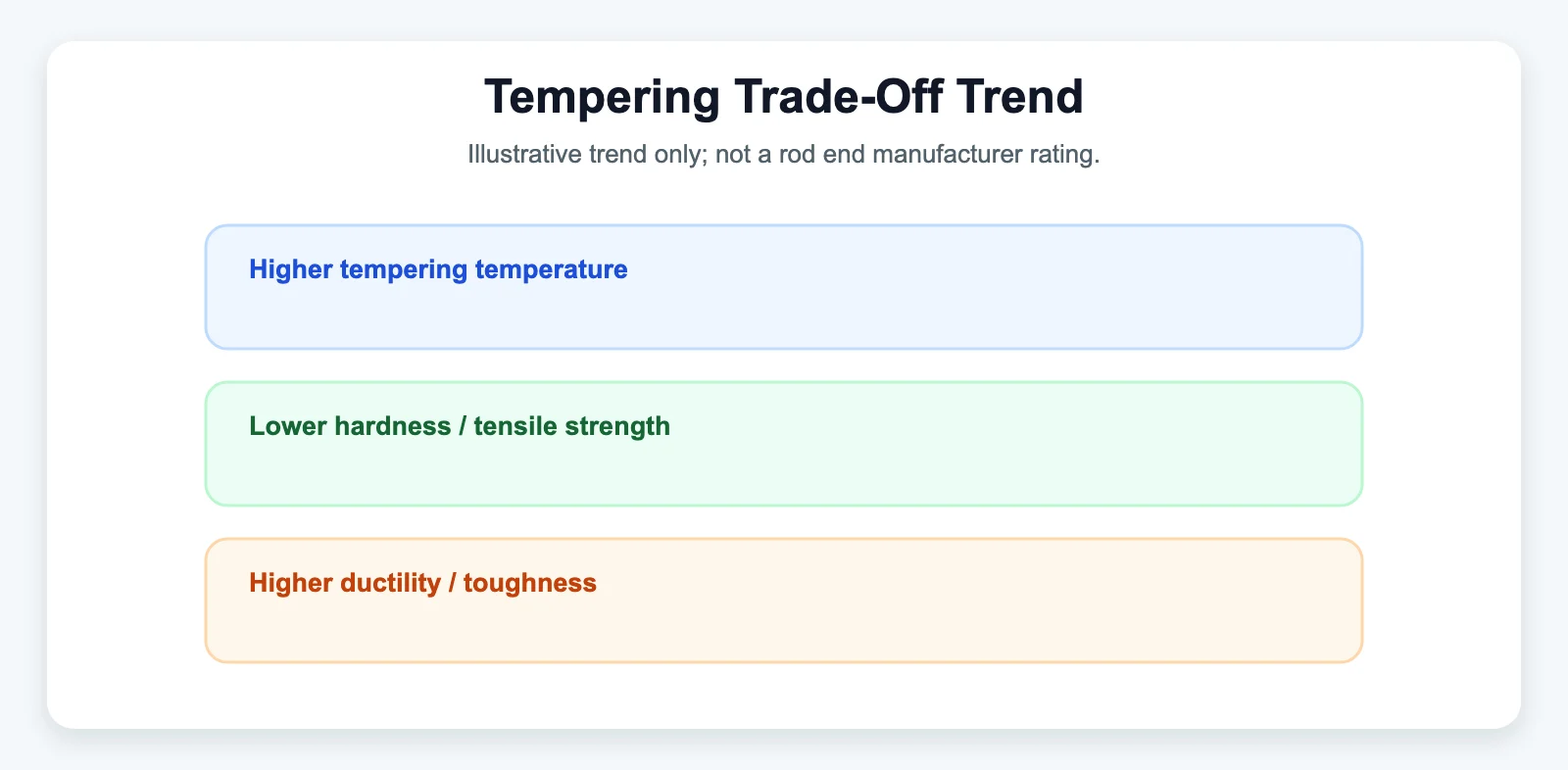
- Tempering — reheating the quenched part below the critical temperature to relieve brittleness and residual stress. As tempering temperature increases, tensile strength decreases while ductility and toughness increase.
The central heat-treatment trade-off is that higher tempering temperatures generally reduce tensile strength while increasing ductility and toughness. The correct balance depends on the steel grade and intended service.
A Concrete Illustration of the Trade-off
A university laboratory study (National Technical University of Athens, published via Thermal Processing magazine) ran this exact sequence on 0.53%-carbon steel samples and measured the result directly:
| Condition | Hardness (HRC) | Approx. tensile strength |
|---|---|---|
| Quenched, no temper | 59 | (not converted in study) |
| Quenched + 200°C temper | 51 | ~1,734 N/mm² (~251 ksi) |
| Quenched + 400°C temper | 44 | ~1,403 N/mm² (~203 ksi) |
| Quenched + 600°C temper | 38 | ~1,200 N/mm² (~174 ksi) |
Read this table as an illustration of the relationship, not a rod end spec. This is a generic 0.53%-carbon steel tested under laboratory conditions, not the 4130 chromoly or 4340 alloy steel most rod ends are actually made from, and it isn’t a manufacturer’s published rating for any specific part. What it demonstrates clearly, though, is the shape of the curve: strength drops steadily as tempering temperature rises, and that relationship holds directionally for the alloy steels rod ends actually use, even though the specific numbers differ.
For 4130 and 4340 alloy steels, tensile strength changes substantially with heat treatment and product condition. Do not use a generic alloy value to design a rod end; base calculations on certified material condition and component-specific data. (Our companion piece on chromoly vs. carbon steel rod ends covers material selection in more depth.)
Why the Failure Location Matters More Than the Bulk Number
A rod end’s tensile strength as a material property and its strength as an assembled part are two different questions. The parts of a rod end most likely to fail under load are:
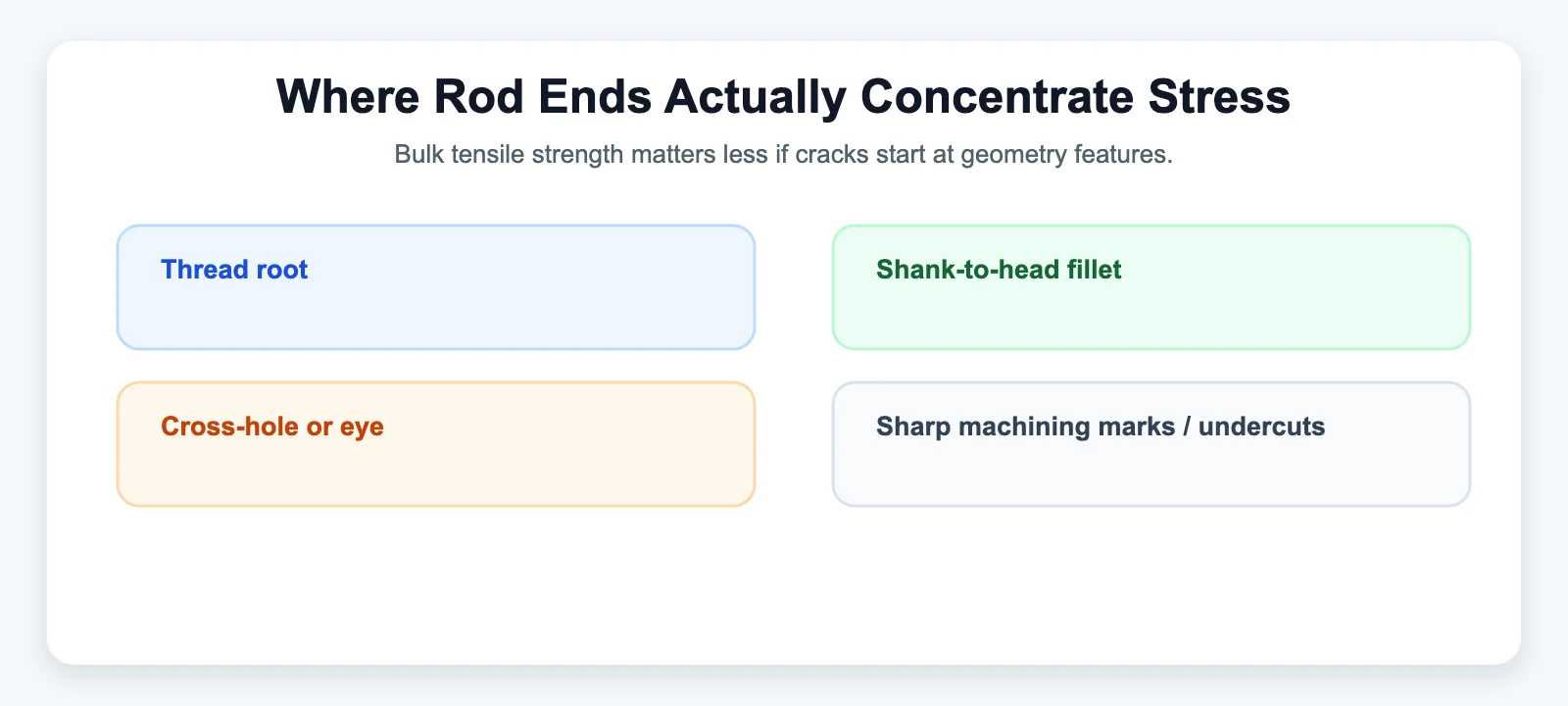
- the thread root, where the thread profile itself creates a stress concentration
- the fillet/transition between the shank and the head
- the cross-hole or eye, if the design uses one
- any stress riser introduced by machining — a sharp internal corner, a tool mark, an undercut
Pushing hardness as high as possible to maximize bulk tensile strength makes these locations more dangerous, not less — higher hardness generally means lower fracture toughness, so a crack that starts at a thread root or fillet propagates faster and with less warning. The better target is usually a strength-toughness compromise tuned to where the load actually concentrates, not a specification that simply maximizes hardness or UTS in isolation.
The Post-Heat-Treatment Risk That Connects to Plating
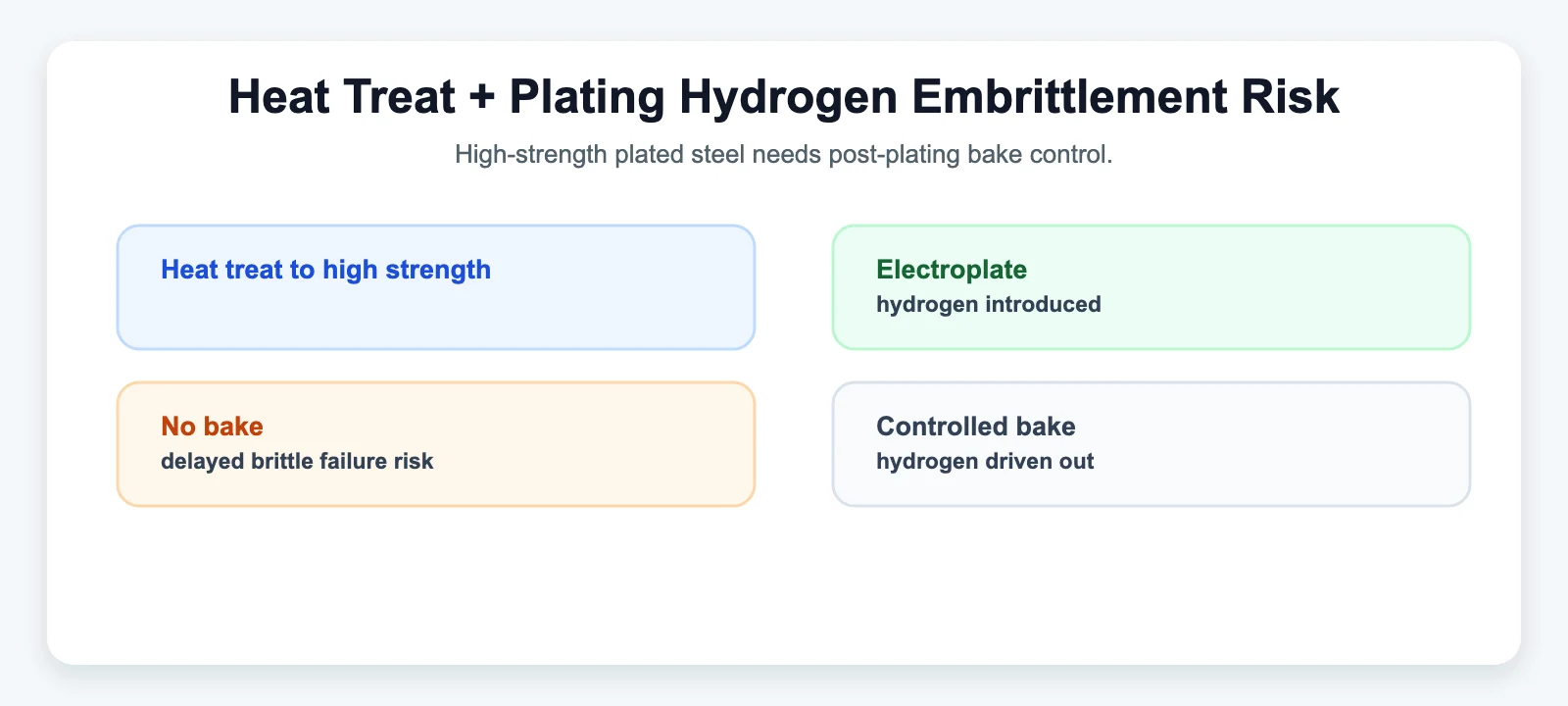
There’s a specific failure mode worth flagging because it connects directly to a step covered in our hard chrome plating piece: hydrogen embrittlement. When a high-strength steel part (generally above roughly 160 ksi UTS) is electroplated after heat treatment — zinc and cadmium plating are the classic examples, but this risk applies to hard chrome plating as well — atomic hydrogen generated during the electroplating process can migrate into the steel. Under sustained tensile load, that absorbed hydrogen can trigger sudden, delayed brittle failure with little or no warning, unless the part is baked (a controlled post-plating heat soak) to drive the hydrogen back out. This is a real and well-documented risk in fastener and high-strength-steel manufacturing, not a theoretical edge case — anyone specifying heat-treated-then-plated rod ends above that strength threshold should confirm the supplier’s process includes a post-plating hydrogen bake.
What This Means Practically
Heat treatment is not a single dial that only goes "stronger" or "weaker" — it’s a strength-versus-toughness trade-off applied to a part whose real failure risk concentrates at specific geometric features, not spread evenly through the material. The right heat treatment spec for a rod end depends on where it’s expected to fail first if it fails at all, and any electroplating step applied afterward needs its own process control to avoid introducing a brittle-failure risk that heat treatment alone didn’t create.
Related reading: Hard Chrome Plating: How It Increases Rod End Service Life · Chromoly (4130) vs. Carbon Steel: Which Is Right for Your Build?