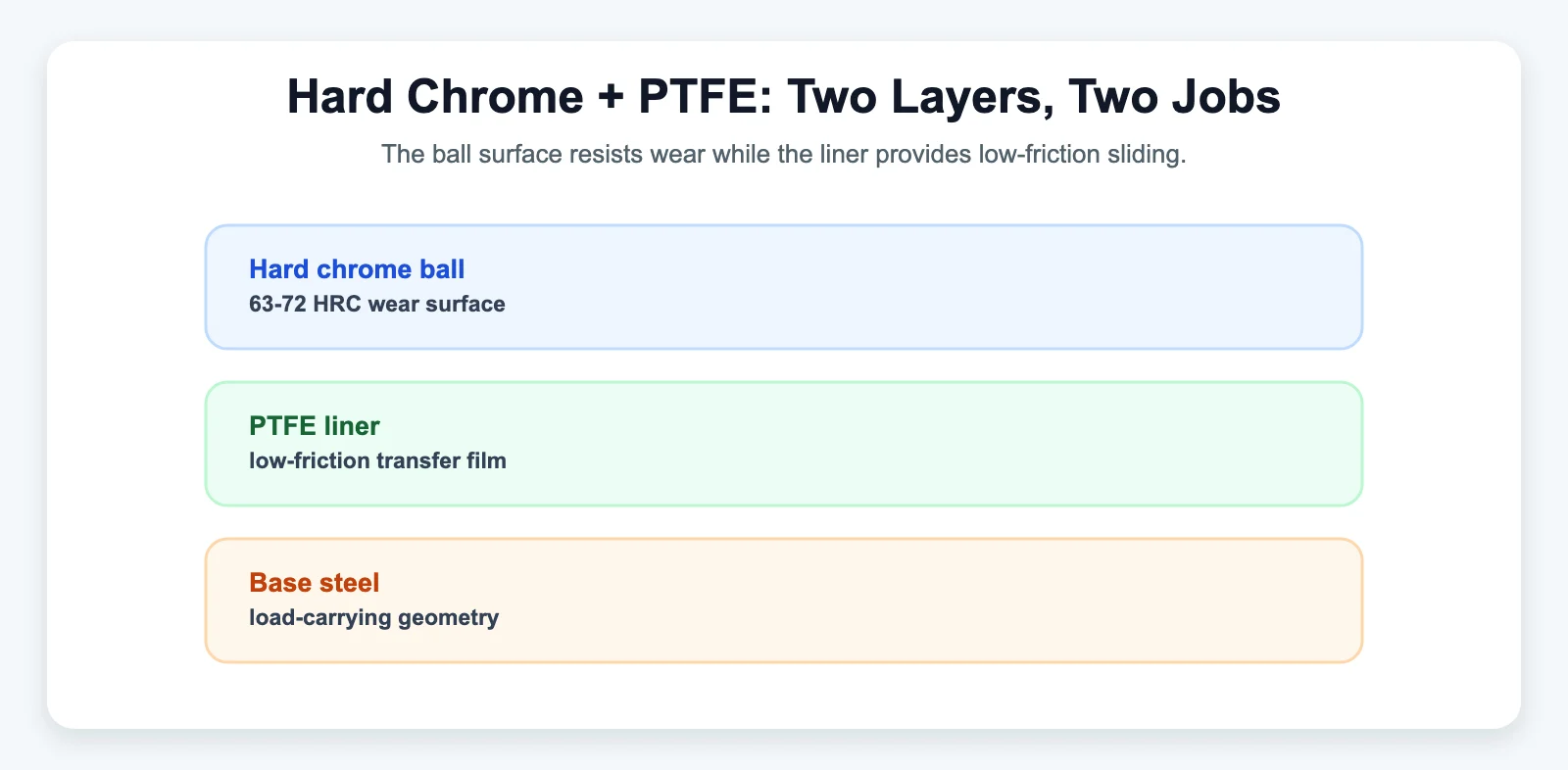
A rod end’s ball is almost never bare steel. In nearly every self-lubricating (PTFE-lined) spherical bearing or rod end and most metal-to-metal designs, the ball is finished with hard chrome — an electrodeposited chromium layer roughly 850–1050 HV (63–70 HRC) in hardness, applied at a controlled thickness of anywhere from 0.25 to 1,000 microns depending on the application. That layer is doing three jobs at once: resisting wear, cutting friction against the mating race, and shielding the base steel from corrosion — and it’s the reason a hard-chrome-plated ball can outlast an unplated one by a wide margin under the same load.
What Hard Chrome Actually Is
Hard chrome (also called "industrial" or "engineering" chrome, as distinct from decorative automotive trim chrome) is deposited electrolytically from a chromic acid bath. Unlike decorative chrome — a thin cosmetic layer over a nickel undercoat — hard chrome is built up in thicker, functional layers purely for mechanical performance, and it can be applied directly to most metallic substrates including the alloy steels rod end balls are machined from.
The Numbers That Matter
Industrial hard-chrome plating references commonly discuss hardness, wear resistance, corrosion resistance, and temperature tolerance. Actual performance depends on coating thickness, surface preparation, substrate, load, and lubrication, so confirm the required properties with the plating supplier.
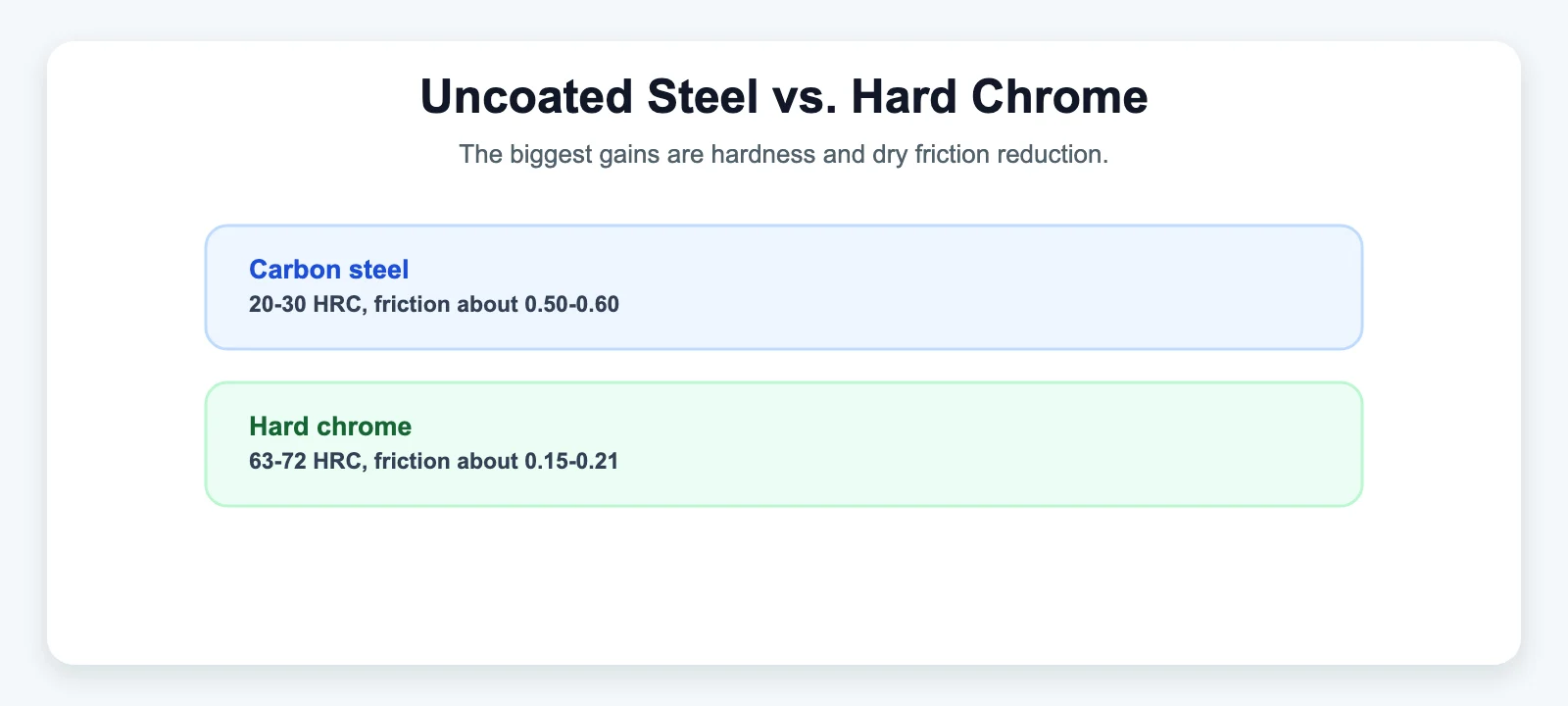
| Property | Uncoated carbon steel | Hard chrome plated |
|---|---|---|
| Surface hardness | 20–30 HRC | 63–72 HRC (850–1050 HV) |
| Coefficient of friction, dry, vs. steel | ~0.50–0.60 | ~0.15–0.21 |
| Coefficient of friction, lubricated | — | ~0.16 |
| Typical deposit thickness | — | 0.25–1,000 microns |
| Operating temperature | — | -400°F to +1,300°F (one source; above ~1,300°F chrome reacts with carbon monoxide, sulfur vapor, and phosphorus) |
That hardness figure is the headline number: a hard chrome surface is roughly two to three times harder than the hardened alloy steel underneath it, which is what lets it resist scratching, gouging, and abrasive erosion from grit that works its way into the joint.
Why Lower Friction Matters as Much as Hardness
A hard chrome surface’s coefficient of friction against steel — roughly 0.15 to 0.21 dry — is less than half that of untreated steel-on-steel contact. Lower friction means less heat generation at the ball-race interface, which matters in two ways for a rod end specifically:
- Less frictional heat reaching the PTFE liner. PTFE-lined rod ends already run on a thin transfer film rather than grease (see our companion piece on how the PTFE liner self-lubricates); a smoother, harder counter-face reduces the heat and abrasive wear the liner has to absorb over its service life.
- Slower wear in metal-to-metal designs. Where the ball rides directly against a greased race, a hard chrome surface resists galling — the tendency of two metal surfaces to transfer material back and forth under sliding contact — which is a common failure mode when lubrication breaks down temporarily.
What "Increases Service Life" Actually Means — With the Caveat
The plating industry commonly cites wear-life improvements of 2× to 10× over uncoated parts, with the higher end of that range reserved for well-controlled applications. This figure shows up consistently across independent sources, but it is a range, not a guarantee: the actual multiplier depends on load, lubrication regime, contamination, coating thickness, and surface preparation before plating. A hard chrome ball in a clean, well-lubricated application might see wear life closer to the low end of that range; a ball exposed to abrasive grit and marginal lubrication won’t see 10× no matter how good the plating is. Treat "up to 10×" as an upper bound observed in industry literature, not a spec you can hold a supplier to without controlling the rest of the system.
Where Hard Chrome Has a Real Limit
Hard chrome forms a passive, self-protecting oxide layer that resists atmospheric oxidation and most acidic and alkaline environments well. Its one documented weak point is halide exposure — chlorides in particular. Road salt, marine spray, and some industrial chemical environments fall into this category. This isn’t a reason to avoid hard chrome plating on a rod end (it’s still the standard finish for exactly this reason across the industry), but it’s worth knowing that "corrosion resistant" has a boundary, and a rod end that lives in a salt-heavy environment benefits from a boot or seal on top of the plating, not instead of it.
Hard-chrome coatings can have a microcracked surface structure that helps retain lubricant, but crack density depends on the coating process. Ask the plating supplier for process-specific data; do not use a generic crack count as a design specification.
The Economics: A Sacrificial, Replatable Layer
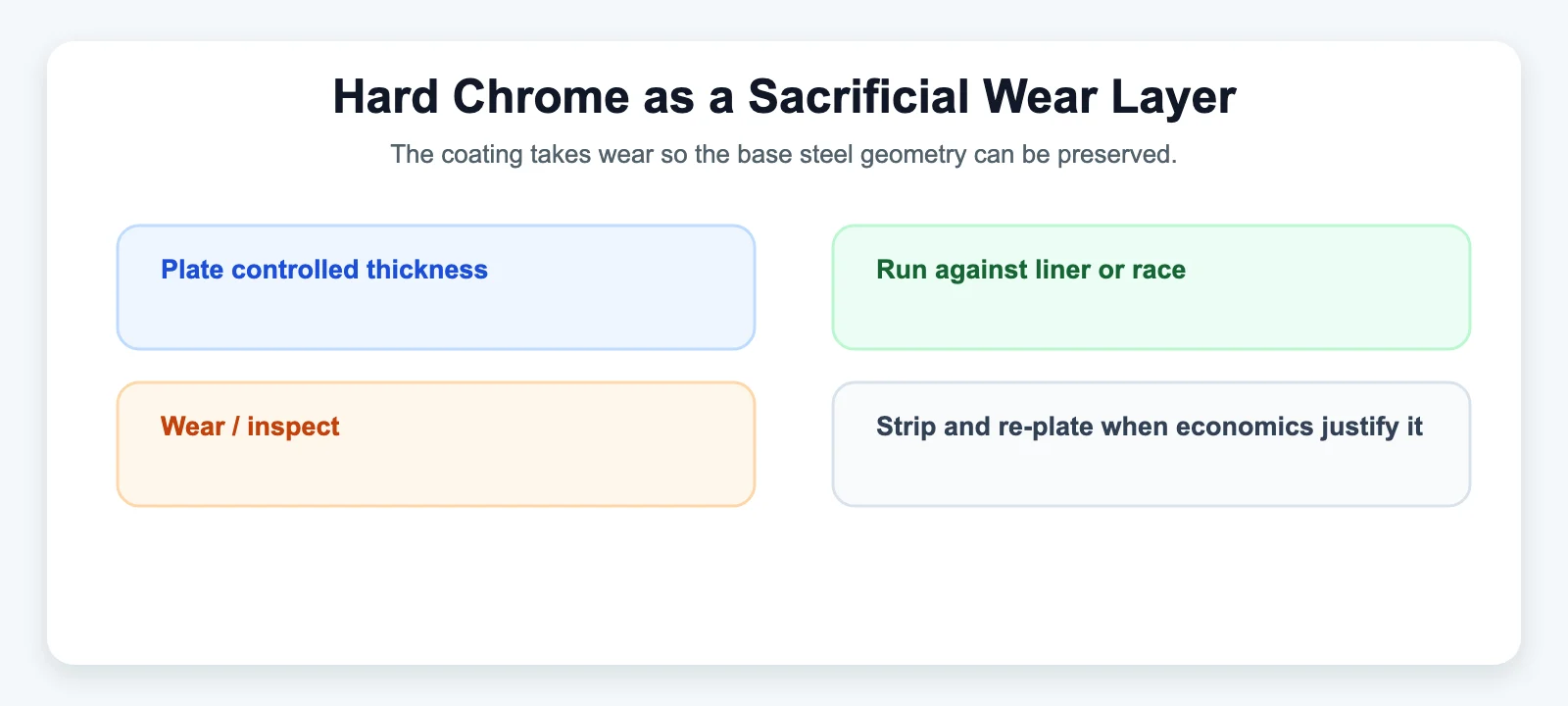
Because hard chrome can be chemically stripped without damaging the base steel, a worn plated part doesn’t have to be scrapped — it can be stripped, inspected, ground if needed, and re-plated back to original tolerance. For a rod end ball, this matters less at the individual-part level (most rod ends are replaced as a unit, not re-plated in the field) but it explains why hard chrome remains the default finish choice across the bearing and hydraulic-rod industries broadly: the coating is designed to be the wear layer, taking the damage so the load-bearing geometry underneath doesn’t have to.
Related reading: The PTFE (Teflon) Liner: How Self-Lubrication Works · How Heat Treatment Impacts Rod End Tensile Strength · What is a "self-lubricating" rod end?