
The decision to spec a stainless steel spherical bearing or rod end almost never comes down to strength — it comes down to corrosion exposure. A stainless rod end typically has a lower load rating than an equivalent chromoly part and costs more than carbon steel. You choose it because the environment will destroy anything else, not because it’s the strongest option on the shelf.
The Environments That Actually Call For It
Stainless steel rod ends are the right call when the joint faces sustained moisture, chemical exposure, or hygiene requirements that would rust or contaminate a plated carbon steel part:
- Marine and coastal environments — saltwater spray, humidity, or direct exposure where carbon steel would rust and seize the bearing within a season.
- Food, beverage, and pharmaceutical processing — frequent high-pressure washdowns with aggressive sanitizers that would pit or flake a plated finish.
- Chemical and industrial processing — ongoing exposure to mild acids, caustic cleaning agents, or solvents.
- Outdoor/exposed applications where appearance also matters — visible linkages where you don’t want a plated finish that eventually wears through.
Where stainless is the wrong call: heavy shock-load suspension or steering (chromoly’s fatigue and impact margin wins), strict weight budgets (aluminum or titanium instead), or dry indoor machinery on a budget (plated carbon steel is far cheaper and moisture isn’t a factor).
The Mistake Most Buyers Make: Treating "Stainless" as One Grade
This is where most guidance stops short. "Stainless steel" isn’t one material with one corrosion-resistance level — grade selection matters enormously, and the industry has a standard way to quantify it: PREN, the Pitting Resistance Equivalent Number.
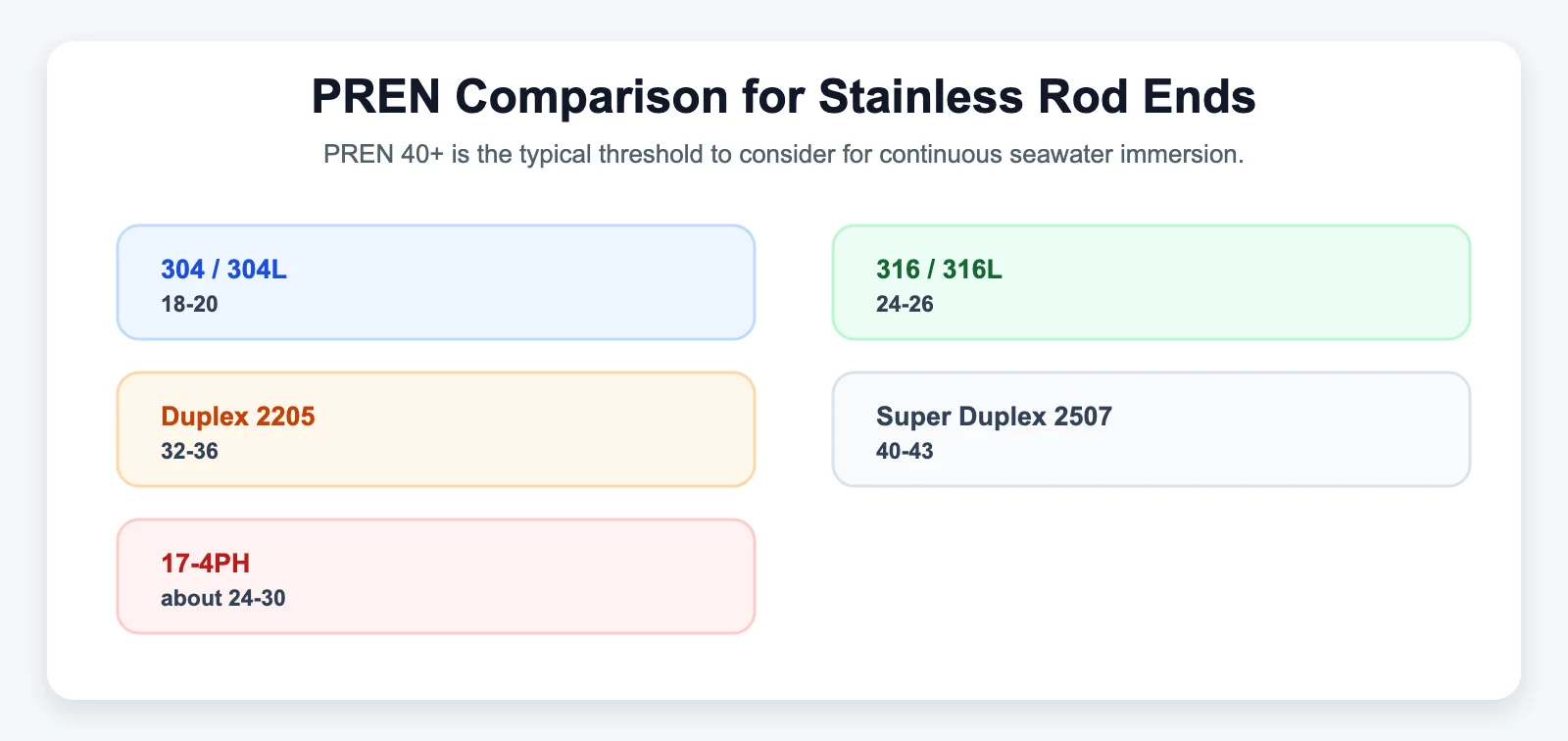
PREN = %Cr + 3.3 × %Mo + 16 × %NChromium stabilizes the passive oxide film that gives stainless its corrosion resistance. Molybdenum stabilizes that film specifically against chloride attack — which is why it’s weighted so heavily in the formula. Approximate PREN values for grades relevant to rod ends:
| Grade | PREN | Where it’s actually appropriate |
|---|---|---|
| 304 / 304L | 18–20 | Non-marine, occasional humidity only |
| 316 / 316L | 24–26 | Sheltered coastal, chlorinated washdown, freshwater with chloride contamination |
| Duplex 2205 | 32–36 | Splash zone, intermittent seawater contact |
| Super Duplex 2507 | 40–43 | Continuous seawater immersion, offshore/subsea |
| 17-4PH | ~24–30 (heat-treat dependent) | High-load marine linkages needing strength, not extra corrosion resistance |
Figures per one detailed third-party metallurgy reference (ssprofab.com); the PREN formula itself is a standard, publicly documented calculation, not proprietary to that source.
The reflexive assumption "316 = marine-grade, done" is wrong for continuous seawater immersion. 316’s PREN of 24–26 covers sheltered coastal use, splash-limited exposure, and chlorinated washdown — it’s the correct and most common choice for a large share of marine rod end applications. But for direct, continuous seawater immersion, the offshore-engineering threshold generally cited is a PREN above 40 — which puts you at Super Duplex 2507, not 316. If your application is truly submerged rather than splashed or sheltered, confirm the grade meets that threshold before assuming "stainless" solved the problem.
Why 17-4PH Shows Up in Marine Specs (It’s Not for Corrosion Resistance)
17-4PH has roughly the same PREN range as 316 — its corrosion resistance advantage over 316 isn’t the reason to spec it. The reason is mechanical: in the H900 (peak-aged) condition, 17-4PH reaches a yield strength of roughly 1,000–1,170 MPa versus about 205 MPa for annealed 316. For a high-load marine linkage where 316 can’t hit the required load rating at a reasonable cross-section, 17-4PH gets you the strength without sacrificing much corrosion performance.
One important caveat: the H900 condition should generally be avoided for seawater-exposed parts, because stress corrosion cracking (SCC) susceptibility is highest at peak strength. Overaged conditions like H1025 or H1075 sacrifice some peak strength in exchange for meaningfully better SCC resistance in chloride environments — a trade-off documented in metallurgical research on 17-4PH aging conditions. If you’re speccing 17-4PH for a marine linkage, the heat-treat condition matters as much as the alloy choice.
The Angle Almost Nobody Mentions: Rod End Geometry Accelerates Corrosion
Generic stainless-steel comparisons treat flat bar or tube stock as the reference shape. A rod end isn’t flat — it has three specific geometric features that create localized, oxygen-depleted pockets where chloride concentrates faster than it would on an open surface:
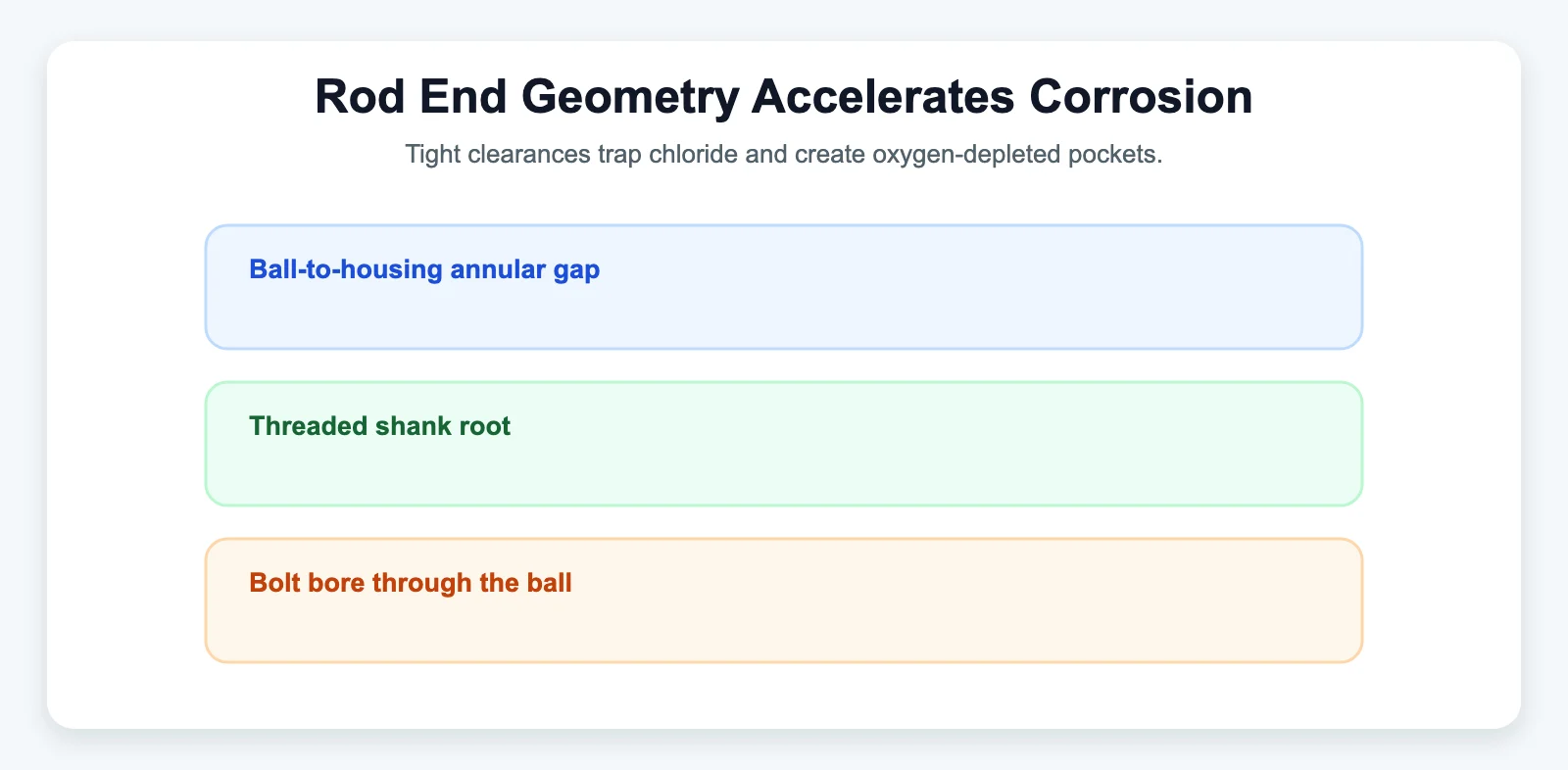
- The ball-to-housing annular gap — the narrow clearance at the bore opening where the ball meets the housing rim fills with seawater, oxygen depletes inside it, and chloride concentration builds. This is textbook crevice-corrosion geometry, which initiates at lower chloride concentrations than open-surface pitting on the same grade.
- The threaded shank root — thread roots are both stress concentrators and crevice geometry, especially where thread engagement isn’t full depth.
- The bolt bore through the ball — the clearance around a bolt passing through the ball can trap moisture, and a dissimilar-metal bolt (e.g., plated steel) creates a galvanic couple that accelerates corrosion of the fastener.
This matters practically: 316 has a crevice corrosion temperature (CCT, per ASTM G48 testing) of roughly 0°C in aggressive chloride testing — meaning a 316 rod end that would resist open-surface pitting in a given marine environment can still develop crevice corrosion at the ball-housing gap under the same conditions. PREN predicts open-surface pitting resistance; it doesn’t directly predict crevice corrosion at these tight-clearance features.
Surface Treatment Changes the Outcome — Even on the Same Grade
Two rod ends machined from identical 316 bar stock can have meaningfully different corrosion resistance depending on surface finish:
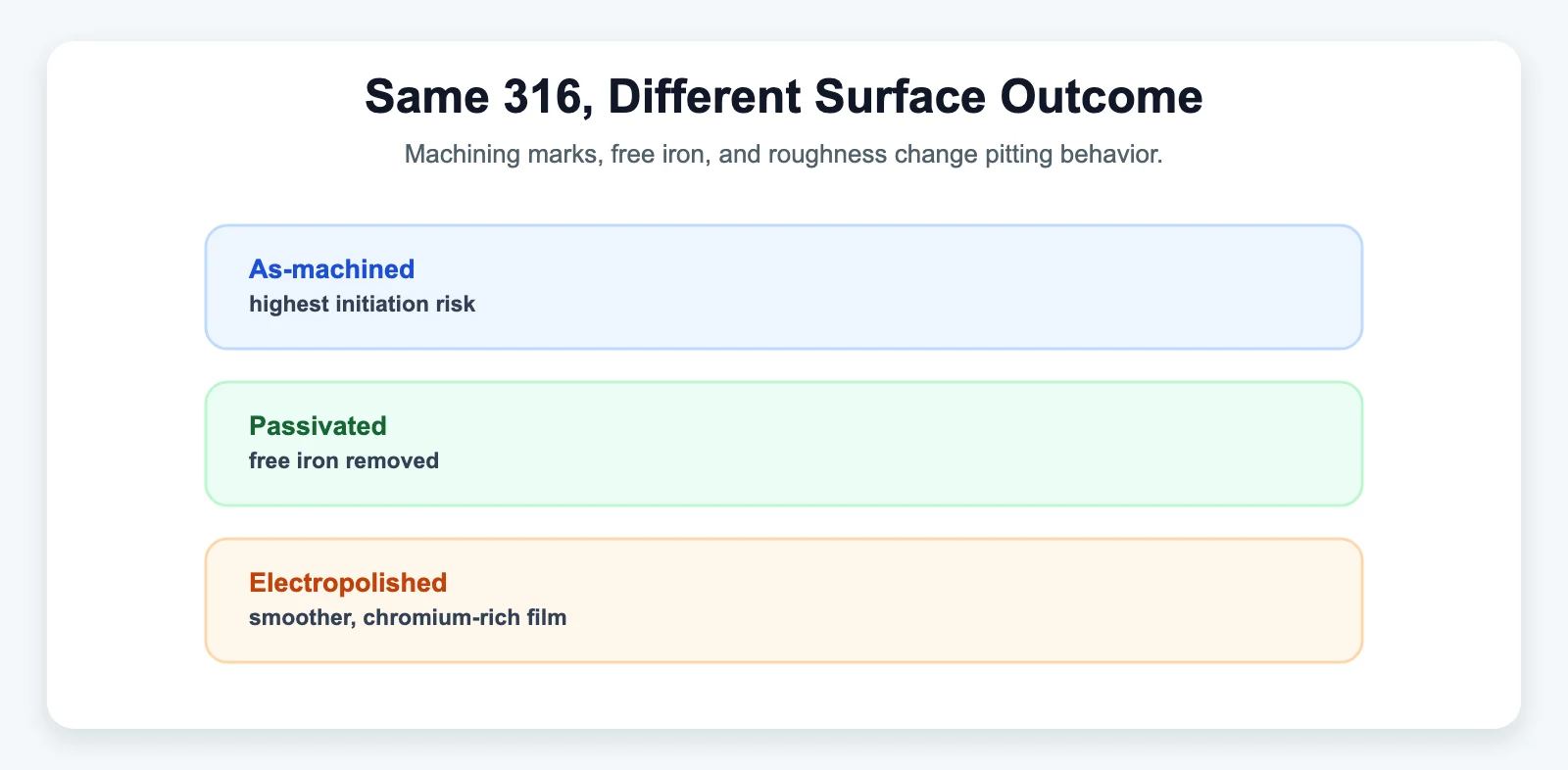
- Passivation (ASTM A967) removes free iron embedded in the surface from machining, which otherwise creates galvanic micro-cells that trigger pitting at much lower chloride concentrations. It costs very little relative to part value and is, per the source, frequently omitted from specs anyway.
- Electropolishing goes further — it smooths surface asperities, reduces pitting initiation sites, and produces a thicker, more chromium-rich passive film than mechanical polishing alone. On ball and housing bore surfaces specifically, it also reduces the micro-crevice geometry that surface roughness creates.
- Shot peening introduces compressive residual stress that doesn’t prevent pit formation but interrupts the progression from pit to stress-corrosion crack — relevant for high-cycle-fatigue marine rod ends.
If you’re specifying stainless for a marine application, ask what surface treatment the part gets — grade alone doesn’t finish the job.
The Decision, Summarized
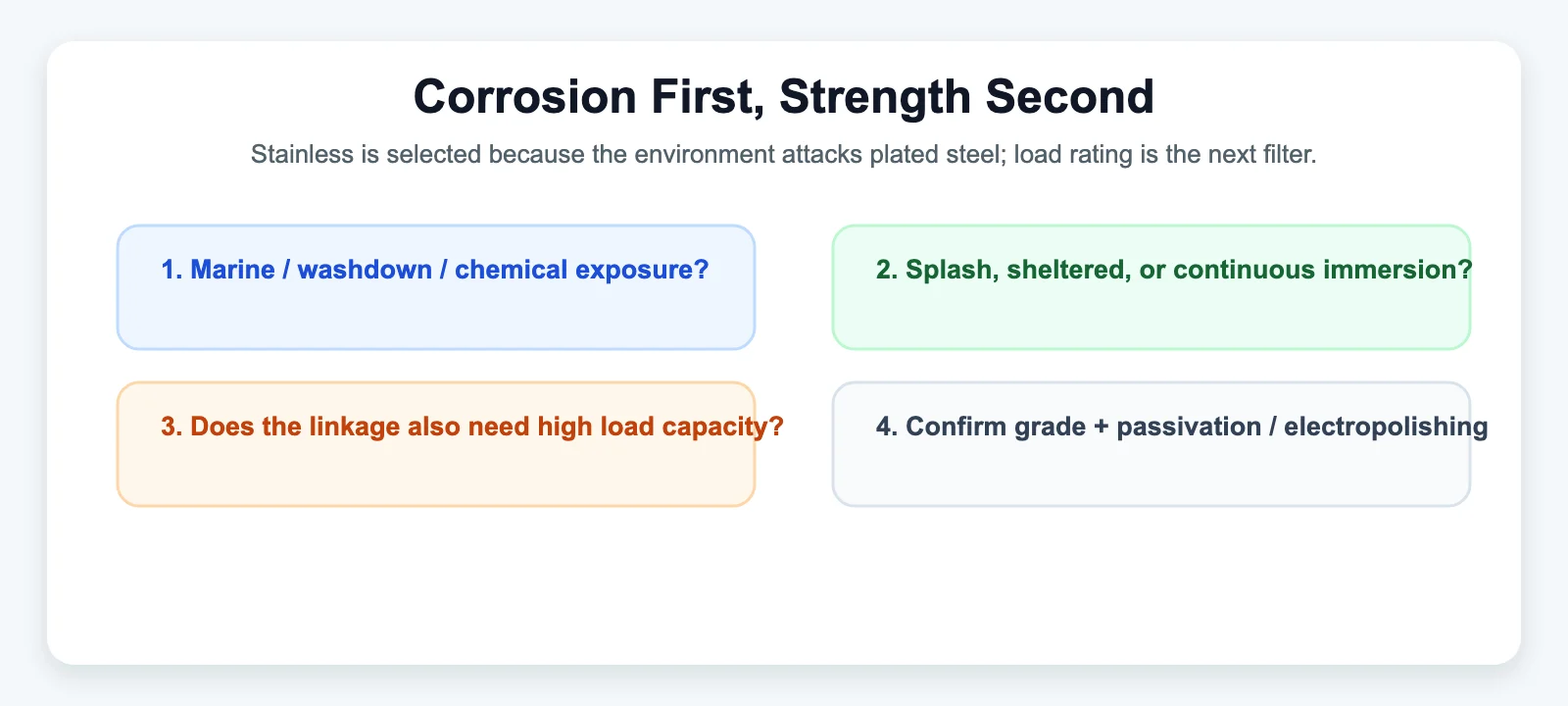
Ask these in order:
- Is the exposure marine, washdown, or chemical? If no, you likely don’t need stainless — plated carbon steel or chromoly is more cost-effective.
- If marine — sheltered/splash, or continuous immersion? Sheltered/splash → 316 is usually correct. Continuous immersion → confirm PREN 40+ (Super Duplex 2507), not 316.
- Does the linkage also need high mechanical load capacity? Consider 17-4PH in an overaged condition (H1025/H1075), not H900, for chloride-exposed service.
- What surface treatment does the quoted part actually get? Passivation at minimum; electropolishing for splash-zone or continuous-exposure ball/housing surfaces.
Related reading:Chromoly (4130) vs. Carbon Steel: Which Is Right for Your Build? · Aluminum Rod Ends: Pros, Cons, and Weight-Saving Benefits · Titanium Heim Joints: Are They Worth the Premium Cost? · Marine Applications: Preventing Seizure in Saltwater Environments