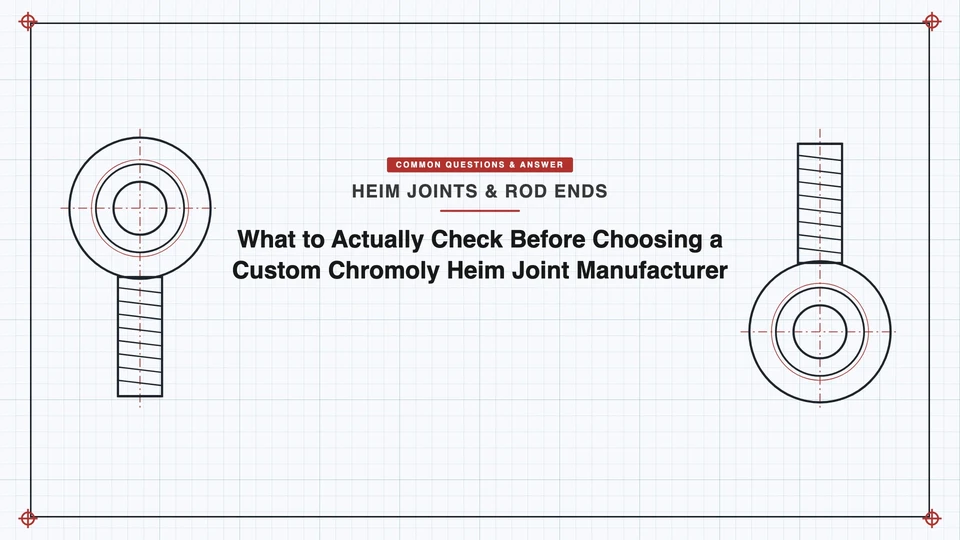
"Chromoly" on a spec sheet is not, by itself, a reason to choose one manufacturer over another. It’s a material name — and the difference between a chromoly heim joint that survives 100,000 cycles and one that doesn’t comes from what happens to that material after it leaves the mill: heat treatment, machining tolerance, race/liner selection, and whether the finished part actually matches what the spec sheet claims. This is the checklist to run before you commit to a supplier, followed by a factual look at what SYZ Machine’s own published technical pages confirm — and where they don’t say enough to draw a conclusion.
Material Traceability: Ask for the Mill Test Certificate, Not Just the Alloy Name
Any supplier can print "4130 chromoly" on a product page. The question that separates a traceable part from an unverified one is whether the supplier can produce a Mill Test Certificate (MTC) — the document that shows the actual chemical composition and mechanical properties of the specific steel heat used to make your parts, not just the nominal alloy spec.
What to ask: Can you provide a mill test certificate for this batch? Is the material sourced from a named mill, or is origin unverified?
What SYZ’s own published content confirms: SYZ Rod Ends’ chromoly product page states plainly that "material certs (mill test reports) available on request" and describes its 4130 body construction as having "no silent substitution" — language that addresses this exact question, though it’s a policy statement on the page rather than a certificate you can inspect before ordering. Confirm the actual document for your specific order before you rely on it.
Heat Treatment: Verified Per Batch, or Just "Heat-Treated"?
4130 chromoly’s strength advantage over plain carbon steel — tensile strength on the order of ~97,000 psi normalized, plus the fatigue resistance that matters for a part cycling millions of times in suspension or steering — only exists if the heat treatment was actually done correctly and consistently, batch to batch. "Heat-treated" on a spec sheet says nothing about whether every lot was verified.
What to ask: Is hardness verified per production lot, or only during initial process qualification?
What SYZ’s own published content confirms: The same SYZ Rod Ends page states that "bodies and balls [are] heat-treated to spec; hardness verified per lot" — a specific, checkable claim about per-lot verification rather than a one-time process certification. It doesn’t specify which hardness scale or acceptance range is used, so if that level of detail matters to your application, that’s a follow-up question for the quote request, not something to assume.
Custom Tooling Range: Does the Catalog Actually Cover Your Geometry?
A manufacturer that only makes one or two standard configurations will either talk you into a compromise fit or quote a long tooling lead time for anything outside their range. The useful signal here is a documented product matrix — not a claim of "we can make anything."
What SYZ’s own published content confirms: SYZ Rod Ends’ chromoly line documents seven distinct series covering different construction needs: self-lubricating 2-piece (XM/XF), 3-piece precision (JMX/JFX), heavy-duty high-misalignment (HJMX), extended-shank (XM-C), offset/eccentric body (XM-JMX-OS), and metric equivalents (JMX-M/JFX-M, MXM/MXF). SYZ Machine’s general heim joints page separately lists a size range of 10-32 to 2 in (inch) and M5 to M48 (metric), plus five body material options (chromoly, carbon steel, aluminum, stainless, titanium) and cross-reference support against FK, QA1, Aurora, Alinabal, and Midwest Control part numbers. These are specific, checkable product-catalog facts, not adjectives — worth comparing directly against your own drawing before assuming any supplier’s range covers it.
QC and Test Reporting: What’s Actually on Offer, Not What’s Implied
Beyond the mill certificate question above, a rigorous buyer also wants to know what happens during and after production: dimensional inspection method, what’s checked (thread pitch diameter, bore, radial clearance), and whether third-party test reports (salt spray, fatigue cycling) are available for the specific product line you’re buying.
This is the point where honesty about the research matters more than filling in a plausible-sounding answer: SYZ’s published chromoly and general heim joint pages confirm the mill-certificate and per-lot hardness-verification points above, but do not publish a specific list of third-party test reports (salt spray hours, fatigue cycle counts, PPAP-style documentation) for these product lines. If that documentation matters for your application — and for anything safety-critical, it should — ask for it directly as part of your quote request rather than assuming it exists because the material and heat-treat claims check out.
In-House Machining vs. Outsourced: A Question to Ask, Not an Answer to Assume
Buyers researching Chinese rod-end sourcing broadly (see our China sourcing quality control guide) consistently flag vertical integration — casting, heat treatment, grinding, and assembly happening under one roof rather than split across subcontractors — as a meaningful quality-risk indicator, because a fragmented supply chain multiplies the points where a spec can silently drift.
This is a real evaluation criterion, but it’s not one SYZ’s own published technical pages make an explicit claim about one way or the other. Rather than fill that gap with an assumption, the honest answer is: ask any manufacturer, including SYZ, directly which of the value-chain steps (casting/forging, heat treatment, precision grinding, assembly, inspection) happen in their own facility versus a subcontractor’s, and ask to see it during a factory audit if the order size justifies one.
Sample-to-Production Flexibility
A manufacturer that requires a full production commitment before you can test a single part shifts all the qualification risk onto you.
What SYZ’s own published content confirms: SYZ Rod Ends’ chromoly page states "sample quantities welcome; volume pricing scales" — confirming that sample orders are supported as a matter of policy. It does not publish a specific minimum order quantity or sample lead time on that page; for exact numbers, see our companion piece on MOQ for custom production runs or request a quote directly, since MOQ terms vary by whether the part is stock, semi-standard, or fully custom.
The Honest Summary
| Evaluation criterion | What to ask any supplier | What SYZ’s published pages confirm |
|---|---|---|
| Material traceability | Mill test certificate for this batch? | Available on request; "no silent substitution" stated |
| Heat treatment control | Hardness verified per lot? | Stated as verified per lot |
| Custom tooling range | Does the catalog cover my geometry? | 7 documented chromoly series, inch 10-32–2in / metric M5–M48, 5 body materials, cross-ref to FK/QA1/Aurora |
| QC/test reporting | Which third-party reports exist for this product line? | Not published for these lines — ask directly |
| In-house vs. outsourced machining | Which steps are done in-house? | Not stated either way on published pages — ask directly |
| Sample/MOQ flexibility | Can I order a sample before a production commitment? | Samples stated as welcome; specific MOQ not published on this page |
"Chromoly" tells you the alloy family. It doesn’t tell you whether the heat treatment was verified, whether the geometry you need is actually in the catalog, or whether the test reports you’d want for a safety-critical application exist. Run the checklist above against any manufacturer’s actual published claims — not their material name — before you decide.
Related reading: Why Off-Road Racing Prefers 4130 Chromoly Rod Ends · Heat Treatment and Rod End Tensile Strength · China Sourcing: Quality Control Standards for Rod End Manufacturing · Minimum Order Quantities (MOQ) for Custom Production Runs