
Cookie Consent Banner

Quick Answer

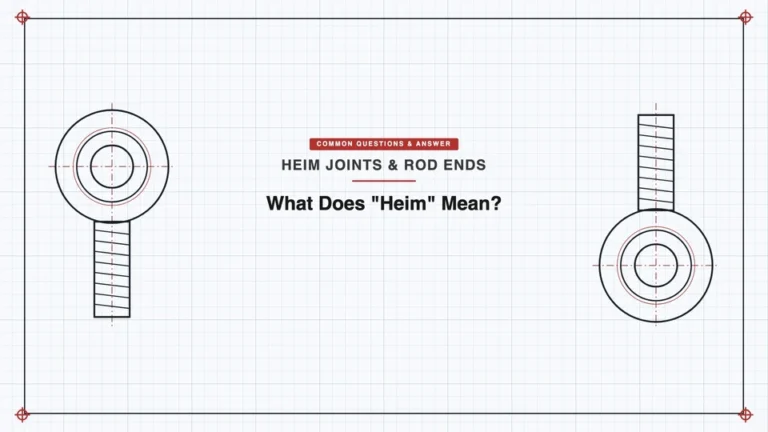
A Heim joint, or spherical rod end, is a specialized mechanical joint that allows for controlled rotational movement and angular misalignment across multiple planes. Originally developed for aircraft control systems, it consists of a spherical ball captured within a housing, providing a low-friction, zero-deflection pivot point for suspension, steering, and industrial linkages.

The origin of the spherical rod end

The joint was patented by the Heim Company during World War II to solve a specific problem in aerospace engineering: how to allow a control rod to move smoothly even when the mounting points are not perfectly aligned. Today, this design is the industry standard for any application requiring high-strength articulation.
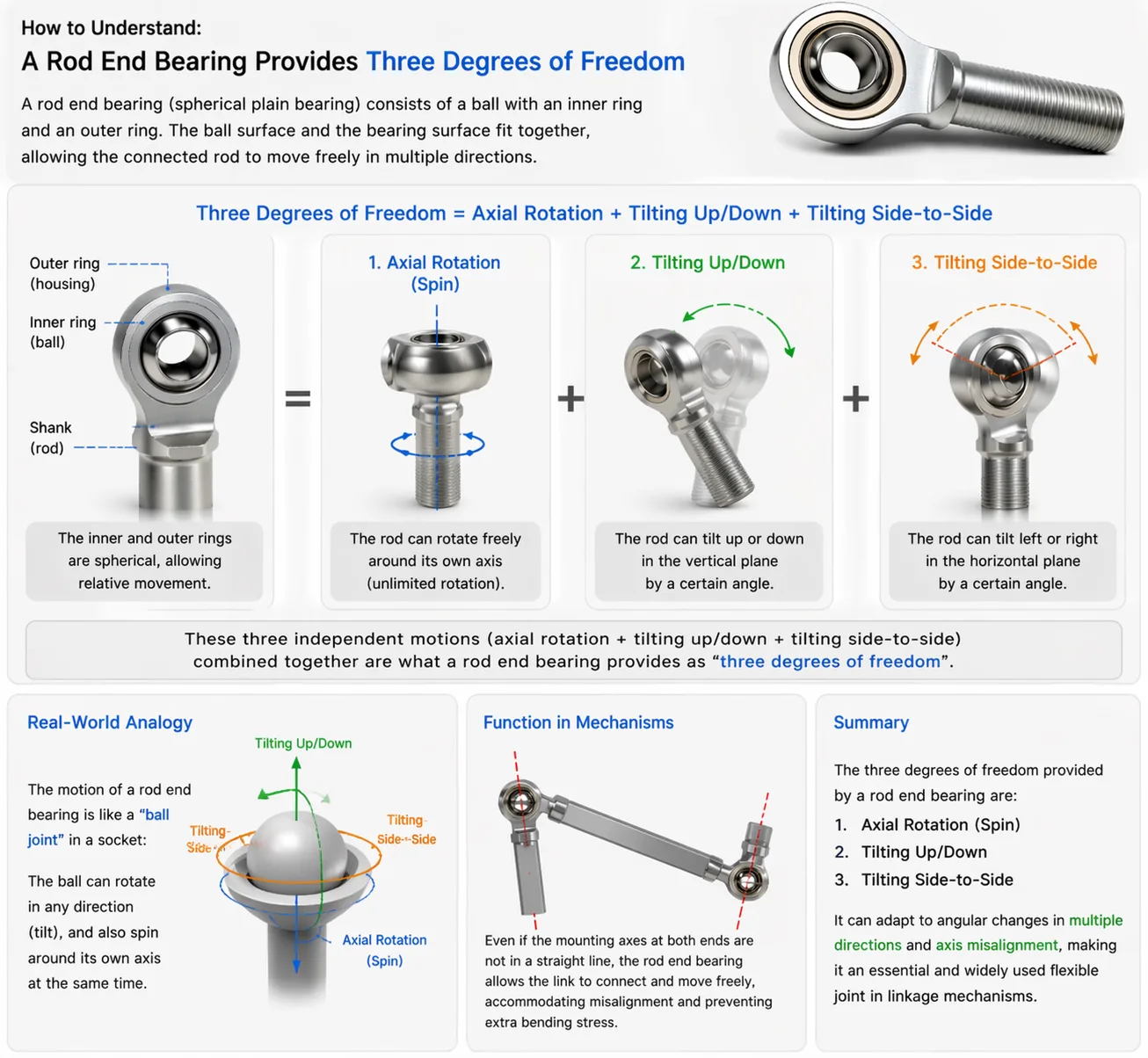
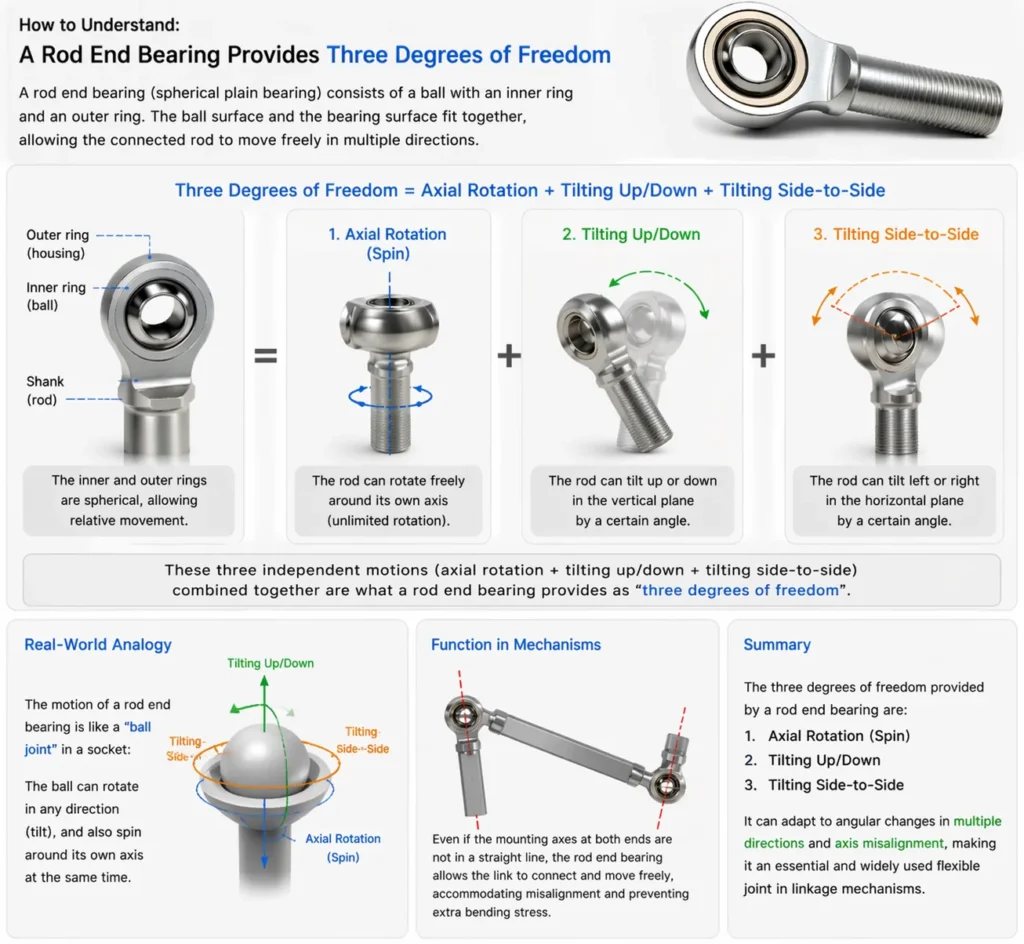
Diagram of a spherical rod end bearing showing three degrees of freedom: axial rotation (spin), tilting up/down, and tilting side-to-side, with labeled components and real-world analogy.
Rod end bearing three degrees of freedom diagram

Key mechanical characteristics

Unlike a standard ball joint or a rubber bushing, a Heim joint offers three degrees of freedom. This means the connected link can rotate around its axis while also tilting up, down, or side-to-side.

  • Precision: Because there is no rubber to compress, the joint offers "zero-deflection," which is critical for maintaining exact suspension geometry in racing.
  • Strength: A high-quality 3/4" Chromoly joint can handle over 40,000 lbs of static radial load, according to SAE J1120 testing standards.

Related Articles:

  • Heim Joint vs. Rod End vs. Rose Joint: Clearing the Confusion.
  • Anatomy of a Rod End: Understanding the Body, Ball, and Race.
  • How Heat Treatment Impacts Rod End Tensile Strength.
author avatar
Danny Ni Engineering & Mechanical Systems Writer
Danny Ni is an engineering-focused technical writer at SYZ Machine, specializing in mechanical components, linkage systems, and real-world application engineering. His work covers aftermarket vehicle parts, industrial joints, and mechanical principles, translating complex engineering concepts into practical insights for engineers, fabricators, and industry buyers.

Need custom rod ends?

Send bore size, thread size, material, load requirement, drawings, or a sample part number for engineering review.

Related products