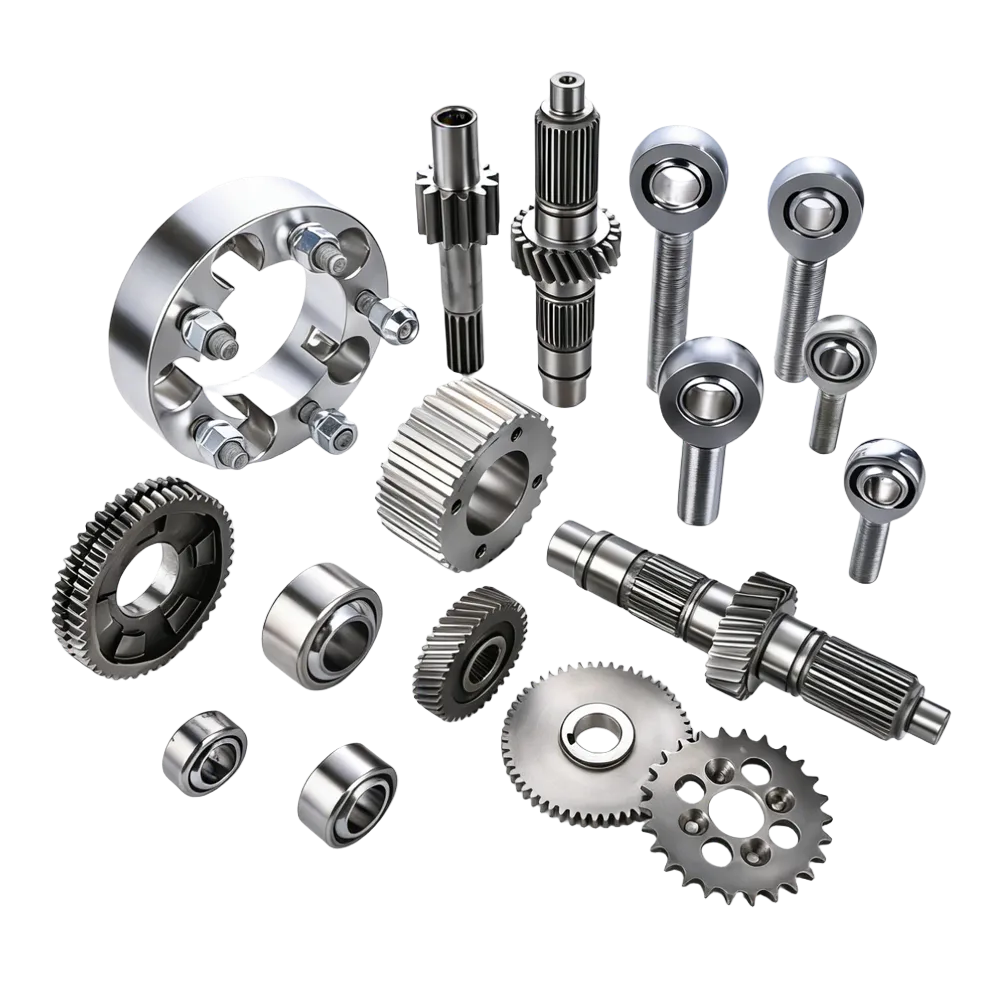

Control arm bushings are the flexible sleeves that let a control arm pivot at its frame mount while cushioning road vibration — the full definition and construction are covered in the companion piece on this hub. What's worth its own page is the part most people never think about until they're standing at a parts counter: the material a bushing is made from changes how the car feels to drive, not just how long the part lasts.
Rubber vs. Polyurethane vs. Metal — the Real Trade-off
| Material | Ride comfort | Durability | Maintenance | Best fit |
|---|---|---|---|---|
| Rubber (OEM standard) | Quiet, absorbs NVH well | Degrades faster with heat/age | None — sealed, replace when worn | Daily drivers, comfort-focused vehicles |
| Polyurethane | Firmer, transmits more road noise | More durable, holds geometry longer | Needs periodic lubrication to avoid squeaking | Street performance, light off-road, drivers who want sharper response |
| Metal ball-and-socket (Heim/rod-end style) | Harshest — transmits most NVH | Longest-lasting under load, near-zero deflection | Requires regular inspection/lubrication | Dedicated off-road or race builds, not daily commuting |
The pattern is consistent across every material on this list: stiffer and more precise always trades away ride comfort. There's no material that wins on both axes — a bushing that holds geometry perfectly under hard cornering or rock-crawling load is, by the same property, a bushing that transmits more of what the suspension is feeling straight into the cabin.
Rubber: The Default for a Reason
Factory bushings are rubber because it's the right trade-off for the vehicle's actual job — daily commuting, where quiet and comfort matter more than eliminating the last fraction of a millimeter of deflection. It's also maintenance-free: rubber doesn't need lubrication, it just wears out and gets replaced. The trade-off is that rubber softens and cracks faster under heat, road salt, and years of flex cycles than the alternatives below.
Polyurethane: The Common Upgrade
Polyurethane bushings show up most often as an aftermarket upgrade rather than an OEM part. They resist deflection better, which means the suspension geometry stays closer to spec under load — sharper, more predictable handling. The trade-off is noise: polyurethane transmits more road harshness into the cabin than rubber, and it needs periodic grease to avoid developing a squeak as it wears.
Metal Ball-and-Socket Joints: The Off-Road Extreme
At the far end of the spectrum, some off-road and race builds replace the bushing entirely with an all-metal ball-and-socket joint (a Heim joint or similar rod-end style connection). This eliminates deflection almost completely — useful when a vehicle is flexing hard over uneven terrain and any play in the joint translates directly into imprecise wheel control. The cost is NVH: metal-on-metal transmits essentially everything the suspension feels, which is why this option shows up on dedicated off-road or race builds rather than daily-driven trucks.
Between the polyurethane and full metal-joint extremes, some manufacturers also sell composite bushings that blend a synthetic elastomer with a metal sleeve, aiming for more articulation than rubber without the full harshness of a metal joint. How well any specific product actually splits that difference varies by manufacturer — that's a question for the part's own spec sheet, not a property of "composite bushings" as a category.
Which One Should You Actually Buy?
For a daily-driven street vehicle, factory-style rubber (OEM or quality aftermarket equivalent) is the right default — it's what the suspension was tuned around, and there's no handling benefit to a stiffer bushing if you're not pushing the suspension hard enough to notice the difference. Polyurethane or metal joints make sense once you're modifying the vehicle for performance driving or serious off-road use, where the handling and durability gains are worth the added noise and maintenance. Going stiffer "just because" on a vehicle that's otherwise stock usually just means a harsher ride with no corresponding benefit.
Related reading: What Is a Control Arm Bushing? · What Is a Control Arm on a Car?