
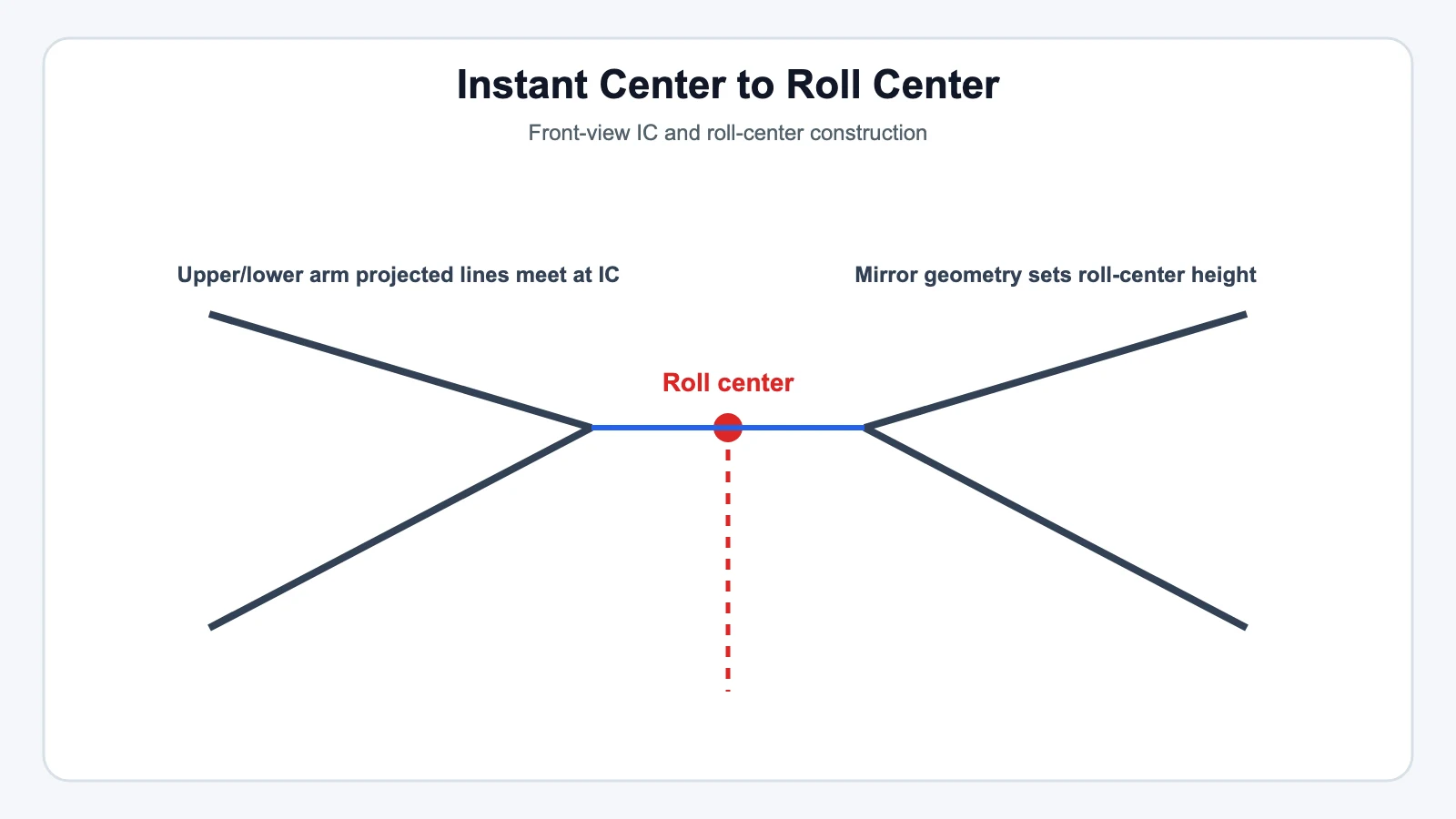
An instant center (IC) is the point where a suspension’s upper and lower control arm centerlines intersect — the virtual pivot the wheel rotates around at that specific moment of travel. A roll center (RC) is derived from it: draw a line from the IC to the tire’s contact patch, and where that line crosses the vehicle’s centerline is the roll center. Both points move as the suspension travels.
If you’re specifying or tuning link suspensions with rod ends — three-links, four-links, adjustable control arms — these two points are the geometry you’re actually controlling, whether or not you’ve been thinking about them explicitly.
Finding the Instant Center
On a double-wishbone suspension, the construction is straightforward: extend the centerlines of the upper and lower control arms until they cross. That intersection is the instant center for that side of the car. It isn’t a physical bolt or bearing — it’s a geometric construction that tells you how the wheel/upright assembly is momentarily rotating relative to the chassis.
The IC isn’t fixed. As the suspension compresses or extends, the control arm angles change, and the IC moves with them — sometimes dramatically. A MacPherson strut setup uses a similar construction (a line perpendicular to the strut axis stands in for the missing upper arm), and multi-link and three-/four-link suspensions can be reduced to the same double-wishbone logic if you know which links are doing the work.
From Instant Center to Roll Center
Once you have the IC for one side, draw a line from it down to the center of that tire’s contact patch. Do the same for the opposite side. Where the two lines cross — normally on the vehicle’s centerline, if the suspension is symmetrical — is the roll center. The vertical distance from that point to the ground is the roll center height.
This matters because the vertical gap between the roll center and the vehicle’s center of gravity (CG) creates a lever arm — the roll moment arm. Cornering force acts at the CG; the suspension resists it at the RC. The longer that arm, the more leverage the cornering force has to roll the chassis, and the harder your springs and sway bars have to work to control it.
Why Roll Center Height Isn’t "Higher Is Always Better"
A higher roll center shortens the roll moment arm and reduces body roll — that part is intuitive. What’s less obvious is that raising the RC too far introduces a different problem: jacking.
Engineer Huibert Mees (who worked on the Tesla Model S and Ford GT suspensions) lays out the mechanism clearly in a widely cited explainer: think of the suspension, at any instant, as a single imaginary link running from the tire contact patch to the instant center. When cornering force pushes the contact patch inward, and that imaginary link sits at a steep angle, part of that force gets redirected into standing the link upright — which pushes the chassis up on that corner instead of just compressing the suspension. The math is simple trigonometry:
Jacking Force = Cornering Force × sin(roll center line angle)
The classic real-world failure case is the swing-axle rear suspension used on early VW Beetles and Triumph Spitfires — a design with an inherently very high roll center. Under hard cornering, the outside wheel would tuck under the body and the chassis would jack itself upward, sometimes staying jacked up even after the driver straightened the wheel. That’s the extreme version of the trade-off every roll-center decision involves: lower RC means more body roll to manage with springs; higher RC means less roll but a growing jacking tendency you have to watch for.
Roll Center Migration: It’s Not a Fixed Point
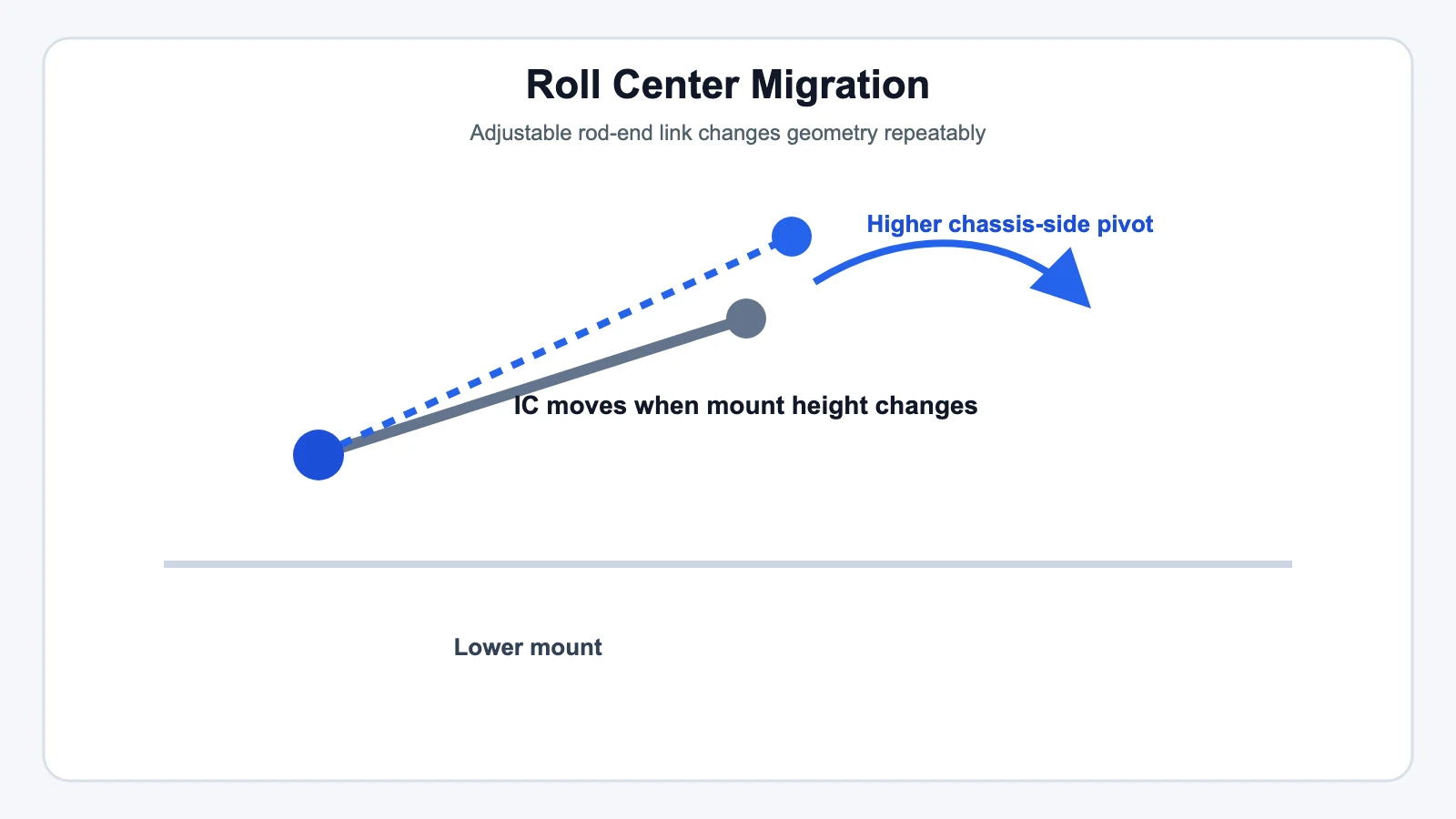
A roll center calculated at static ride height is only a snapshot. As the suspension moves through bump, droop, and body roll, the IC on each side shifts independently — and because the RC is where the two sides’ contact-patch-to-IC lines cross, it moves too. During body roll specifically, the outside and inside instant centers move in opposite directions, so the two roll-center lines can cross at a noticeably different point than they did at rest.
Suspension tuners active in the hpacademy.com forum’s suspension-tuning discussion converge on a practical rule of thumb: you generally want the roll center to move up and down with ride height (it gives you a way to shift handling balance via ride height/rake), but you want to minimize how far it migrates side-to-side as the car rolls. Large side-to-side migration makes the car’s roll behavior inconsistent and harder to predict from one corner to the next — it’s a bigger practical concern for most builders than the static RC height number itself.
Solid Axle vs. Independent Suspension
The jacking problem above is specific to independent suspension, where each side can move on its own. A solid (live) axle doesn’t have that failure mode — both wheels are rigidly connected by the axle tube, so one side can’t tuck under the body independently of the other. That means a solid-axle roll center can sit much higher without introducing jacking.
Per Mees’s explainer, solid-axle roll centers typically run roughly 3–4 times higher than a comparable independent suspension’s. Treat that as an engineer’s working estimate from one technical article, not an industry-standard figure — the exact ratio depends heavily on the specific axle and spring geometry.
Instant Center vs. Roll Center, Side by Side
| Instant Center (IC) | Roll Center (RC) | |
|---|---|---|
| What it represents | Virtual pivot for one side’s suspension at a given instant | Point where lateral cornering force is reacted into the sprung mass |
| How it’s found | Intersection of extended control-arm centerlines | Line from IC to contact patch, intersected with vehicle centerline |
| Moves with travel? | Yes, continuously | Yes — both height (bump/droop) and lateral position (roll) |
| Primary design use | Camber gain, track change, kinematics | Roll moment arm, jacking behavior, front/rear handling balance |
| One important caveat | Two definitions exist — SAE’s force-based roll center isn’t always the same point as the geometric/kinematic one most builders calculate by hand |
Why This Matters for Rod-End Suspensions
Every time a rod end, heim joint, or adjustable link changes a control arm’s mounting angle, it moves that side’s instant center — and therefore the roll center. That’s the whole mechanism behind roll-center tuning with adjustable link suspensions, which is a separate, more practical question from the concepts covered here.
Related reading: Tuning Your Rig: Adjusting Roll Center Height With Rod Ends