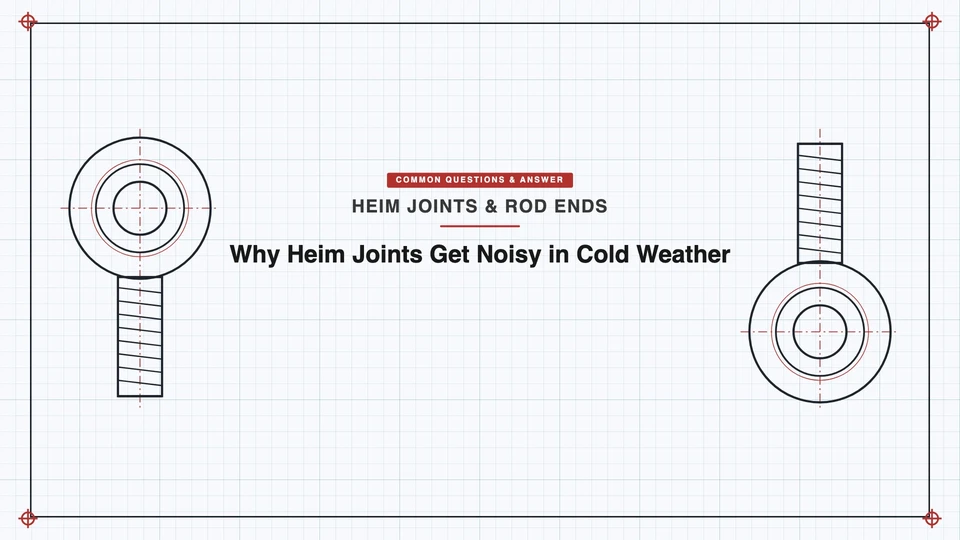
Cold weather doesn’t create a new problem in a Heim joint — it makes an existing one impossible to ignore. The same clearance that stays quiet in warm weather, when lubricant flows easily and materials are slightly expanded, turns into a sharp knock once temperatures drop, materials contract, and lubricant thickens. If your Heim joints have gone from silent to noisy the moment winter arrived, the cold is exposing wear that was already there, not causing damage from scratch.
Four Things Happening at Once in Cold Weather
1. Road salt and slush act like sandpaper. Most performance Heim joints are unsealed by design — there’s no boot protecting the ball-and-race interface the way there is on a factory tie rod end. Winter brings road salt, brine, and slush directly into that exposed clearance. As the moisture evaporates or freezes, it leaves salt crystals behind, and those crystals grind against the ball and race surfaces every time the joint articulates.
2. Freeze-thaw cycles trap and expand ice inside the joint. Water that works its way into the tight clearance between the ball and race can freeze there. Ice takes up more volume than water, so it physically resists the ball rotating freely. Forcing the joint to move against that trapped ice is what produces the sharp popping or snapping sound some owners describe — it’s the ice breaking apart under load, and each cycle chips a little more at the liner underneath.
3. PTFE (Teflon) liners stiffen in the cold. Self-lubricating PTFE-lined joints depend on the liner staying pliable enough to do its job. Extreme cold causes the liner material to stiffen and lose some of its natural lubricity. Once road grit works its way into a hardened liner, wear accelerates quickly, and the end state is metal-on-metal contact — which produces a heavier, more clunk-like noise than the earlier stages of wear.
4. Wet grease thickens and stops flowing. On joints lubricated with traditional grease rather than a PTFE liner, cold temperatures make the grease thick and sluggish. Instead of coating the contact surfaces as the joint moves, thick grease gets pushed aside, leaving the ball and race running dry — and dry metal-on-metal contact is loud.
Is This Normal, or Is the Joint Actually Wearing Out?
This is the question that actually matters, and cold weather makes it harder to answer by feel alone:
- Likely just cold-weather stiffness: a light, occasional creak or tick on the first few minutes of driving after the vehicle has sat in the cold, especially on an exposed race-style joint, without any detectable play when you check it by hand.
- Likely actual wear: a persistent, worsening clunk that shows up on every bump, doesn’t fade once things "warm up," or comes with detectable radial play when you grab the link and check for movement.
The second category doesn’t go away in spring — it just becomes less obvious once warmer temperatures and better-flowing lubricant mask it again, until the same joint gets noisy the following winter, usually worse than before. Checking for play now, while the noise is impossible to miss, is a better time to catch a wearing joint than waiting for a warm-weather false sense of security.
What Helps
- Clean off road salt and grit rather than letting it sit in the joint through the winter — this addresses the sandpaper effect directly.
- Use a dry PTFE or silicone lubricant, not wet grease, on exposed or PTFE-lined joints. Wet grease thickens in the cold and attracts the grit that causes the wear in the first place; a dry film lubricant stays functional across a wider temperature range.
- Add a protective boot or seal if the joint doesn’t already have one — this is the most direct way to stop road salt and meltwater from reaching the race at all.
- Check for measurable play, not just noise, before deciding the joint is fine to run through another winter.
The full cleaning and dry-lubrication procedure — including why wet grease is the wrong call on a PTFE-lined joint — is covered in more depth in Best Dry Lubricants for Open Heim Joints and Maintenance Interval: How Often to Grease Metal-to-Metal Joints.
One aftermarket manufacturer, JeePerf, has described experimenting with a hybrid spherical bearing design and rubber-wrapped misalignment spacers specifically to cushion this kind of impact noise on larger and smaller joints, respectively — worth noting as one company’s product design direction, not as an independently validated engineering standard across the industry.
Related reading: Best Dry Lubricants for Open Heim Joints · Maintenance Interval: How Often to Grease Metal-to-Metal Joints · How to Check for Excessive Play in a Spherical Bearing