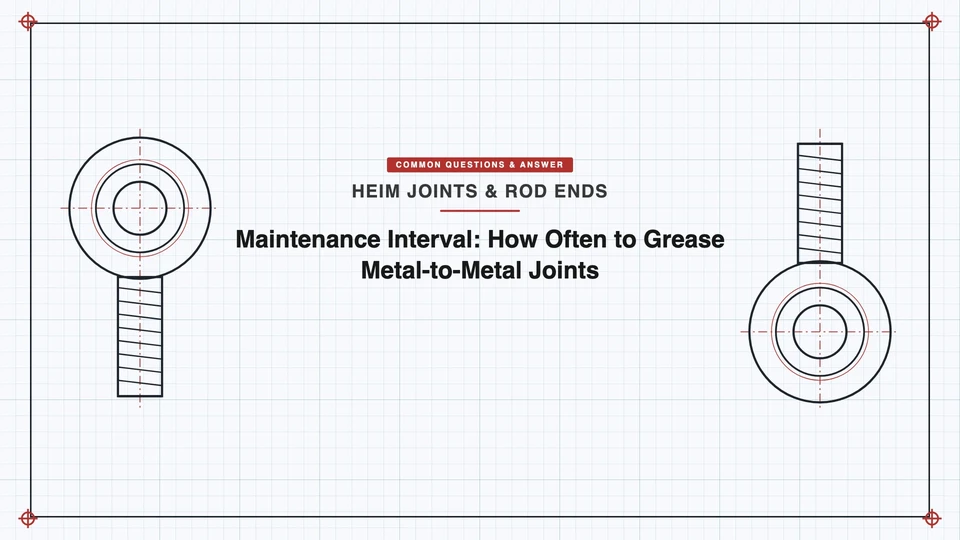
This only applies to metal-on-metal (non-PTFE) Heim joints — if yours has a PTFE liner, grease is the wrong move entirely; see The Lubrication Myth: Why You Should Never Grease PTFE-Lined Joints instead. For a metal-on-metal joint, though, the calculus flips: the ball rides directly against the race with no liner to fall back on, so a grease film is the only thing standing between normal wear and galling. The question is how often to renew it.
There’s No Single Number, and Every Source Agrees On That
Ask three different technical sources for "the" greasing interval and you’ll get three answers that all start the same way: it depends. Load, sliding/oscillation speed, and environmental exposure (dust, water, temperature) each independently shift how fast a grease film breaks down inside the joint. A joint on a daily-driven street rig, a competition crawler, and an industrial linkage all wear through their grease film at different rates even if they’re mechanically identical parts — so a single mileage or calendar number that fits every application doesn’t exist and shouldn’t be treated as if it does.
That said, "it depends" isn’t useful by itself. Below is a starting-point reference, organized by how close each figure’s source is to an actual Heim joint use case.
Starting-Point Reference by Application
| Application | Interval | Source type |
|---|---|---|
| Automotive chassis (tie rods, ball joints, steering joints — closest analog to a metal-on-metal steering/suspension Heim joint) | 3,000–4,000 miles, tied to oil change interval | Industry-standard DIY/retail guidance (eBay Motors), not a specific manufacturer spec |
| Heavy equipment pins/pivots (excavators, loaders) | 8–50 operating hours depending on machine and duty | Cross-industry reference range, not rod-end specific |
| Industrial machinery bearings | 500–2,000 operating hours | Cross-industry reference range, not rod-end specific |
| Trailer axles / marine hardware | Every 12 months or 10,000 miles | Cross-industry reference range, not rod-end specific |
| Light mechanical / low-duty pivots | Every 6–12 months | Cross-industry reference range, not rod-end specific |
Treat every row except the first as an order-of-magnitude reference, not a spec — none of the sources behind those numbers were testing a rod end. The automotive chassis figure is the closest real-world analog because tie rod ends and ball joints share the same basic exposure profile as a steering or suspension Heim joint: greaseable metal-to-metal joint, road grit and moisture exposure, cyclic loading. If your Heim joint sees a genuinely different duty cycle — a shift linkage that barely moves versus a steering joint that articulates constantly — shift your own interval accordingly rather than defaulting straight to the automotive number.
A Closer-to-Home Data Point, With a Caveat
SYZ Machine’s sister site has published a specific interval for a related but structurally different product: Johnny Joints (a rebuildable joint with a replaceable bushing, ball, and snap ring — not a solid Heim joint). That guidance recommends greasing every 10,000–15,000 miles or 2–3 times per year, using a moly-based grease rather than full-synthetic lithium. See How Often and How to Grease a Johnny Joint for the full writeup. The number is worth knowing, but don’t import it directly to a standard metal-on-metal Heim joint — the two designs wear differently (a Johnny Joint’s bushing and snap ring take load in a way a solid rod end’s ball-and-race doesn’t), so the interval that’s right for one isn’t automatically right for the other.
The Signs Are More Useful Than the Number
Use condition indicators rather than relying on a fixed mileage interval: these warning signs can show when a metal-to-metal joint needs fresh grease:
- New or increasing noise — squeaking, grinding, or a dry-sounding click during articulation
- Increased play or looseness in the joint compared to when it was last serviced
- Grease that’s visibly dirty, dark, or hardened when you wipe the fitting before greasing
- Grease weeping or leaking from the joint or its boot outside of a normal purge
If any of these show up well before your calendar/mileage interval is due, that’s the joint telling you the interval is too long for its actual conditions — shorten it rather than waiting out the schedule.
Grease Type Matters As Much As Frequency
Molybdenum disulfide (moly) grease is the commonly recommended choice for high-pressure, high-load metal-to-metal joints — it’s formulated to hold up under extreme pressure and temperature swings, which is exactly the loading profile a suspension or steering Heim joint sees. Standard lithium-based grease is fine for lighter-duty applications but can perform poorly under sustained heavy load, consistent with the guidance in the Johnny Joint article referenced above. If you’re unsure which to use, moly is the safer default for anything load-bearing.
Adjust From There
Shorten the interval for: heavy load, frequent full-range articulation, off-road/dusty/wet exposure, high ambient temperature. Lengthen it only if inspection consistently shows clean, uncontaminated grease and no play — don’t extend the interval just because nothing’s failed yet; extend it because the evidence says the joint doesn’t need service that often.
Related reading: The Lubrication Myth: Why You Should Never Grease PTFE-Lined Joints · Can Over-Greasing Damage Your Rod Ends? · Understanding "Dry-Start" Wear in Rod Ends · Best Dry Lubricants for Open Heim Joints · How Often and How to Grease a Johnny Joint