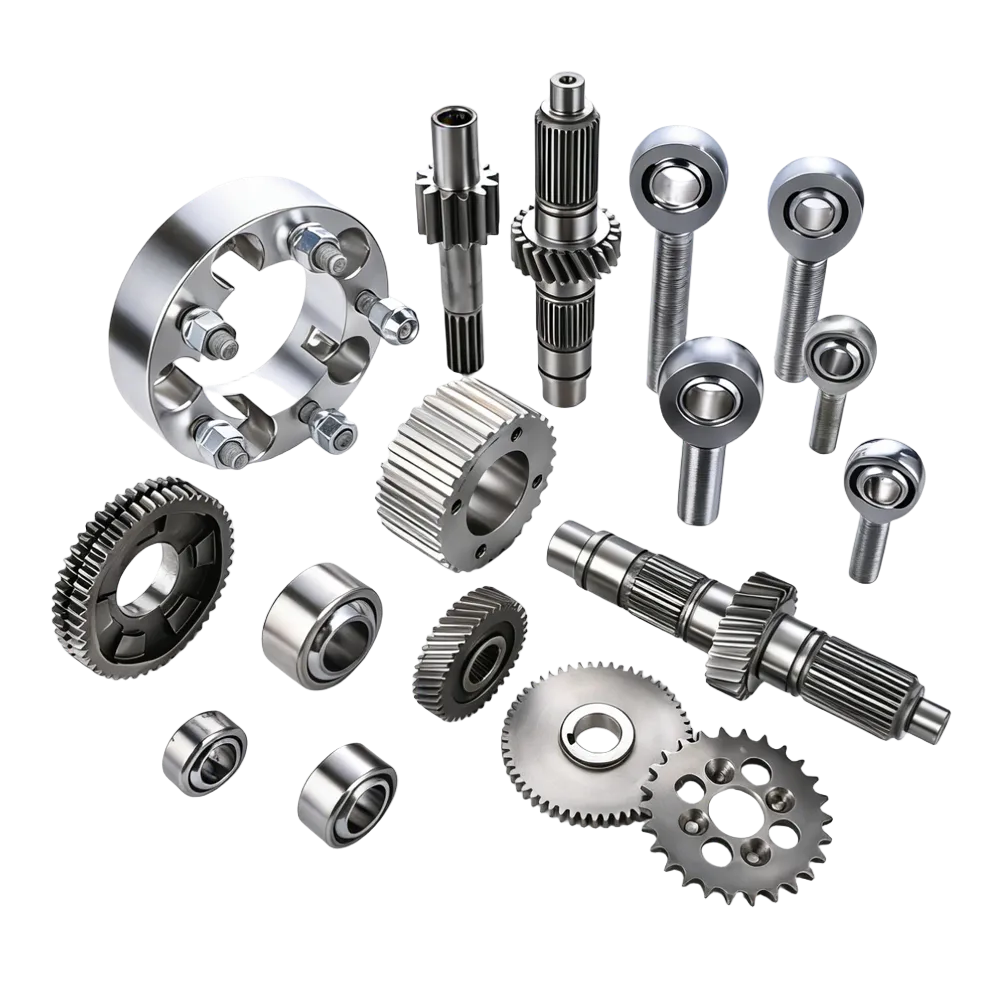
These three setups solve three different geometry problems, not three tiers of the same upgrade. An extended ball joint corrects a height change you already made. An adjustable ball joint or control arm fixes an alignment range you never had to begin with. A ball joint delete swaps the whole joint design because a standard ball joint can't survive the load case you're putting it in. None of the three is a blanket upgrade — on a vehicle at stock ride height with no oversized tires, most people don't need any of them.
What Each One Actually Fixes
| What it changes | The problem it solves | When it's actually needed | |
|---|---|---|---|
| Extended ball joint | Stud length/offset only | Restores roll-center height and control-arm angle that a lift or lowering job pushed out of spec | Only after a height change that visibly altered the arm's resting angle |
| Adjustable ball joint / control arm | Effective arm length, or an eccentric/sliding mount | Adds camber/caster adjustment range the factory design doesn't have | Only if the vehicle lacks factory alignment adjustment and measured camber/caster is genuinely out of range |
| Ball joint delete | Replaces the ball-and-socket design entirely with a spherical bearing (uniball) | Eliminates the play and pull-out failures a standard ball joint develops under oversized tires and repeated hard impacts | Mainly 35"–40"+ tires on a solid axle, dedicated off-road/rock-crawling use — not a daily-driver upgrade |
Extended Ball Joints: Correcting a Height Change, Not Upgrading Anything
When a vehicle is lowered, the lower control arm can end up close to horizontal or even angled upward toward the chassis — geometry it was never designed to run at. An extended ball joint has a longer stud than the factory part, which moves the effective pivot point back down and restores something closer to the original roll-center height and control-arm angle. It's a correction, not a performance part: a stock-height vehicle gains nothing from one.
Adjustable Ball Joints / Control Arms: Filling a Gap the Factory Left
Some platforms — solid-axle Jeeps, older Ford trucks, non-adjustable strut cars — simply don't have factory alignment adjustment built in. An adjustable ball joint (offset stud, eccentric housing, or sliding mount) or an adjustable control arm gives an alignment shop something to actually turn when camber or caster is out of spec, especially after a lift or a suspension change that moved things outside the factory range. If the vehicle already has factory adjustment slots or an aftermarket adjustable arm doing this job, adding a second adjustable joint on top doesn't add anything.
Ball Joint Delete: Trading Sealing for Load Capacity
A standard ball joint's telescoping stud-in-socket design is built for moderate angular movement and mostly compressive load. Push it past that — 35"+ tires on a solid axle, sustained rock-crawling impacts, aggressive wheel offsets — and the stud starts flexing, pulling apart under tension, or wearing out fast. A ball joint delete kit replaces that design with a fixed spherical bearing (uniball) captured in a pressed-in steel sleeve: once the outer cup is installed, you never press a joint out again — the inner wear bearing swaps with basic hand tools in minutes.
What it costs you: a spherical bearing has no equivalent to a ball joint's rubber boot, so mud, sand, water, and road salt reach the bearing surface directly. On a daily-driven vehicle in a wet or salted climate, that means more frequent cleaning and lubrication than a sealed ball joint ever needed — which is exactly why this setup is a poor fit for daily driving and a good fit for dedicated off-road builds where the maintenance trade is already accepted.
The Failure Mode That Applies to All Three
Swapping one component without checking the rest of the geometry is the most common way any of these setups goes wrong. An extended ball joint changes arm angle without necessarily correcting tie-rod length, which can introduce bump-steer that wasn't there before. A ball joint delete installed so the bearing takes load in bending rather than straight through its axis will fail faster than the factory joint it replaced — the same loading-direction mistake that shows up in heim joint installations generally (see Press-Fit vs. Bolt-On Ball Joints for how mounting method and load path interact). Any of these three is a system-level change, not a drop-in single-part swap — check the rest of the linkage geometry at the same time, not after something starts clunking.
The Decision, Stated Plainly
- Vehicle at stock ride height, no oversized tires, alignment within spec: none of the three. There's no problem to correct.
- Lifted or lowered, and control-arm angle or roll-center height visibly changed: extended ball joint is the fix that matches the problem.
- Camber/caster measurably out of range and no factory adjustment exists: adjustable ball joint or control arm, sized to the actual amount of correction needed.
- 35"+ tires on a solid axle, dedicated rock-crawling or desert-running use, and you're already accepting a higher maintenance routine: ball joint delete is solving a real load problem a standard ball joint structurally can't handle. On a daily-driven rig in a wet/salted climate, it's usually the wrong trade.
For the underlying mechanical reason a spherical bearing behaves so differently from a sealed ball joint in the first place, see Ball Joint vs. Heim Joint vs. Spherical Bearing vs. Bearing.
Related reading: Ball Joint vs. Heim Joint vs. Spherical Bearing vs. Bearing: How They're Actually Related · Press-Fit vs. Bolt-On Ball Joints: Does It Determine Whether You Need a Press?