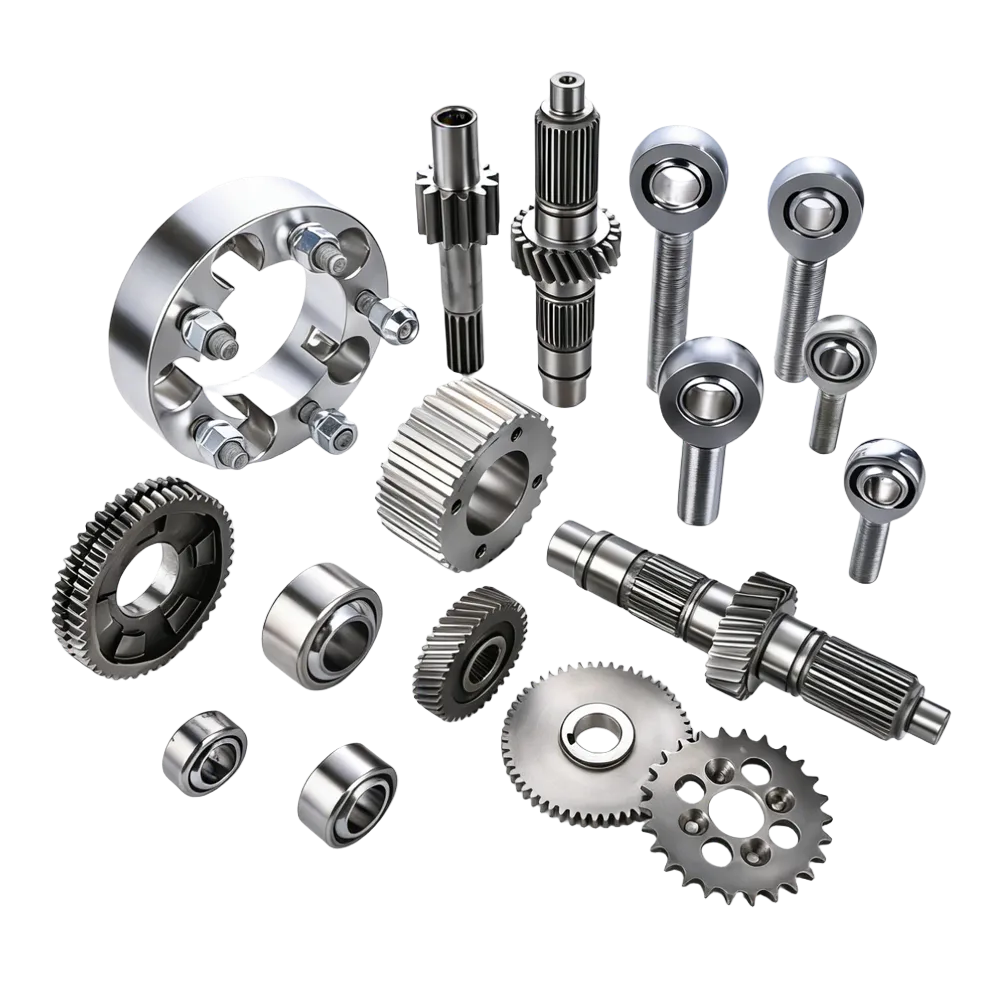
A heim joint (rod end) and a ball joint are both ball-and-socket connections, but they're not the same part and they're not interchangeable. A ball joint is a sealed, cushioned joint built into a vehicle's suspension to connect a control arm to the steering knuckle. A heim joint is an exposed, rigid rod-end bearing — a threaded body with a ball riding directly against a metal or PTFE-lined liner — used mainly on custom linkages, steering setups, and race/off-road builds where precision matters more than long-term sealing.
What Each One Actually Looks Like
| Ball Joint | Heim Joint (Rod End) | |
|---|---|---|
| Core structure | Steel ball on a stud, seated in a cushioned socket (rubber/nylon-lined) | Steel ball rotating against a rigid liner — metal-on-metal or PTFE composite |
| Sealing | Rubber dust boot, packed with grease | Usually exposed, no boot |
| Where it's found | Factory suspension — connects control arm to steering knuckle | Custom linkages, tie rods, radius arms, steering arms on off-road/race builds |
| Mounting | Pressed or bolted into a control arm; not adjustable | Threaded body — screws in/out for length adjustment, locked with a jam nut |
| Ride feel | Smoother, quieter — the cushioned socket absorbs some deflection | More direct — less deflection means sharper, more immediate feedback |
| Impact strength | Higher — sealed housing handles hard hits (rocks, curbs) better | Lower — exposed bearing surface is the weak point under impact |
| Maintenance | Low — sealed and greased, often for the life of the part | Higher — exposed to dirt and grit, needs regular cleaning/lubrication |
Where You'll Actually Find Each
Ball joints are standard equipment on virtually every factory vehicle's front suspension — that's their job, and it's why they're built for long, low-maintenance service life under a rubber boot. Heim joints show up where someone has deliberately traded that sealed durability for precision and adjustability: 4-link suspensions, custom tie rods and steering arms, race and rock-crawling builds, and any application where a fabricator wants to fine-tune geometry with a threaded rod end rather than swap a fixed-length factory part.
The Common Misconception: "Heim Joints Are Just Tougher"
It's a common assumption in off-road and racing circles that a heim joint, being all-metal and exposed, must be the stronger part. Independent sources — including off-road parts suppliers with no reason to favor one over the other — say the opposite: ball joints generally outperform heim joints on raw impact strength, even oversized heim joints. The sealed, cushioned design that makes a ball joint less precise is the same design that lets it absorb a hard hit without the bearing surface or housing taking the damage directly. Heim joints win on precision and adjustability, not on toughness.
If You're Deciding Which One You Need
For a daily-driven vehicle or anything that takes regular hard impacts without a maintenance schedule to match, a ball joint's sealed durability is the right call — which is exactly why it's the factory default. A heim joint earns its place when steering or linkage geometry needs to be precisely tunable, when suspension travel is large enough that a fixed joint risks binding, or on a dedicated race/competition build where the extra cleaning and inspection is an accepted cost of the precision gained.
SYZ Machine (through its rod ends line, SYZ Rod Ends) manufactures heim joints for exactly this kind of application — custom linkages and steering setups where adjustability and geometry control matter more than sealed, maintenance-free service life. If your build is at the point of choosing between the two, that's the real trade-off to weigh, not which part sounds tougher.
Want the Deeper Technical Breakdown?
This article covers the basics — what each part is, where it's used, and the core trade-off. If you're specifically weighing a heim joint against a ball joint for a steering application and want the mechanics of why a heim joint tracks steering input more precisely (deflection under load, angular misalignment range, and real-world angle examples), see SYZ Machine's deeper technical comparison: Precision Response: Why Heims Beat Standard Ball Joints in Steering. And if the part you're actually comparing a heim joint against is a tie rod end rather than a suspension ball joint, see Heim Joint vs. Tie Rod End.
Related reading: What Is a Ball Joint on a Car? · What Does the Lower Ball Joint Do? · Precision Response: Why Heims Beat Standard Ball Joints in Steering (SYZ Machine) · Heim Joint vs. Tie Rod End (SYZ Machine)