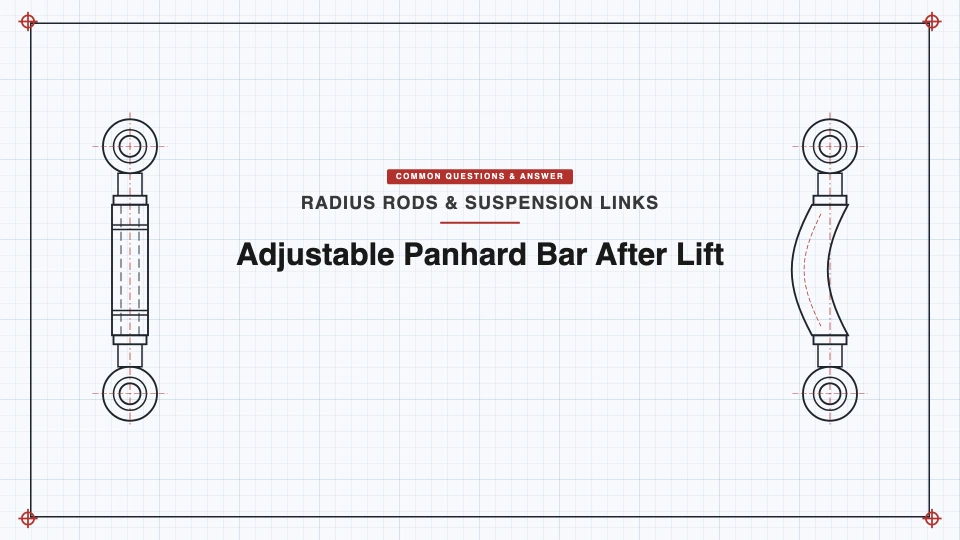
This only applies to solid-axle (live-axle) suspensions — Jeep TJ/JK/JL, XJ, and similar solid-front-axle trucks, plus solid-axle rear suspensions on trucks like the Ram and Ford Super Duty. If your vehicle has independent front suspension, none of this applies to it, because there's no solid axle for a track bar or panhard bar to locate in the first place. Our Panhard bar explainer covers what the part is and how it's built; this article goes deeper into what happens to it specifically after you change ride height.
The Mechanism: A Fixed-Length Bar on a Bent-Arc Path
A track bar (also called a panhard bar) is a single rigid link with one end on the frame and the other end on the axle. Because it only has two mounting points and a fixed length, the axle end doesn't travel straight up and down as the suspension moves — it travels along a shallow arc, with the bar's length as the arc's radius. At the factory-designed ride height, that arc keeps the axle centered under the frame. Change the static ride height — up with a lift, down with a lowering kit — and the axle now sits at a different point on that same arc. The bar's length hasn't changed, so the axle gets pulled toward one side (on a lift) or pushed toward the other (on a lowering kit) instead of staying centered under the chassis.
An adjustable track bar fixes this by changing its own length: lengthen it after a lift, shorten it after a drop, and you pull the axle back to center under the frame — restoring the geometry the factory-length bar can no longer maintain at the new ride height.
What Happens If You Don't Correct It
- Physical rubbing. Tires, shocks, or suspension components can start contacting the frame or fender well once the axle is off-center.
- Dog-tracking. The rear of the vehicle no longer tracks directly behind the front, which shows up as the vehicle appearing to travel slightly sideways down the road and causes uneven tire wear.
- Bump steer (front axle applications only). On a front solid axle, the track bar's arc has to stay synchronized with the steering drag link's arc. Change ride height without correcting the track bar and the two arcs fall out of sync — hit a bump and the steering wheel can turn on its own as the suspension compresses, independent of driver input. This doesn't apply to rear track bars, since there's no steering linkage back there to fall out of sync with.
- Accelerated bushing/joint wear. Running the bar at an angle it wasn't designed to hold for extended periods loads the end joints unevenly, wearing them faster than normal.
- A contributing factor in death wobble. An out-of-angle or worn track bar has been identified as one of several contributing causes of death wobble — the violent front-end shake covered in depth in our death wobble article. This article won't re-explain death wobble itself; if that's what you're experiencing, that's the page to read.
Front vs. Rear Correction: Not the Same Job
- Front axle: More complex, because the track bar's angle must stay matched to the drag link's angle and length. If they fall out of sync after a height change, you get the bump-steer risk described above — correcting a front track bar properly usually means addressing both the track bar and the drag link geometry together, not the track bar in isolation.
- Rear axle: Generally simpler. There's no steering linkage to keep in sync, so a rear track bar can often be corrected with just a relocation bracket or an adjustable bar on its own.
Adjustable Track Bar vs. Relocation Bracket: They Solve Different Problems
It's easy to assume "just get an adjustable track bar" is the whole answer, but the two most common fixes address different parts of the geometry problem:
| Fix | What it corrects | What it doesn't correct |
|---|---|---|
| Relocation bracket | Restores the bar's original working angle at the frame mount | Doesn't change the bar's length — doesn't re-center the axle if the offset is significant |
| Adjustable (extend/retract) track bar | Changes the bar's length to re-center the axle under the frame | Doesn't by itself restore the original mounting angle |
For moderate lifts, one or the other is often enough. For larger lifts (roughly 4–6 inches, per the reference figures below), using both together — a relocation bracket to restore angle plus an adjustable bar to restore length — is the more common recommendation. Treat "just swap in an adjustable bar" as an oversimplification if your lift is on the larger end.
How Much Lift or Drop Before It Matters?
There's no single industry-wide standard for this threshold — the numbers below come from two independent sources and should be read as reference ranges, not fixed rules. Confirm the right correction point for your specific vehicle and lift kit with that kit's manufacturer.
| Height change | Reference guidance (not an official standard) | Source |
|---|---|---|
| Around 1 in. (≈25 mm) or less | Often small enough that many owners don't correct the track bar at all | General fitment guidance; verify against the specific lift kit and vehicle |
| Around 2 in. (≈50 mm) | Commonly cited as the point where switching to an adjustable track bar starts being worthwhile | General fitment guidance; verify against the specific lift kit and vehicle |
| 2.5 in. and up (Jeep-specific) | Described as making an adjustable track bar or relocation bracket "necessary," not optional | offroad-express.com |
| 4–6 in. | Recommended to combine a relocation bracket and an adjustable track bar together | offroad-express.com |
Both sources land in the same rough range (roughly 2 inches as the point where correction starts to matter), which is a reasonable sanity check, but the specific numbers are each single-source and shouldn't be treated as a precise cutoff for any particular vehicle.
Which Vehicles This Applies To
Jeep (TJ, XJ, JK, and JL) and similar solid-front-axle 4×4 trucks are common applications for track-bar correction after a lift. Toyota solid-axle platforms, including some Land Cruiser and older 4Runner models, may also require correction depending on year and suspension configuration. Confirm the application with the lift-kit instructions or manufacturer.
Related reading: What Is a Panhard Bar? · Are Track Bars/Panhard Bars Necessary? · Can a Bad Track Bar Cause Death Wobble? · Panhard Bar vs. Track Bar: Is There a Real Difference?