
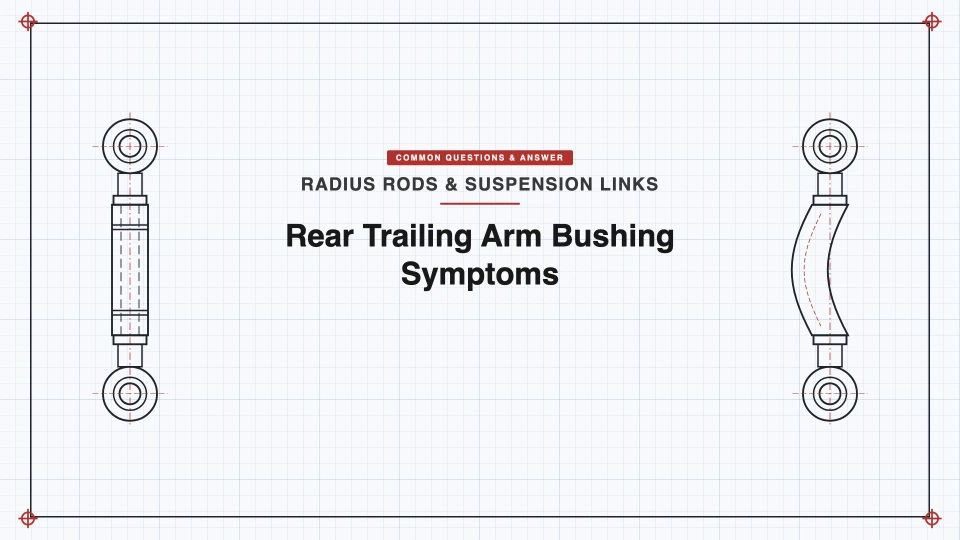
A rear trailing arm is one of several rod-end or bushing-equipped suspension links that connect the rear axle or wheel to the vehicle body, letting the wheel travel up and down over bumps while holding it in place front-to-back. The rubber or polyurethane bushing at each pivot point is the part that wears out — and it fails gradually, not all at once. The most common signs are a clunk over bumps, a rear end that feels loose or "steps out" during acceleration or braking, and uneven rear tire wear.
If you're noticing these symptoms now: short, low-speed driving isn't usually an emergency, but don't put off getting it inspected. A worn bushing lets the axle's alignment shift while you drive, which means tire wear and handling both get worse the longer you keep driving on it — and if you've had it aligned recently, expect the alignment to drift again until the bushing is fixed.
What a Rear Trailing Arm Does
The trailing arm's pivot bushing bolts to the body or subframe; the other end connects to the axle or wheel hub. As the suspension compresses and extends, the wheel end swings through a small arc behind that pivot point — controlling the wheel's fore-aft position while still allowing vertical travel. The bushing at the pivot is the only compliant part in that link, which is exactly why it's the part that wears out first.
Symptom 1: Clunking or Knocking Noise
A clunk over bumps, under braking, or during acceleration is a commonly reported sign of a worn trailing-arm bushing. Excess play can let adjoining metal components move against each other under load.
Symptom 2: Rear End Feels Loose or "Steps Out"
Described variously as wandering, swaying, or the rear end "stepping out" — this shows up most during acceleration, braking, and cornering, when the load on the trailing arm changes direction. Real owner reports on forums describe it in similar terms: the rear end kicking slightly outward mid-turn, or shifting position noticeably when transitioning between accelerating and coasting. The mechanism is the same slack that causes the clunk — the bushing is no longer holding the arm rigidly in position, so the axle's actual position lags behind or drifts from where it should be.
Symptom 3: Uneven Rear Tire Wear
As the bushing wears, the rear wheel's alignment angle changes slightly every time the suspension loads and unloads — meaning the wheel isn't tracking at a consistent angle even if it was aligned correctly when the bushing was new. That inconsistency shows up as uneven wear, usually on the inside or outside edge of the tire, and it will return even after a fresh alignment if the bushing itself isn't addressed first.
Symptom 4: What Worn Bushings Actually Look Like
If you can get the trailing arm bushing in view (on a lift, or with the wheel off), look for:
- Visible cracking, tearing, or dry rot in the rubber
- The inner metal sleeve sitting off-center in the bushing rather than centered
- Metal-to-metal contact marks where the bushing has worn through completely
The off-center sleeve is the detail that's easy to miss on a quick glance — a bushing can look intact from one angle while the sleeve inside has already shifted, which is why a hands-on check (below) catches problems a visual-only inspection can miss.
Causes: Why Bushings Fail
| Cause | How it happens |
|---|---|
| Age and rubber hardening | Rubber stiffens and loses compliance over years, even without heavy use |
| Road salt / corrosion | Corrodes the metal sleeve and degrades rubber from the outside in, especially in winter-road-salt regions |
| Pothole and impact damage | Sudden shock loads tear or deform the bushing faster than gradual wear |
| Overload or towing | Sustained extra load accelerates wear beyond the bushing's design range |
This four-cause breakdown is consistent across two independent sources, which is a reasonable level of agreement for this kind of maintenance-item cause list.
How to Check It Yourself
- Raise the rear of the vehicle safely and support it on jack stands.
- Insert a pry bar between the vehicle body and the trailing arm near the bushing.
- Apply leverage and watch/feel for movement at the bushing — noticeable play here means the bushing has failing internal compliance, not just normal give.
- Visually inspect the bushing for the cracking, tearing, and off-center sleeve signs described above.
- Road-test: pay attention to clunking over bumps and any rear-end shift during braking and acceleration, and compare it to how the vehicle felt before you suspected a problem.
This pry-bar test is described independently in two different forum threads using close to identical wording, which is a good sign it's a real, repeatable diagnostic method rather than a one-off suggestion.
Bushing-Only Replacement vs. Full Trailing Arm Replacement
Replacing just the bushing is cheaper in parts but usually requires a hydraulic press and more labor time to remove the old bushing and press in the new one correctly. Replacing the entire trailing arm assembly (with the new bushing already installed) costs more in parts but saves labor — and it's the more sensible option if the arm itself shows rust, bending, or if multiple bushings on the same arm are worn, since pressing out old, corroded bushings without damaging the arm gets harder the more deteriorated everything already is.
How Long Do They Last, and Is DIY Realistic?
The trailing arm is a structural component and generally outlasts its bushing, which is a wear item. Actual service life depends on the vehicle, road conditions, corrosion, and bushing material. DIY replacement requires a suitable press, correct ride-height positioning before final torque, and an alignment check afterward.
DIY replacement is possible but has real prerequisites: you need a way to press the bushing in and out correctly (not just hammer it), the arm needs to be preloaded to the correct position before final torque (tightening it at the wrong ride height puts a permanent twist into the new bushing), and an alignment check afterward is a good idea even if you were careful.
Related Reading
For what a trailing arm costs to fix once you've confirmed the bushing is the problem, see How Much Does It Cost to Replace Rear Trailing Arm Bushings?. If you're not sure whether "trailing arm" and "control arm" mean the same thing on your vehicle, see Trailing Arm vs. Control Arm: What's the Real Difference?.
Related reading: What Is a Trailing Arm? Structure, Types, and How It Locates Your Axle · How Much Does It Cost to Replace Rear Trailing Arm Bushings? · Trailing Arm vs. Control Arm: What's the Real Difference?