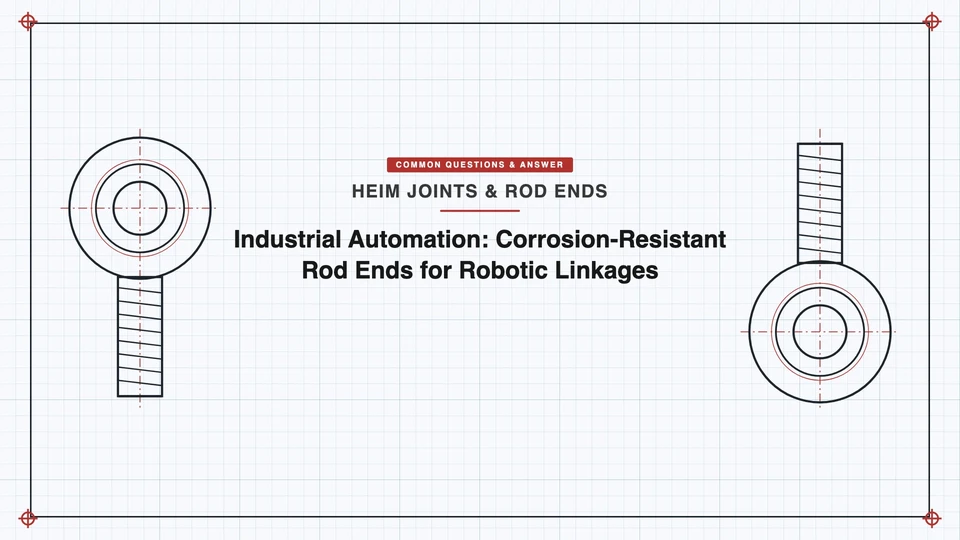
Robotic arms and automated linkages working in washdown, marine, chemical, or pharmaceutical environments face a problem a standard carbon-steel rod end was never built to survive: repeated exposure to moisture, cleaning chemicals, or salt spray that a dry factory floor never sees. In these environments, the rod end that connects an actuator to a gripper, a gate, or a positioning arm needs to be selected for corrosion resistance and low-maintenance operation as deliberately as it’s selected for load rating — because a seized or pitted joint doesn’t fail gracefully in a continuous-duty automated system, it stops the line.
Why a Standard Rod End Fails Here
A carbon-steel rod end with a light zinc plating handles a dry indoor environment fine. Introduce any of the following, and the failure mode shifts from gradual wear to corrosion-driven seizure or pitting:
- Washdown cycles (food, beverage, pharmaceutical): frequent high-pressure cleaning with water and sanitizing chemicals strips protective coatings and washes out conventional grease lubrication faster than it can be replenished.
- Salt spray and humidity (marine, offshore, coastal outdoor automation): chlorides attack unprotected steel surfaces and accelerate pitting corrosion at a rate dry indoor use never produces.
- Process chemical exposure (chemical processing, water treatment): acids, caustics, and disinfectants degrade standard platings and can attack the base metal itself over repeated exposure.
Once a joint starts to corrode, the practical failure isn’t usually catastrophic breakage — it’s binding. A pitted or rusted bearing surface loses its smooth rotation, backlash increases, and cycle-to-cycle repeatability (the thing an automated system depends on) degrades well before the part actually breaks.
Material Selection Framework
The material logic below is standard corrosion-engineering practice applied to the rod-end category specifically — it’s a synthesis of general material-selection principles, not a set of test results from a specific rod-end product line, so treat it as a starting framework for a conversation with whoever specs your linkage, not a drop-in spec sheet.
| Material | Corrosion Resistance | Strength / Weight | Typical Fit |
|---|---|---|---|
| 316 / 316L stainless steel | Excellent — chloride and chemical resistant | Good strength, moderate weight | Food/beverage washdown, pharmaceutical, marine, chemical processing |
| 304 stainless steel | Good general resistance, lower chloride tolerance than 316 | Good strength, moderate weight | General indoor automation without heavy chemical or salt exposure |
| Titanium (Grade 5) | Very high — corrosion resistant, non-magnetic | Excellent strength-to-weight | High-performance or weight-sensitive joints; higher cost limits routine use |
| Anodized aluminum | Good surface protection; anodized layer can be compromised by pitting/scratching | Excellent strength-to-weight, lowest mass | Weight-sensitive robot arms in moderate (not heavy washdown) environments |
| PTFE-lined bearing (steel or stainless housing) | Depends on housing material; liner itself is chemically inert | Self-lubricating — no grease to wash out | Washdown-heavy environments where maintenance access is limited |
A practical rule that shows up across corrosion-engineering guidance regardless of industry: 316/316L is the default choice once chlorides or aggressive cleaning chemicals are involved, and passivation (a chemical surface treatment that removes free iron and reinforces the stainless steel’s protective oxide layer) is what actually delivers the corrosion resistance the alloy is capable of — an unpassivated 316 part underperforms its own material spec.
Where This Actually Gets Deployed
This isn’t a hypothetical concern — corrosion-resistant rod ends and spherical bearings are already specified into a specific, recurring set of automation applications:
- Marine and underwater robotics — steering, stabilizing, and manipulator-arm linkages on ROVs and hull-cleaning robots, where saltwater exposure is constant and unplanned downtime for maintenance is expensive.
- Packaging machinery — pick-and-place end effectors and carton-erector/sealer linkages that cycle continuously and are often washed down between production runs.
- Pharmaceutical manufacturing — automated arms on tablet presses, vial filling/capping stations, and autoclave door-locking mechanisms, where cleanroom and CIP (clean-in-place) chemical exposure rules out standard plated steel.
- Water treatment — sluice gate actuation, aerator positioning, and sludge-scraper bridge drives, all continuously wet or intermittently submerged.
- Textile machinery — loom heddle-frame motion control and dyeing-machine tension rollers, where lint buildup and dye-chemical exposure both play a role.
An Illustrative Example (Not a Quote)
To make the framework concrete: consider a food-sorting robotic arm subjected to a daily high-pressure washdown cycle with a chlorine-based sanitizer. A plausible specification path — illustrative only, not a quoted price or a validated spec for any real product — might land on a 316L stainless housing (chloride resistance for the sanitizer exposure), a PTFE-lined bearing (no grease to wash out between cycles), and a passivated finish on all exposed hardware. The same arm running in a dry indoor cell with no washdown requirement would likely be over-specified by that same joint — 304 stainless or even a standard plated steel rod end could do the job at lower cost. The point isn’t the specific materials in this example; it’s that the environment, not the load rating alone, is what should drive the material call.
PTFE-Lined vs. Metal-to-Metal: Which Path
- PTFE-lined bearings are the default choice when washdown frequency is high and maintenance access is limited — they don’t need re-greasing, and there’s no grease film to be stripped by cleaning chemicals in the first place.
- Metal-to-metal bearings with a scheduled re-passivation/lubrication routine can outlast a PTFE liner under sustained high-load, high-impact cycling, where the softer liner material wears faster — but only if that maintenance routine is actually followed, which is a real operational commitment, not a one-time spec decision.
Neither option is universally correct; the choice depends on load profile and how realistic the maintenance schedule actually is for the specific installation.
The Underlying Point
Corrosion resistance in a robotic linkage isn’t a single material swap — it’s matching housing material, liner type, and surface treatment to the specific chemical and moisture exposure the joint will actually see, then verifying that the finish (passivation, in particular) is actually applied and not just implied by the base alloy. That environment-first specification process — not a generic "stainless steel" upgrade — is the demand profile SYZ Machine’s custom rod ends are built to serve for OEMs designing automation equipment into washdown, marine, or process-chemical environments.
Related reading:When to Choose Stainless Steel Rod Ends · PTFE Liner Self-Lubrication Explained · Hard Chrome Plating: Rod End Service Life · Gym Equipment: Why Rose Joints Are Used in High-End Strength Machines