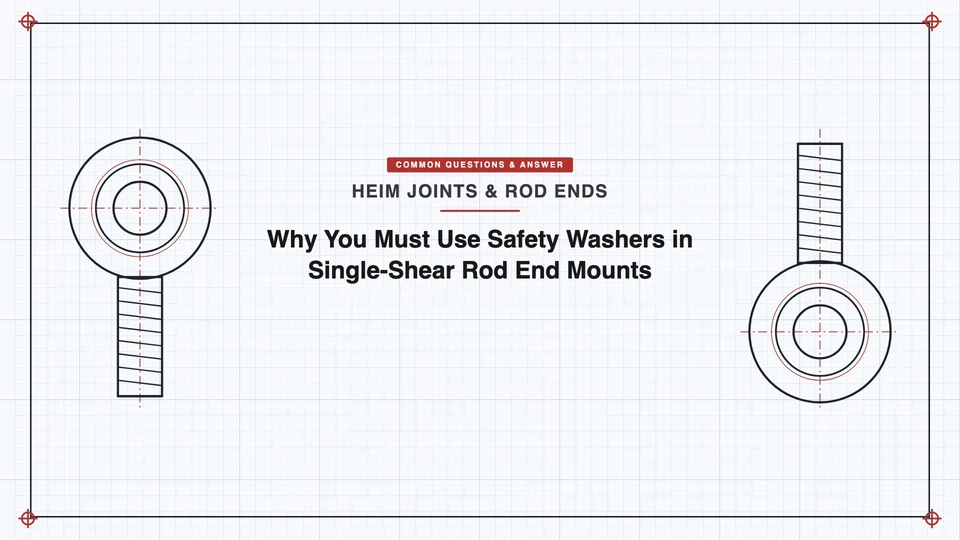
A safety washer isn’t there to carry load — it’s there to catch the linkage if the rod end‘s ball ever fails. In a single-shear mount, that distinction is the difference between a part that needs replacing and a linkage that comes completely apart while you’re driving.
What a Safety Washer Actually Does
A safety washer is a washer with an outer diameter larger than the rod end housing’s opening. Its job has nothing to do with normal operation — a properly functioning rod end doesn’t need it to work. Its job is mechanical capture: if the ball or race ever fails internally, the washer’s larger diameter physically keeps the housing trapped against the bolt instead of letting it slip completely off. It’s a fail-safe, not a wear part.
You’ll also see this hardware called a "capture washer" in some forum and catalog listings — same part, same function, different name. If you’re sourcing one and see "capture washer" instead of "safety washer," it’s the same thing.
Why Single-Shear Mounts Specifically Need One
The reason comes down to what’s physically holding the rod end in place after a failure, not before it.
In a double-shear mount, the rod end’s housing sits captured between two support brackets — one on each side. If the internal ball or bearing surface fails, the housing itself is still physically pinned between those two brackets. It can’t go anywhere.
In a single-shear mount, there’s only one support point. The rod end hangs off one side of the bolt with nothing on the other side to trap it. If the ball fails internally and the housing separates from what it was gripping, there is nothing else in the mount holding the housing in place — it can slide straight off the end of the bolt. For a steering or suspension linkage, that means a joint that’s no longer connected to anything.
A safety washer replaces the second bracket that a single-shear mount doesn’t have. It doesn’t prevent the internal failure — it prevents that failure from turning into a linkage that’s fallen apart.
Installing It Correctly
The detail that’s easy to get wrong: the washer needs to clamp against the rod end’s inner race, not pinch or bind against the outer housing. Bolt torque should load the inner race directly so the housing is still free to articulate normally — if the washer ends up binding the outer housing instead, you’ve effectively locked the joint’s rotation, which defeats the point of using a rod end in the first place. Check that the washer seats flush against the inner race before final torque, and re-check for free articulation once it’s torqued down.
Don’t Confuse It With a High-Misalignment Spacer
These two parts get mixed up because they both sit near the rod end at the mounting point, but they solve different problems:
| Safety washer | High-misalignment spacer | |
|---|---|---|
| Purpose | Catches the linkage if the ball fails — a fail-safe | Increases the angle the joint can articulate through |
| Needed because of | Single-shear mount geometry | Suspension travel that exceeds the rod end’s stock misalignment angle |
| Present in a properly working joint | Does nothing until something fails | Actively used every time the suspension moves |
A high-misalignment spacer sometimes has a stepped design specifically to preserve clearance for articulation while still pressing against the inner race — which is a related idea (also referencing the inner race, also managing clearance) but a different job. Using one doesn’t substitute for the other.
The Short Version
If your rod end is mounted single-shear — one bracket, nothing on the other side — a safety washer isn’t optional hardware, it’s the only thing standing between an internal ball failure and a linkage that physically separates. It costs a few dollars and takes a few extra minutes to install correctly. The alternative, on a steering or suspension linkage, isn’t a inconvenience — it’s a part coming loose while the vehicle is in motion.
Related reading: Why Safety Washers Are Mandatory in Single-Shear Installations: The Failure Mechanics · Single Shear vs. Double Shear Mounting Explained · Do You Always Need High-Misalignment Spacers? · How to Install a Heim Joint Into a Tapered Steering Hole