
A Heim joint delivers more precise steering response than a standard ball joint for one structural reason: it removes the compressible layer that a ball joint relies on. That precision comes with real trade-offs in strength and maintenance, which is exactly why ball joints remain the standard on OEM vehicles and most UTVs/ATVs despite the Heim’s steering advantage.
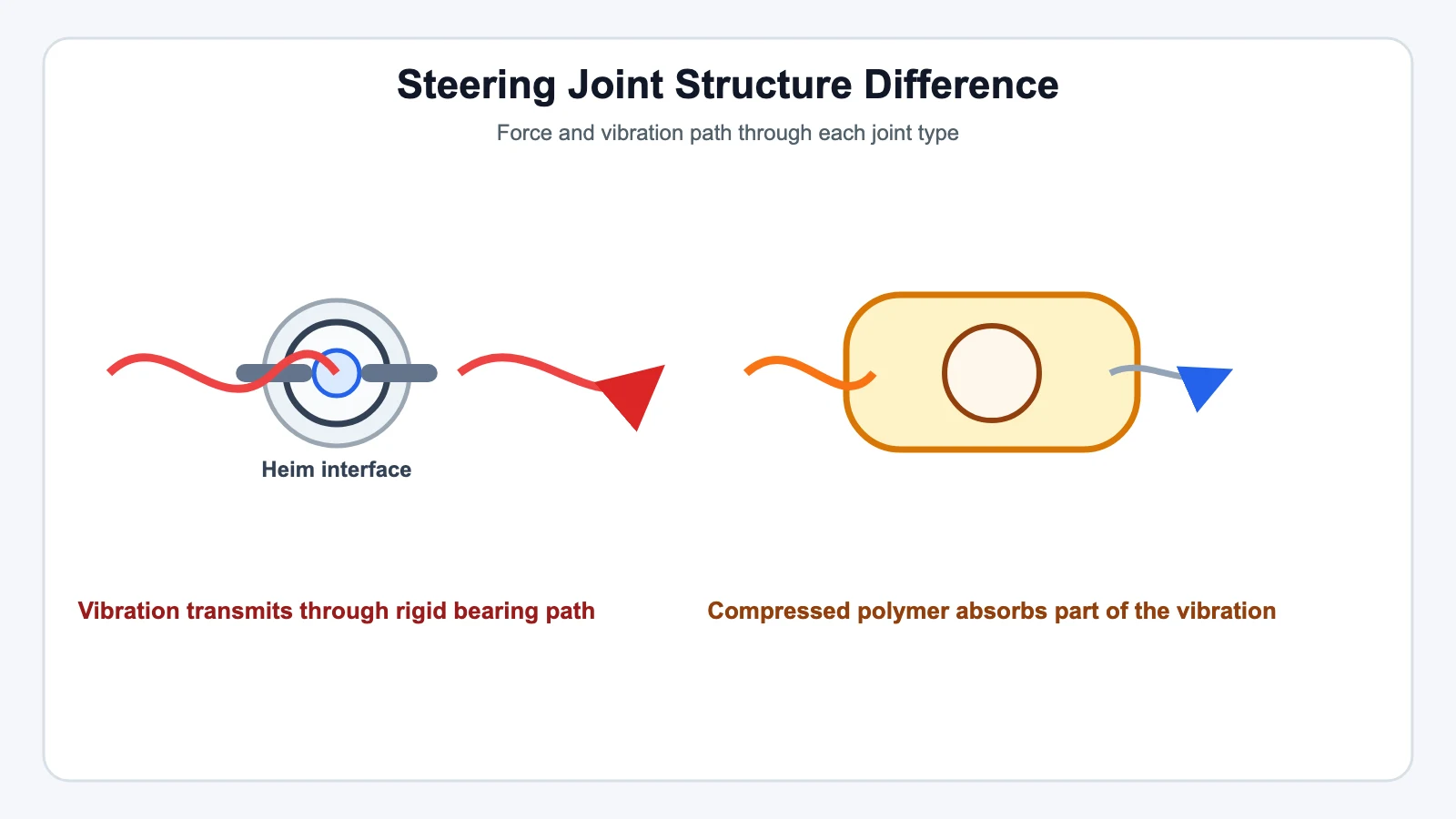
The Structural Difference
A standard ball joint is a steel ball on a stud, seated in a housing packed with grease and sealed behind a rubber boot. The ball rides against a cushioned socket — often rubber or nylon-lined — designed for long service life, quiet operation, and tolerance of road grit, not for eliminating every last thousandth of an inch of play.
A Heim joint (spherical rod end) is a steel ball rotating directly against a rigid liner — bare metal-on-metal, or metal against a thin PTFE composite — with no compressible cushion and typically no protective boot. That direct, low-friction connection is what a ball joint’s cushioned socket trades away in exchange for durability and comfort.
Why That Difference Sharpens Steering Feel
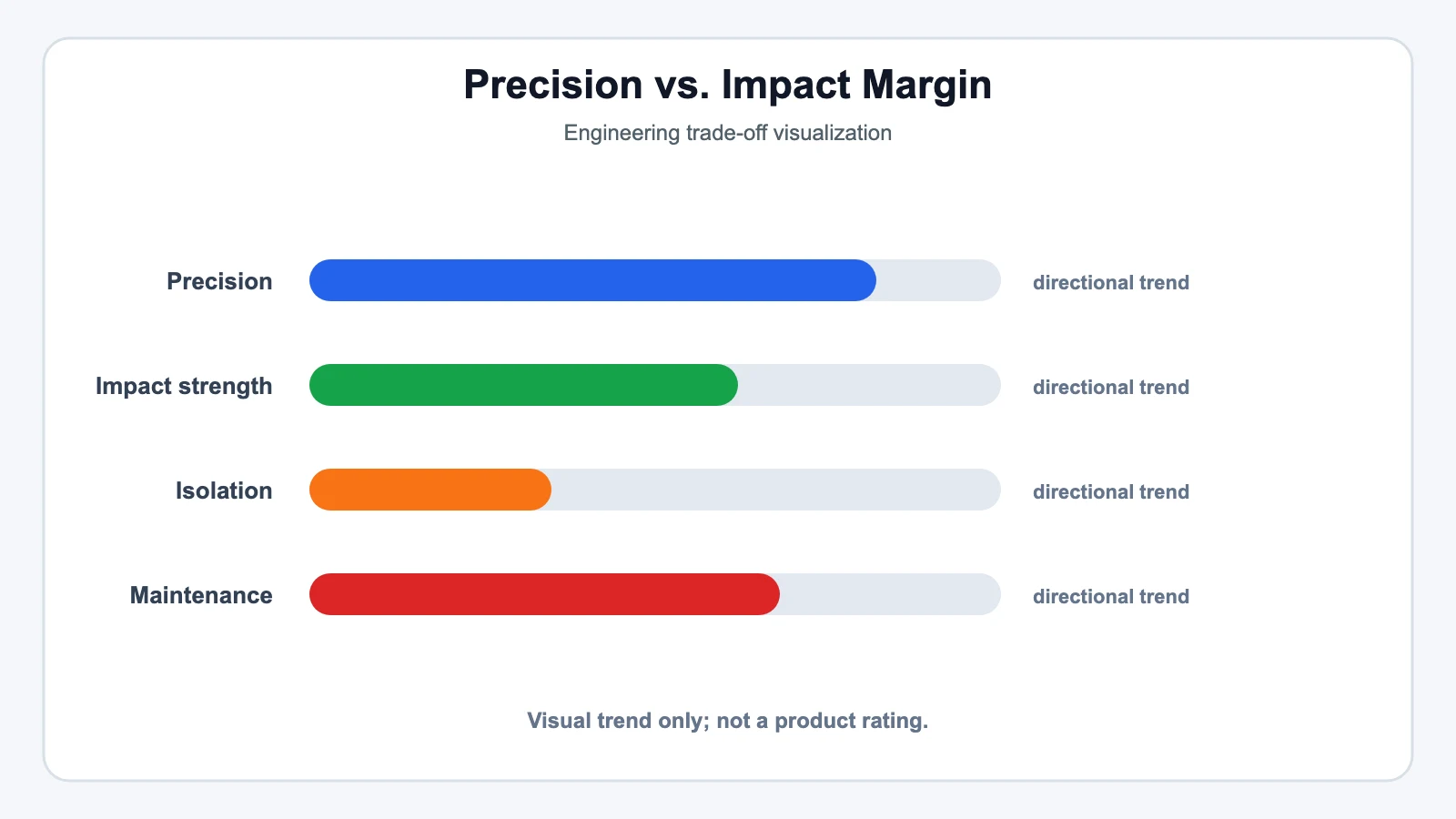
Under steering load, a ball joint’s cushioned socket deflects slightly — it’s built to, since some give reduces road noise and cushions impact. A Heim joint’s rigid connection deflects far less under the same load. Less deflection means the wheel’s actual angle tracks the driver’s input more directly: sharper turn-in, less vague on-center feel, and steering feedback that reflects what the tire is actually doing rather than what’s happening after the joint’s play is taken up.
The Heim joint also tolerates a wider range of angular misalignment before binding. As suspension travel changes the geometry of a steering link — especially on a lifted truck, a long-travel buggy, or a race car with big wheel travel — a Heim joint’s ball can rotate through a larger angle inside its housing without the joint binding or transmitting bind-up force back into the steering wheel. A standard ball joint has a narrower usable angular range before it either binds or is at risk of pulling loose.
Adjustability Is Part of the Precision Story Too
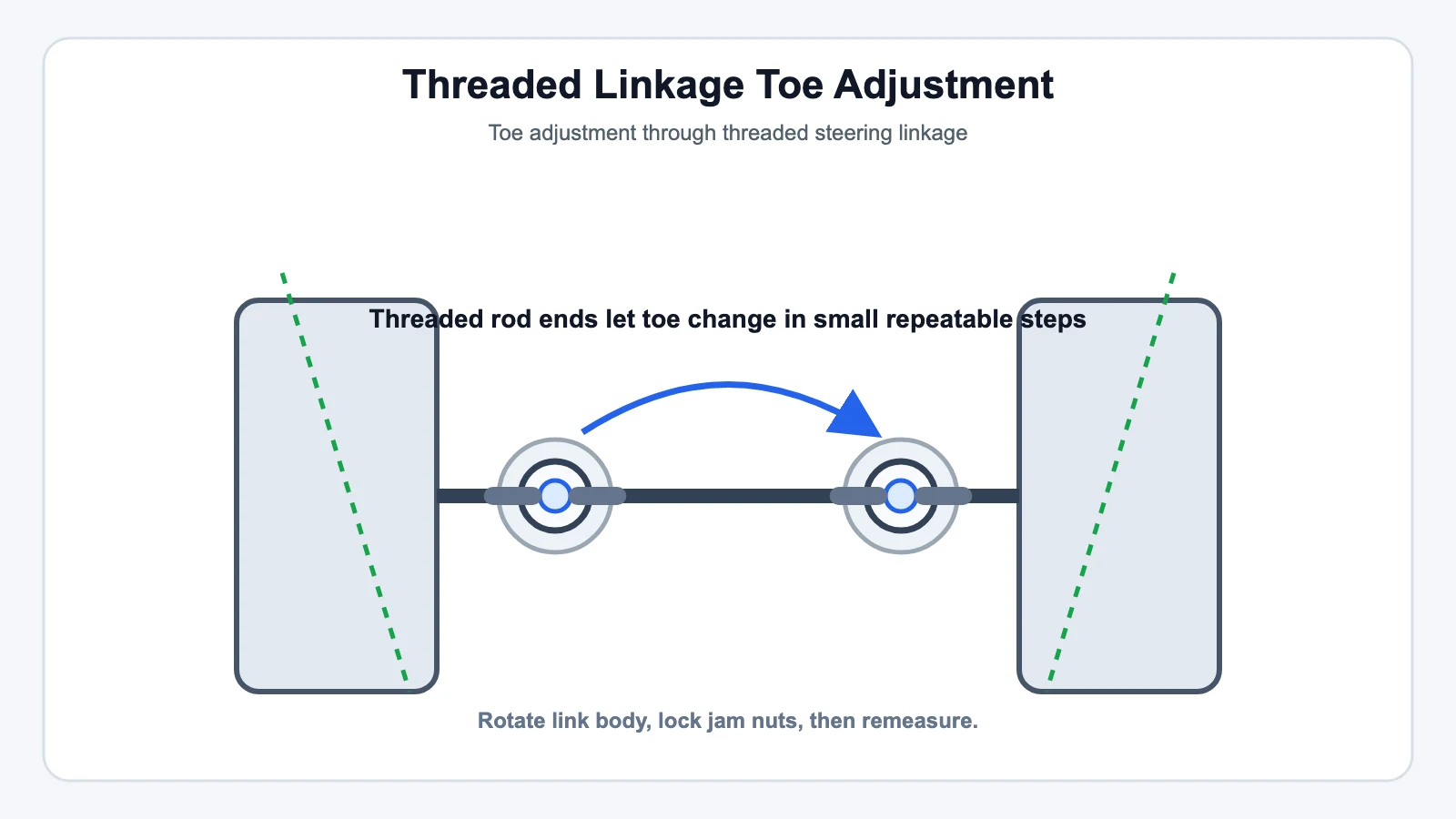
Most Heim-jointed steering links use a threaded rod end body, which makes toe adjustment, custom link length, and bump-steer correction straightforward — thread the joint in or out and lock it with a jam nut. That adjustability is a major reason Heim joints show up on competition steering setups even where a ball joint would technically survive the loads: geometry tuning is part of the job, not an afterthought.
The Angle Numbers, With a Caveat
How much angular range a Heim joint actually has depends on bore diameter and housing thickness — there’s no single industry number. As one example (not a universal spec, just illustrative of the range you’ll see quoted by suppliers): SuperATV’s own engineering team has stated their A-arm-spec Heim joints swivel about 6° from center (12° total range), while their tie-rod-spec Heim joints swivel about 18° from center (36° total range) — the A-arm version is built tougher and trades range for strength. Confirm the actual rated angle for whichever specific part you’re buying rather than assuming a generic figure applies.
What You Give Up: Strength and Maintenance
This is the part that gets skipped in a lot of "Heims are just better" write-ups, and it shouldn’t be: a Heim joint is generally weaker than a comparable ball joint against shear impact. A ball joint’s fully-enclosed, boot-sealed design can absorb a hard hit — a rock strike, a curb impact — that would damage an exposed Heim joint’s bearing surface or bend its housing. Off-road-atlas comparisons from UTV suppliers are blunt about this: "even oversized heim joints can’t keep up with a good ball joint" when it comes to raw impact tolerance.
The maintenance picture runs the same direction. A ball joint’s rubber boot keeps dirt, water, and mud out and grease in; most Heim joints have no equivalent seal, so grit works directly onto the bearing surface and accelerates wear unless the joint is cleaned and relubricated regularly. A Heim joint also usually requires an A-arm or link specifically machined for it — you can’t drop one into a factory ball-joint mount without modification.
| Standard ball joint | Heim joint | |
|---|---|---|
| Internal cushioning | Rubber/nylon socket, sealed boot | None — direct metal or PTFE-liner contact |
| Steering deflection under load | Some (by design) | Minimal |
| Angular misalignment range | Limited, varies by design | Higher, varies by bore/housing |
| Impact/shear strength | Higher | Lower — grit and hard impact are its weak points |
| Maintenance | Low — sealed, greased for life or serviceable | Higher — usually exposed, needs regular cleaning/lube |
| Adjustability (toe, link length) | Limited without different A-arms | High — threaded body, jam-nut adjustable |
Which One Is Actually the Right Call
For a daily-driven vehicle or a UTV/ATV that sees hard, repeated impacts, a ball joint’s sealed durability usually outweighs the Heim’s precision edge — which is exactly why ball joints remain standard equipment nearly everywhere. A Heim joint earns its place where steering geometry needs to be tuned precisely, suspension travel is large enough to risk binding a standard joint, or the vehicle is a dedicated race/competition build where the maintenance overhead is an accepted cost of the added precision and adjustability.
Related reading: Anti-Squat and Anti-Dive: How Heim Joints Influence Traction · Heim Joint vs. Johnny Joint: Which Is Better for Rock Crawling?