Heim joints don’t create anti-squat or anti-dive — they preserve it. Anti-squat and anti-dive are geometric properties built into where a suspension link‘s mounting points sit relative to the wheel and the vehicle’s center of gravity. A heim joint’s job is to hold that geometry exactly where it was designed, under load, so the anti-squat/anti-dive percentage you calculated on paper is still true the instant the tire is actually loaded hard under acceleration or braking.
What Anti-Squat and Anti-Dive Actually Are
Under acceleration, a vehicle’s mass wants to rotate rearward around its center of gravity — the rear end wants to compress (squat) and the front wants to rise. Under braking, the opposite happens: the front wants to compress (dive). Anti-squat and anti-dive geometry use the angle of the suspension links themselves — not spring stiffness — to resist that rotation, by directing some of the tire’s longitudinal force vertically through the link rather than letting it all compress the spring.
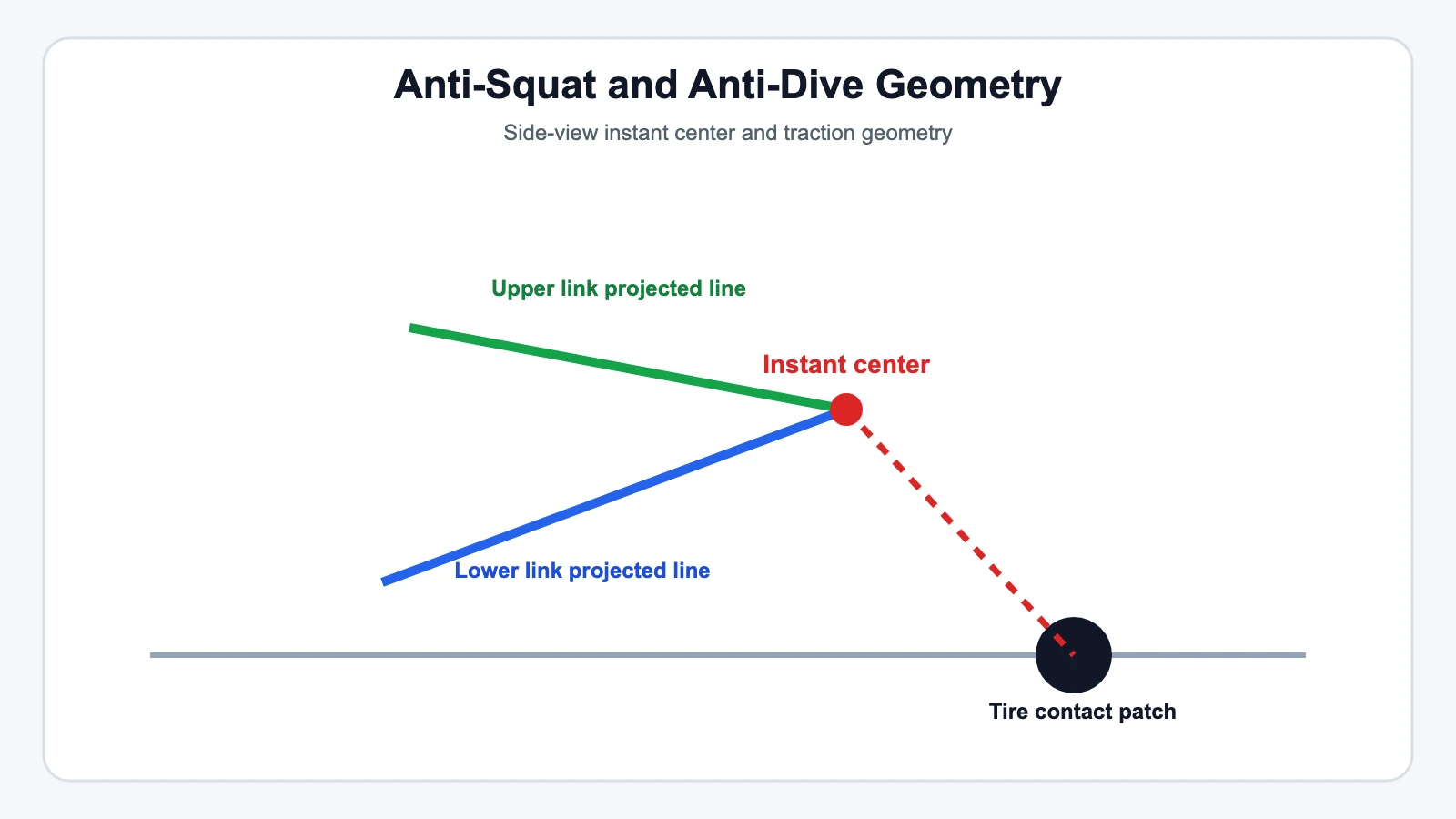
The geometry is defined by each link’s instant center: extend the centerlines of the upper and lower control arms (or, for a 3-link/4-link, the relevant links) rearward until they intersect — that intersection point is the instant center. A line from that instant center to the tire’s contact patch sets the angle that determines how much anti-squat (or anti-dive) percentage the suspension has. At 100% anti-squat, the rear suspension theoretically doesn’t compress at all under acceleration; lower percentages allow progressively more squat.
Where the Heim Joint Comes In
A heim joint doesn’t set this geometry on its own — the control arm mounting points do that. What the heim joint controls is whether that geometry actually holds up once real load hits it.
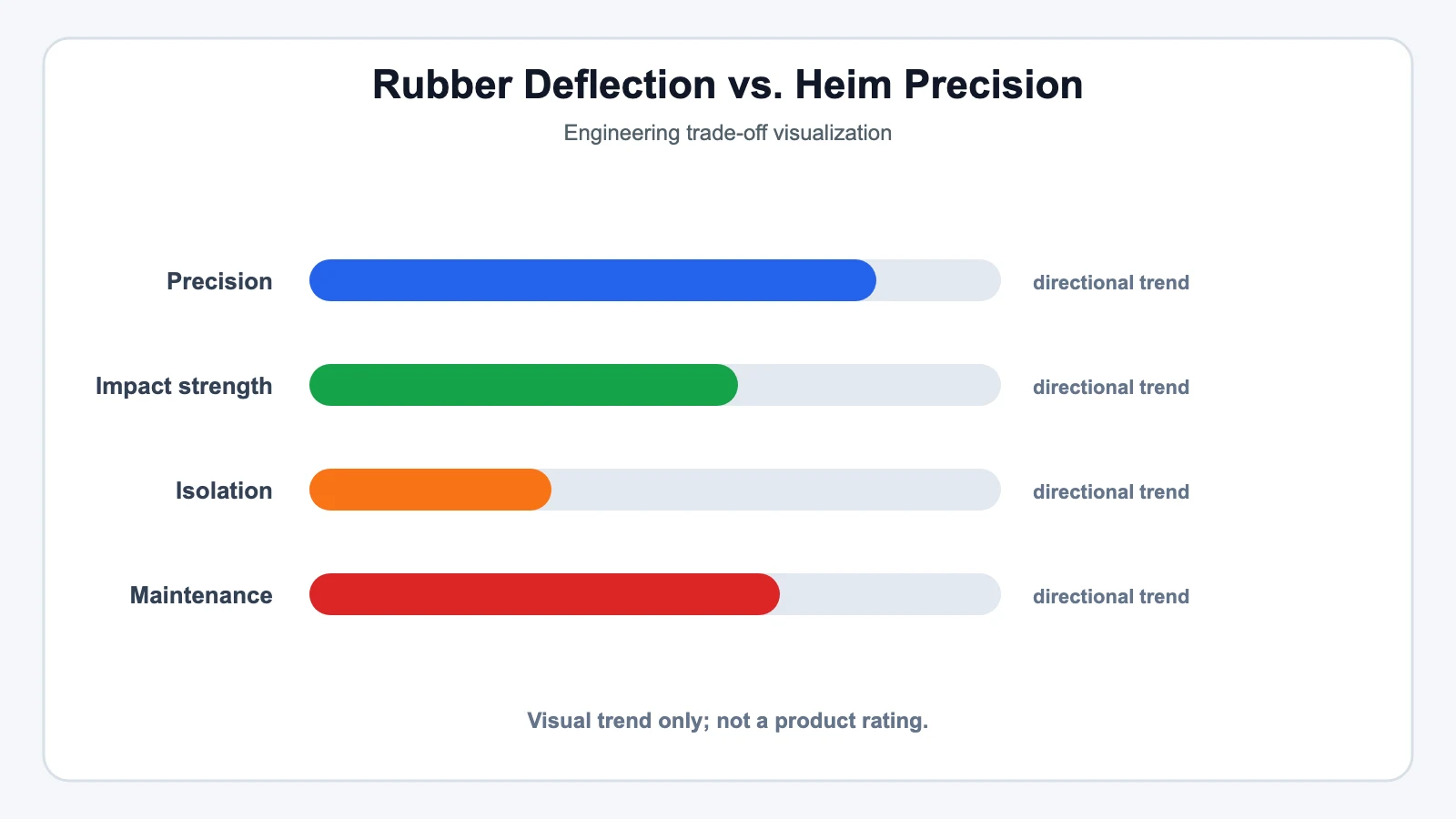
A rubber or polyurethane bushing at a control-arm mounting point deflects under load — often by a few millimeters under hard acceleration or heavy braking. That deflection physically shifts the instant center’s location at the exact moment the vehicle is trying to put power down or shed speed, which means the anti-squat or anti-dive percentage you designed for isn’t the percentage you’re actually getting when it matters most.
A heim joint, being a rigid, near-zero-clearance metal-on-metal (or metal-on-PTFE-liner) connection, doesn’t deflect meaningfully under the same load. The instant center stays where it was designed to be, so the dynamic anti-squat/anti-dive percentage tracks the static calculation much more closely under hard use. That’s the actual mechanism behind "heim joints improve traction": not by generating force, but by refusing to let the link geometry drift away from its design intent under load.
| Rubber/polyurethane bushing | Heim joint | |
|---|---|---|
| Deflection under hard load | Several millimeters, load-dependent | Near-zero |
| Instant center stability under acceleration/braking | Shifts dynamically | Holds at design position |
| Anti-squat/anti-dive percentage under real load | Can diverge from static calculation | Tracks static calculation closely |
| Ride comfort trade-off | Absorbs harshness, quieter | Transmits more road input, no cushioning |
Why the Adjustability Matters Too
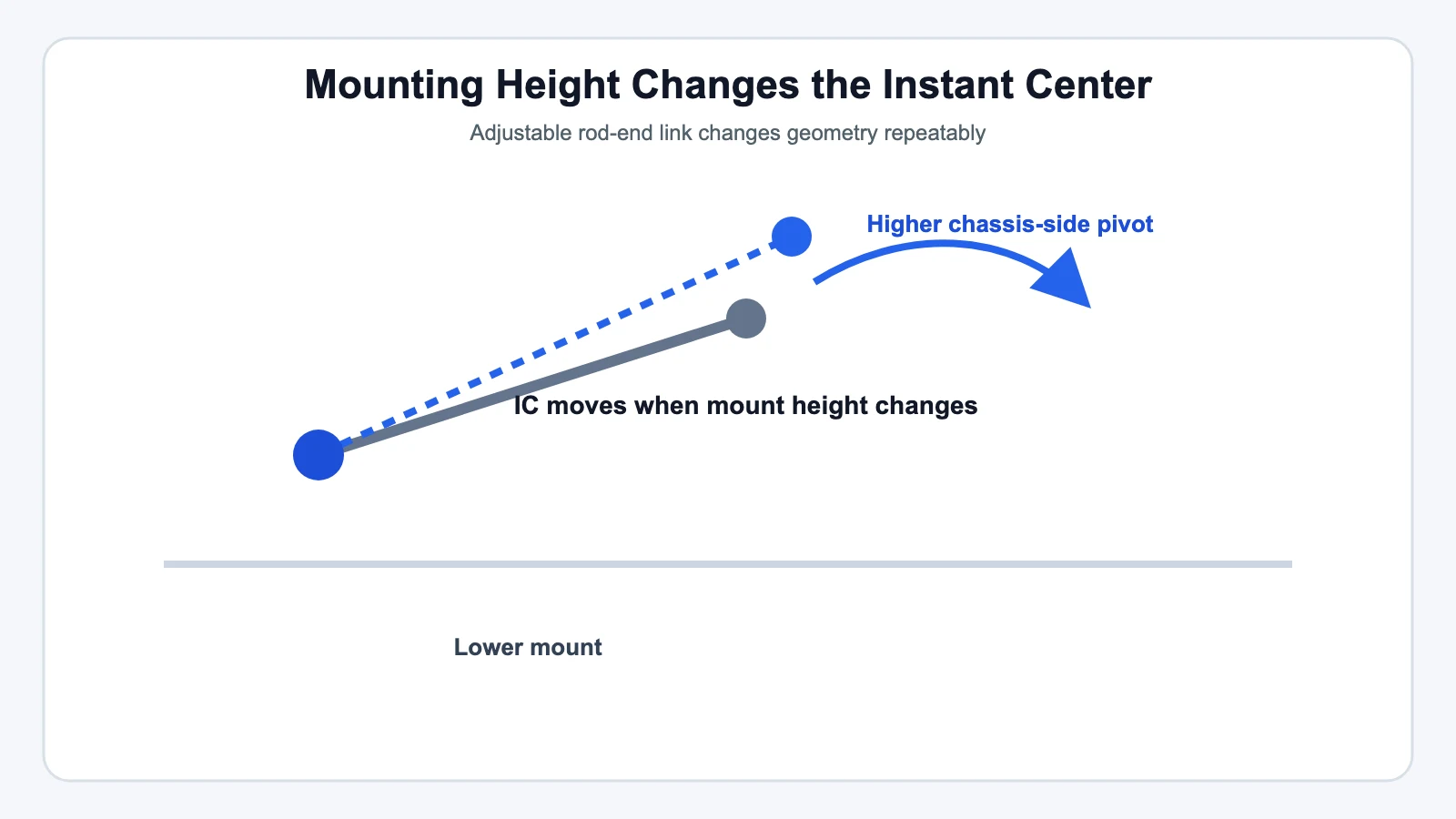
Because a heim-joint-equipped link is typically threaded and adjustable, changing the joint’s mounting height at the chassis end changes the control arm’s angle — which relocates the instant center, which changes the direction the tire’s longitudinal force is reacted through the link, which changes the resulting anti-squat/anti-dive percentage. That’s a real tuning tool: a fabricator or racer can dial in more or less anti-squat by adjusting heim joint height, without changing springs or dampers at all. A fixed rubber-bushed link doesn’t offer that adjustment without changing the physical control arm.
What This Page Doesn’t Claim
There is no universal anti-squat or anti-dive target for every street, race, or off-road build. The right value depends on wheelbase, center-of-gravity height, and link geometry, so calculate it for the actual chassis rather than applying a generic percentage.
Related reading: Heim Joint vs. Johnny Joint: Which Is Better for Rock Crawling? · Precision Response: Why Heims Beat Standard Ball Joints in Steering