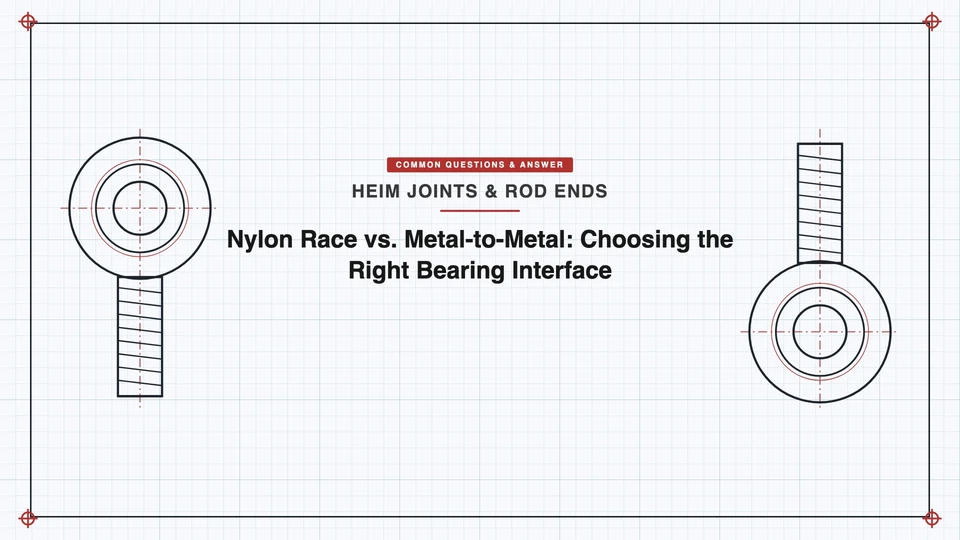
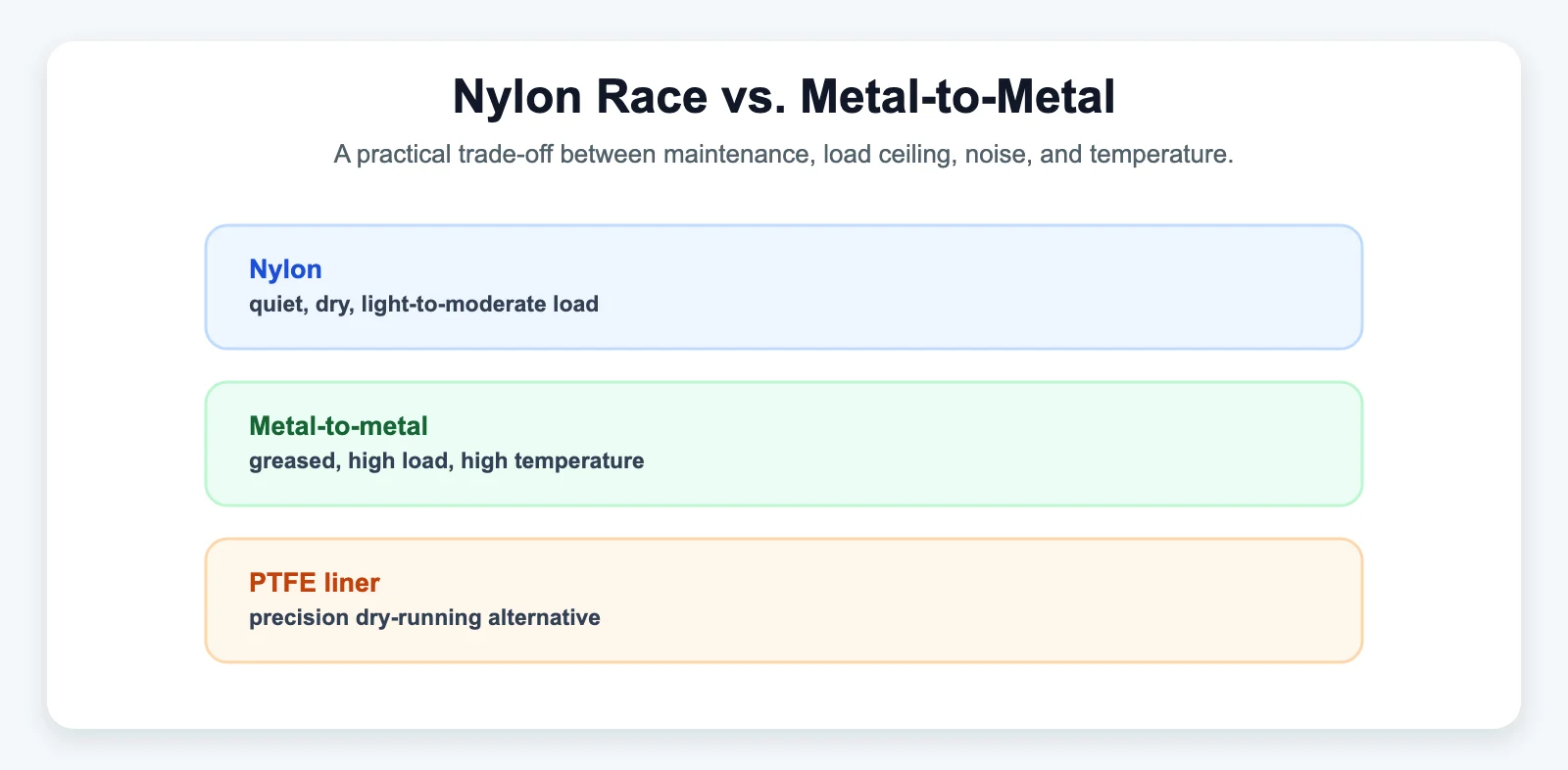
A rod end’s ball can ride against three fundamentally different interfaces: a PTFE liner (covered in depth in our companion piece), a molded nylon race, or bare metal against metal with grease. Nylon and metal-to-metal are the two most commonly confused because both are "solid" interfaces rather than a bonded liner — but they sit at opposite ends of the load-vs-maintenance trade-off. If your joint needs to survive high shock loads or extreme temperatures, metal-to-metal with proper lubrication wins. If it needs to run maintenance-free in a dusty, hard-to-reach location under light-to-moderate load, nylon wins. Everything else is detail on that core trade-off.
The Direct Comparison
| Factor | Nylon race | Metal-to-metal |
|---|---|---|
| Lubrication requirement | None — self-lubricating; adding grease can damage some formulations | Required — grease or oil via zerk fitting |
| Load capacity | Low to moderate | High to extreme |
| Shock/impact resistance | Moderate — can deform under high impact | Excellent |
| Contamination tolerance | High — no tacky grease surface to attract grit | Low unless well-sealed; trapped grit + grease forms an abrasive paste |
| Noise/vibration | Quiet, good damping | Prone to clunking once worn or under-lubricated |
| Initial fit | Tight, near-zero play out of the box (molded around the ball) | Standard clearance needed to allow grease film |
| Operating temperature | Roughly -22°F to +250°F (-30°C to +120°C) | Substantially higher — 400°F+ depending on alloy and grease |
| Typical applications | Gearshift linkages, light sway bar links, throttle controls | Heavy off-road suspension links, hydraulic cylinder ends, structural linkages |
Why the "No Grease Needed" Trade-off Cuts Both Ways
A nylon race’s biggest practical advantage isn’t friction — it’s that there’s no grease surface for dust, mud, or sand to stick to. In a metal-to-metal joint, the opposite happens: grease is necessary for the joint to function at all, but that same grease is exactly what turns airborne grit into an abrasive paste once contamination gets past the seal. This is the same underlying mechanism behind why PTFE-lined joints are also kept dry rather than greased — contamination-in-lubricant is a recurring failure pattern across every non-dry-running bearing interface in this category.
The flip side: metal-to-metal’s dependence on a continuous lubricant film is also what gives it a much higher load ceiling. Nylon deforms under sustained high load or impact — a Heim joint or rod end carrying heavy, reversing shock loads (structural suspension links, hydraulic cylinder rod ends) needs the stiffness of hardened metal running against metal, not a polymer race that can locally deform and introduce play.
The Engineering Detail Most Comparisons Skip: PV Value
No universal PV limit applies to every nylon race. The allowable value depends on the exact polymer formulation, load, sliding speed, lubrication, temperature, and housing. Use the bearing or material supplier’s data sheet rather than assuming a limit.
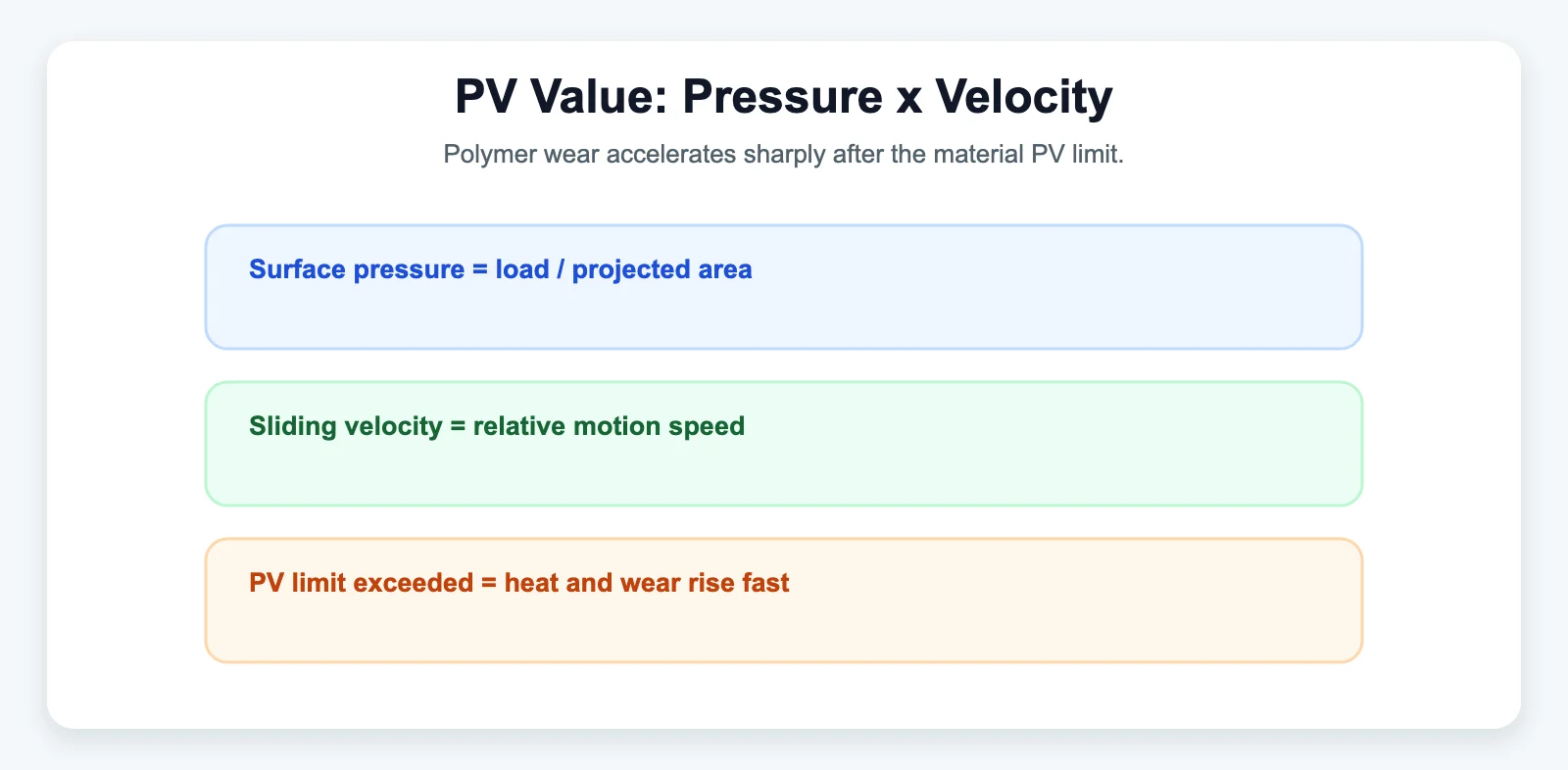
Heat dissipation through the surrounding structure matters too: a steel housing conducts frictional heat away from the bearing much faster than a plastic housing, so the same PV value can produce very different wear outcomes depending on what’s around the joint.
The Mating Surface Matters as Much as the Race Material
This is true for both interfaces, but it’s underappreciated for nylon specifically: a harder, smoother mating shaft or ball — such as a hard-chrome-plated surface — produces the lowest wear rate against a polymer race. There’s a caveat worth knowing, though: a mating surface that’s too smooth can trigger stick-slip behavior at low sliding speeds (a jerky, alternating grip-and-release motion rather than smooth sliding). This is a case where "harder and smoother is always better" isn’t quite true — surface finish for a polymer interface is a target range, not a maximize-at-all-costs variable.
Reading Wear and Failure Signs
How a nylon race fails tells you why it failed, which is useful for anyone diagnosing a worn linkage rather than just replacing parts on a schedule:
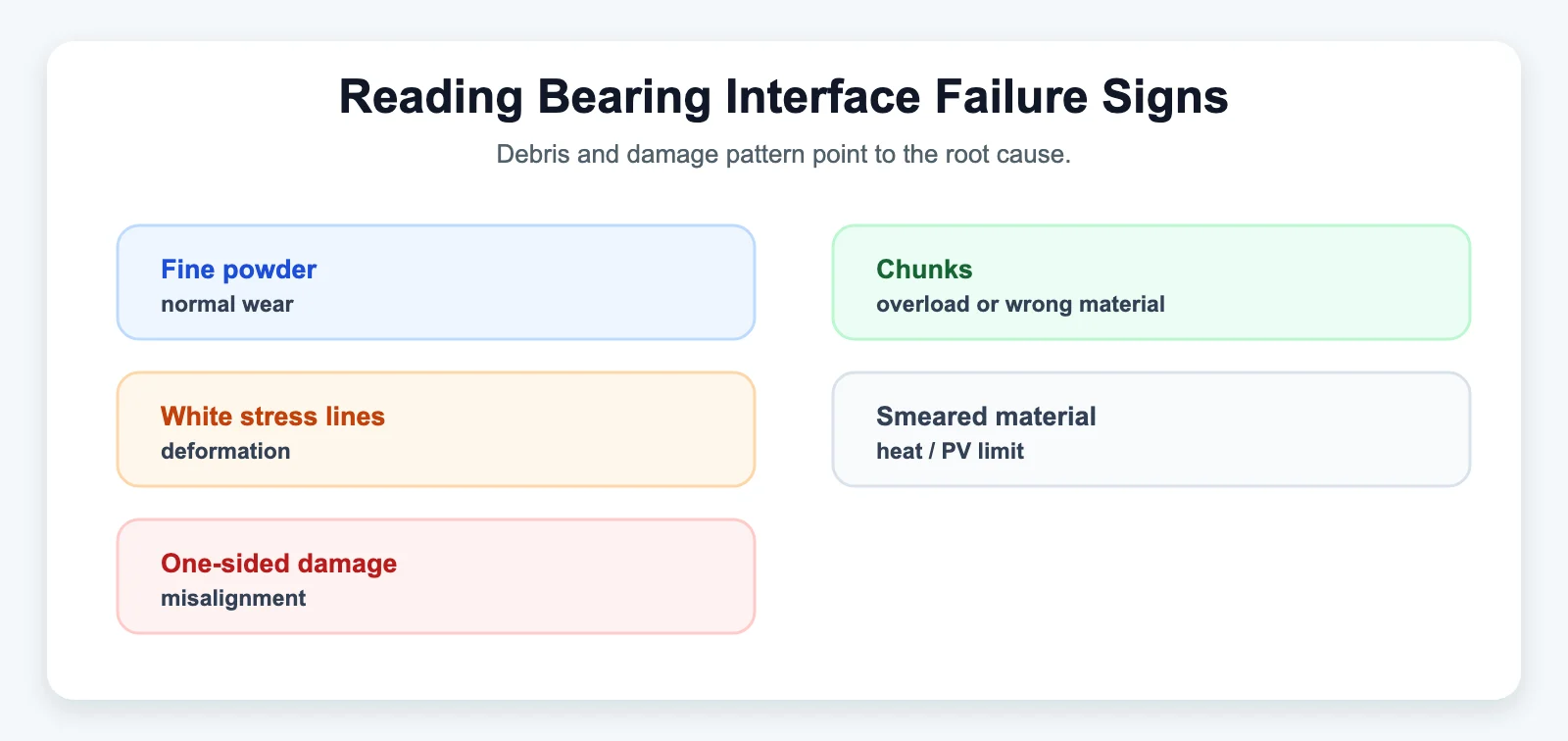
- Fine powdered debris — normal, expected wear from two surfaces gradually grinding against each other. Not a red flag on its own.
- Large chunks or fragments — brittle mechanical failure from overload, shock, or the wrong material for the application, not gradual wear.
- White stress lines or visible deformation — the race was strained past its elastic limit; a warning that load capacity margin is too thin for the application, even if it hasn’t failed yet.
- Melted or smeared material — excessive frictional heat, usually from exceeding the PV limit or inadequate heat dissipation through the housing.
- Damage concentrated on one side — misalignment or edge loading; the race isn’t carrying load evenly across its surface.
When to Choose Which
Choose a nylon race when: the joint is in a hard-to-reach or rarely-serviced location, the environment is dusty or wet, loads are light to moderate and steady rather than shock-heavy, and quiet operation matters (gearshift linkages, light sway bar end links, throttle linkages).
Choose metal-to-metal when: the application sees high static loads, shock loading, or reversing high-frequency loads; operating temperatures exceed nylon’s practical range; or the joint is a structural link where deflection under load isn’t acceptable (heavy suspension links, hydraulic cylinder rod ends).
And if what you actually need is the lowest possible friction with near-zero maintenance in a precision application — rather than nylon’s moderate-load, low-maintenance middle ground — that’s the case for a PTFE-lined liner instead; see how PTFE self-lubrication works for that comparison.
Related reading: The PTFE (Teflon) Liner: How Self-Lubrication Works · Hard Chrome Plating: How It Increases Rod End Service Life