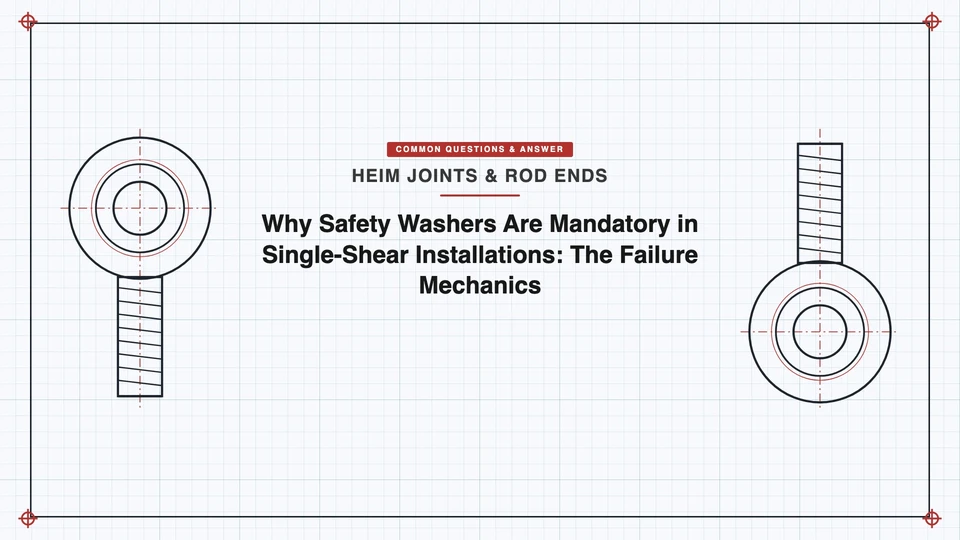
A rod end’s internal ball or race can fail without warning — that’s true regardless of how it’s mounted. What changes based on mounting geometry is what happens next. In a single-shear mount without a safety washer, internal failure and the linkage physically coming apart happen in the same event. That’s the specific mechanical reason "mandatory" is the right word here, not "recommended."
What "Internal Failure" Actually Looks Like First
Before the linkage separates, something has to fail inside the joint itself. The ball and race normally transfer radial and axial load through a sliding fit — either metal-on-metal or against a PTFE liner. That fit degrades over time: the liner wears through to bare metal contact, or the ball develops fatigue cracking under repeated load, eventually letting it work loose from the race or letting the race itself crack. This internal degradation is progressive — a safety washer does nothing to slow it down or prevent it. It only matters for what happens once it’s already happened.
Double Shear: The Housing Has Nowhere to Go
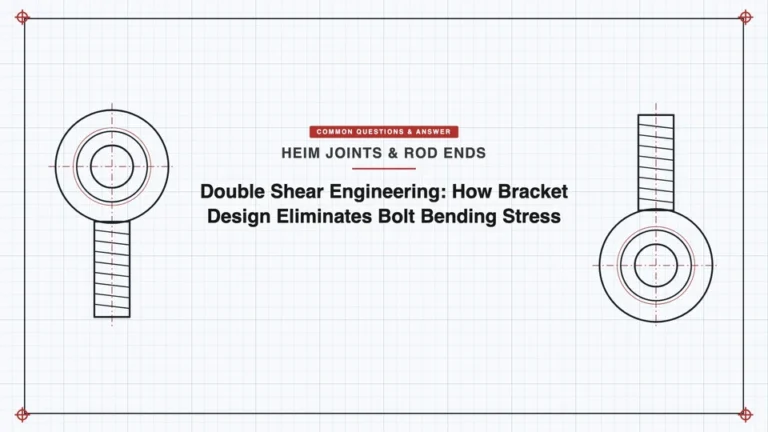
In a double-shear mount, the rod end housing sits captured between two support brackets — one on each side. When the internal ball fails, the housing is still physically pinned in place by that two-sided bracket geometry, independent of what happened inside the joint. The linkage stays mechanically connected, even though it’s now compromised — you might feel new play or hear noise, but the parts are still where they’re supposed to be.
Single Shear Without a Safety Washer: Nothing Stops the Slide
A single-shear mount only has one support bracket. Once the ball fails and the housing loses its normal grip on the bolt, there is no second constraint holding the housing in place — it can slide straight along the bolt’s axis and off the end of it. There’s no geometry in a bare single-shear mount that resists this. The linkage doesn’t degrade into a compromised-but-connected state the way a double-shear mount can; it separates. On a steering tie rod or drag link, that means the driver loses mechanical control of that wheel’s steering input in the instant it happens — which is the specific reason motorsport rulebooks (Baja SAE and similar off-road racing series are commonly cited for this requirement) mandate safety washers on single-shear steering and suspension linkages rather than leaving it as a suggestion.
This is also why the requirement isn’t about installation quality. A perfectly torqued, correctly installed single-shear rod end still has this failure path built into its geometry — the washer isn’t compensating for a mistake, it’s compensating for a structural gap that single-shear mounting has by design.
What the Safety Washer Actually Intervenes On
A safety washer’s outer diameter is larger than the rod end housing’s mounting hole. Once the housing starts to slide along the bolt after an internal failure, the washer’s larger diameter physically catches the housing’s edge and stops it from continuing to slide off. This doesn’t prevent the internal failure — nothing does, from outside the joint. What it does is change the outcome of that failure from "linkage completely separates while in use" to "linkage develops sudden play but stays physically attached, and needs to be taken out of service immediately." That’s the entire job of the part: not preventing failure, limiting its consequence.
This is also why a generic flat washer doesn’t substitute for a purpose-built safety washer. A properly designed safety washer has a stepped, concave profile that clamps against the inner race specifically — a flat washer with enough OD to catch the housing would also bind against the housing face during normal articulation, restricting the joint’s range of motion during everyday use to guard against a failure that (hopefully) never happens.
Real Dimensions, Not Just "A Large Washer"
Rod end safety washers are sized to the joint’s bore, not a one-size-fits-all part. Typical catalog dimensions (303 stainless steel):
| Rod end bore | Washer OD | Thickness |
|---|---|---|
| 1/2" | 1.245" | 0.200" |
| 5/8" | 1.365" | 0.250" |
| 3/4" | 1.615" | 0.313" |
If you’re specifying or sourcing safety washers, match them to the actual bore size rather than assuming any oversized washer will do the job.
For the "how to install it" side of this — mounting orientation, torquing against the inner race, and avoiding a washer that binds the joint — see Why You Must Use Safety Washers in Single-Shear Rod End Mounts.
Related reading: Why You Must Use Safety Washers in Single-Shear Rod End Mounts · Single Shear vs. Double Shear Mounting Explained