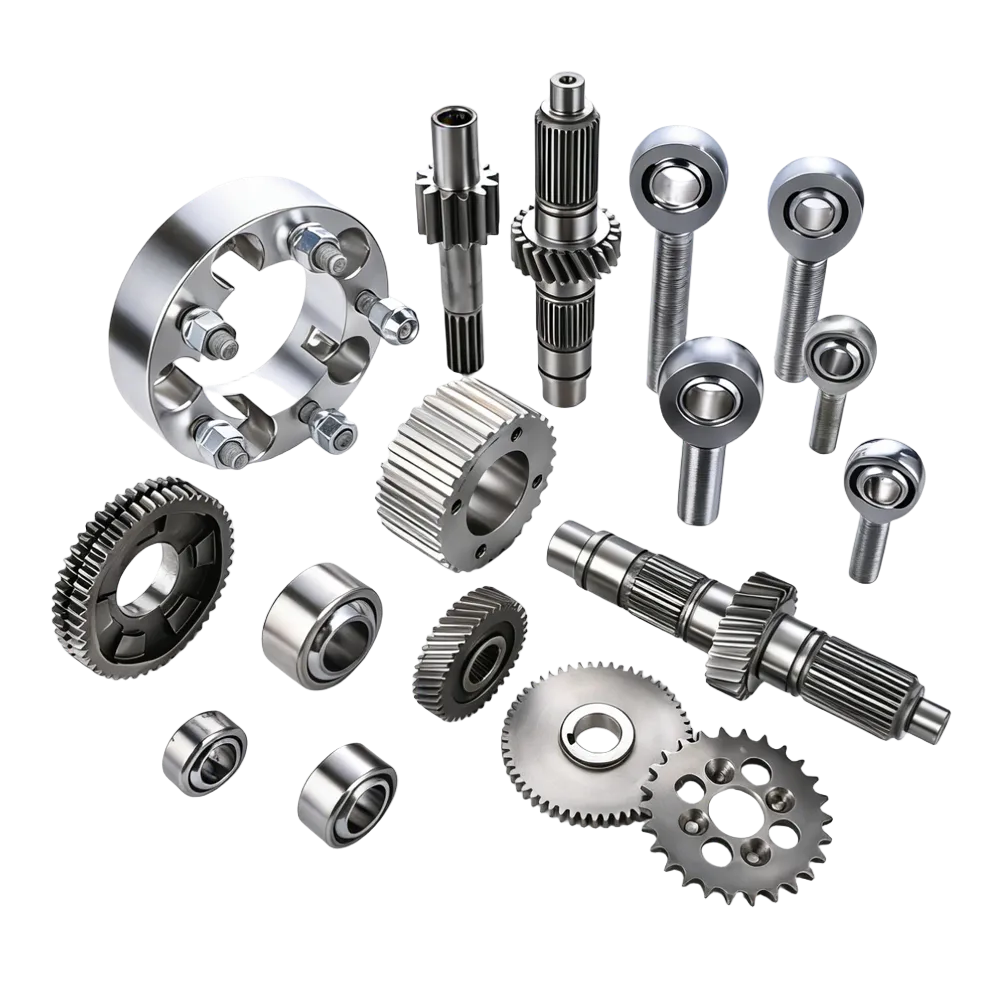

Carbon steel is an alloy of iron and carbon in which carbon — not chromium, nickel, or other elements — is the main property-changing ingredient, typically making up 0.05% to 2.1% of the mix. That carbon content is the single biggest lever on the material’s hardness, strength, ductility, and weldability: more carbon means harder and stronger, but less ductile and harder to weld.
Why Carbon Content Does the Work
Iron on its own is soft and forms a regular, repeating crystal lattice. Adding carbon atoms disrupts that lattice — they wedge into and distort the iron’s crystal structure, making it harder for the structure to deform under load. That’s the whole mechanism in one sentence: more carbon atoms locked into the lattice, more resistance to deformation, which shows up as higher hardness and tensile strength. The trade-off is the same mechanism working in reverse on ductility — a lattice that’s harder to deform is also harder to bend or draw without cracking, and it’s harder to weld cleanly because the same rigidity that resists deformation also resists the localized heating and cooling a weld puts it through.
Carbon steel also lacks the chromium and nickel content that gives stainless steel its corrosion resistance, so unprotected carbon steel will rust in humid or wet environments regardless of where it falls on the carbon scale.
Carbon Steel Classifications
| Classification | Carbon content | Behavior | Typical uses |
|---|---|---|---|
| Low carbon (mild steel) | 0.05%–0.25% | Soft, ductile, easy to weld and machine | Structural beams, car body panels, pipe |
| Medium carbon | 0.30%–0.60% | Balanced strength and hardness | Gears, axles, rails |
| High carbon | 0.60%–1.0% (some sources extend this to 1.25% or 1.5%) | Hard, wear-resistant, hardenable by heat treatment, harder to weld | Cutting tools, springs, high-strength wire |
| Ultra-high carbon | 1.25%–2.0% | Maximum hardness, brittle | Specialty tool steels |
The upper boundary of “high carbon” isn’t a single agreed-upon number — different references put it anywhere from 1.0% to 1.5% carbon. That’s a genuine inconsistency across sources rather than a single authoritative cutoff, so treat any number in that range as a reasonable reference point rather than a hard rule.
One estimate (from a single source, not cross-verified across others) puts carbon steel at roughly 90% of global steel production — worth noting as an industry-scale figure, but not a number to treat as precisely verified.
High vs. Low Carbon Steel at a Glance
The two ends of the carbon-content scale are opposites on every practical axis:
| Low carbon | High carbon | |
|---|---|---|
| Carbon content | ~0.05%–0.25% | ~0.6%–1.0%+ |
| Hardness | Low | High |
| Ductility / formability | High | Low |
| Weldability | Easy | Difficult, prone to cracking without preheat/post-weld treatment |
| Typical parts | Structural shapes, sheet, pipe | Cutting tools, springs, high-strength wire |
There’s no separate “difference” to explain beyond this table — high-carbon and low-carbon steel are simply the two ends of the classification scale above, distinguished entirely by where they land on the carbon percentage.
Well-Known High-Carbon Grades
Within the high-carbon range, a handful of SAE/AISI grades come up constantly in tooling and fastener work:
| Grade | Approx. carbon content | Typical use |
|---|---|---|
| 1060 | ~0.60% | Tools, gears, blades |
| 1080 | ~0.80% | Heavy-duty springs, cutting tools, high-tensile wire |
| 1095 | ~0.95% | Precision cutting tools and blades — best edge/hardness retention of the three |
Applications for this grade family generally fall into four buckets: cutting tools (knives, chisels, saw blades, cutting edges), high-tension springs (vehicle leaf/coil springs, industrial springs), high-strength wire (suspension cable, elevator cable, musical instrument wire), and wear/impact-resistant parts (concrete drill bits, stone-working tools, bearing balls, gears).
Is Mild Steel the Same as Carbon Steel?
Yes, in the sense that matters: mild steel is a low-carbon steel, which makes it a subtype of carbon steel, not a separate material. Mild steel sits at roughly 0.05%–0.25% carbon — exactly the low-carbon row in the classification table above. The confusion is understandable, since the two terms get used somewhat interchangeably in casual conversation, but the relationship is one of inclusion, not two parallel categories.
One supplier reference (metalsupermarkets.com) puts the strength advantage of carbon steel over mild steel at up to 20% — but that figure specifically compares mild steel against medium/high-carbon steel, not against the carbon steel category as a whole (which, again, includes mild steel itself).
Relationship to Alloy Steel
Carbon steel is technically an alloy too — it’s iron plus carbon. But in industry usage, “alloy steel” is reserved for grades where other elements (chromium, nickel, molybdenum, vanadium, manganese) are intentionally added beyond ordinary carbon-steel composition to fine-tune specific properties. For the full comparison — composition, performance trade-offs, and when to choose one over the other — see What Is the Difference Between Carbon Steel and Alloy Steel?
Melting Point
Carbon steel melts across a range rather than at a single point — roughly 1,425°C–1,540°C (2,600°F–2,800°F), with the exact figure shifting depending on carbon content. That’s covered in full, including why higher carbon content lowers the melting point, in What Temperature Does Carbon Steel Melt?
Related reading: What Is the Difference Between Carbon Steel and Alloy Steel? · What Temperature Does Carbon Steel Melt? · What Is 4140 Steel?