
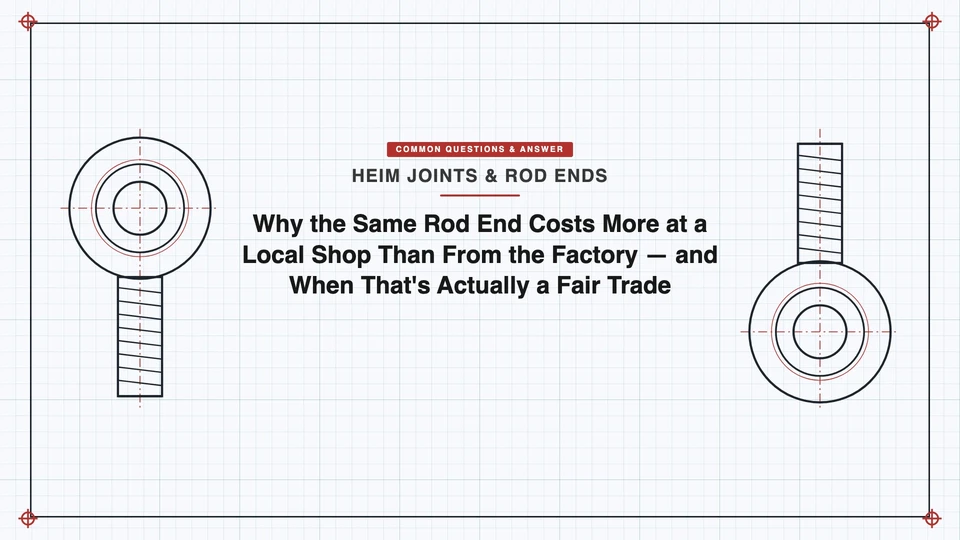
The price gap between buying a rod end direct from the manufacturer and buying the same part from a local retailer or distributor is real, but it isn’t simply "markup you’re being charged for no reason." Every step between the factory and your dock — warehousing, minimum-order handling, technical support, same-day availability — costs something, and someone pays for it. The useful question isn’t "why is the local price higher," it’s "which of those costs am I actually willing to pay for, given my order size and timeline."
Where the Gap Actually Comes From
A part that goes Factory → You has one cost layer. A part that goes Factory → Distributor → Retailer → You has two additional layers, and each one is compensating for something specific:
- Warehousing and inventory risk — someone is holding stock so you don’t have to forecast demand or tie up capital in your own inventory
- Small-order handling — a manufacturer set up for full-container or high-volume runs typically isn’t efficient at shipping a single rod end; a distributor’s business model is built around exactly that
- Technical support and fitment help — a local supplier who can answer "will this thread pitch match my application" on the phone is providing a service, not just a part
- Speed — inventory sitting on a shelf beats a part that has to be produced or shipped from overseas when you need it this week
None of this means the price gap is always justified for your situation — it means the gap has an explainable source, and whether it’s worth paying depends on which of these services you actually need.
What Buying Direct Actually Requires You to Take On
The appeal of manufacturer-direct pricing is straightforward: cutting out the distribution layers usually means a lower per-unit cost. What’s less visible upfront is what shifts onto you as the buyer:
- Minimum order quantities — direct manufacturing relationships are typically structured around production-efficient batch sizes, not single-part convenience
- Lead time — a factory order is subject to production scheduling and, for cross-border sourcing, shipping and customs time; a distributor’s shelf stock is available today
- Forecasting accuracy — if you order too little, you’re back in the queue for another production run; if you order too much, the "savings" is now sitting in your own inventory as tied-up capital
- No safety stock cushion — a distributor absorbs some demand variability by holding buffer inventory across multiple customers; ordering direct means you’re managing that variability yourself
A widely cited illustrative case from industrial packaging procurement makes the point concretely: a buyer who switched to direct purchasing to capture an 8% per-unit price reduction later found that warehouse rental, added labor, and inventory-management software turned that 8% saving into roughly a 3% net cost increase once the total was tallied. That specific number is from packaging procurement, not rod ends — but the mechanism transfers directly: unit price is one line item, not the whole picture. (See our companion piece on unit price vs. total cost of ownership for the fuller framework.)
What a Local Retailer or Distributor Is Actually Selling You
It’s easy to frame the local/distributor price premium as pure markup, but a distributor relationship typically includes value that doesn’t show up on a direct manufacturer quote:
- Immediate availability for a single part or small quantity
- The ability to combine a rod end order with other hardware (jam nuts, spacers, tube adapters) in one shipment instead of coordinating multiple suppliers
- Extended payment terms in some B2B relationships (30–90 days is a commonly cited range in general distribution economics) that improve your cash flow versus paying a factory upfront
- A point of contact who already knows your account and application history
One nuance worth knowing: Manufacturer’s Suggested Retail Price (MSRP) is, per U.S. FTC guidance, exactly what the name says — suggested. A dealer or retailer is generally free to price below or above it unless there’s a lawful minimum-price policy in place, and a manufacturer can choose not to work with retailers who won’t follow its pricing policy. That’s why you may see the same part priced differently at two authorized sellers of the same manufacturer’s product — it isn’t necessarily one of them cutting corners.
Applying This to Rod End and Heim Joint Sourcing
The discussion above describes general procurement economics rather than rod-end-specific pricing. Applied to this product category:
For a one-off replacement or small quantity: the local/distributor price premium is usually buying you real things — same-week availability, no MOQ, and the ability to get expert help matching thread pitch and bore to your exact application. For a single part, the "savings" from going direct rarely survives contact with MOQ requirements and shipping lead time.
For an ongoing OEM or production-volume order: the direct-from-manufacturer economics start to make sense, but only if you’ve accounted for the buyer-side costs above — sample/prototype lead time, the manufacturer’s actual MOQ, incoming inspection capacity on your end, and (for cross-border sourcing) freight and customs handling. Skipping that accounting is exactly the "price-only trap" the packaging-industry case above illustrates: the number on the quote isn’t the number that lands on your total procurement cost at the end of the quarter.
The Honest Bottom Line
There is no universal percentage for how much a direct purchase saves on rod ends or Heim joints. Compare the actual landed cost, including freight, duties, order size, and the services included in a local purchase.
Related reading: Unit Price vs. Total Cost of Ownership · What Test Reports Should You Request From a Sourcing Partner? · Minimum Order Quantities (MOQ) for Custom Production Runs