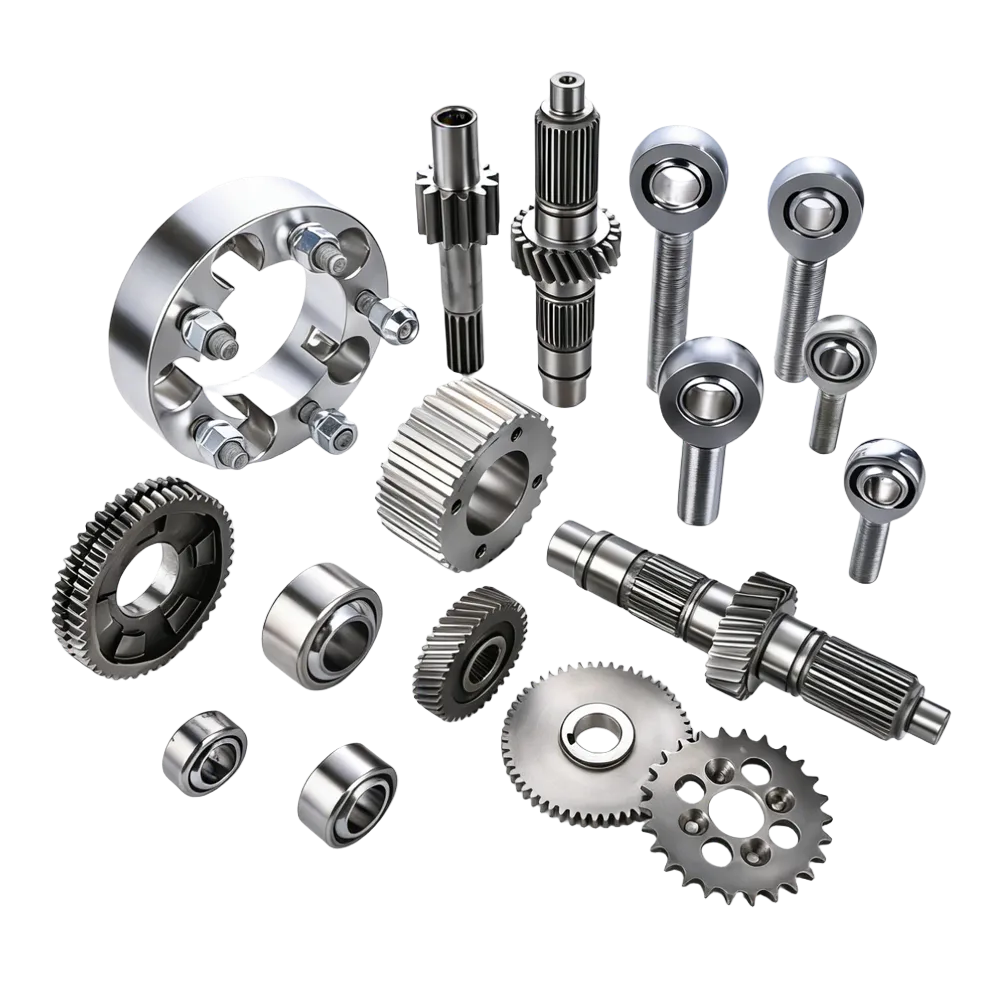

A Heim joint (rod end) carries its ball directly against a metal or PTFE-lined race, with no cushioning — it’s precise but transmits every bit of road shock straight through. A Johnny Joint carries the same idea of ball-and-socket articulation, but seats the ball in replaceable polyurethane bushings inside a rebuildable steel housing. Both are strong enough for serious 4×4 suspension work; the real question isn’t which one is “stronger” in the abstract, it’s which failure mode and maintenance pattern you’d rather live with.
What’s Actually Different Inside Each Joint
A Heim joint’s ball rotates directly in its housing, separated only by a thin liner — usually PTFE (Teflon) or bronze, sometimes nothing at all on cheaper units. The housing itself is commonly 4130 chromoly steel, 7075-T6 aircraft aluminum, or stainless, and the ball is typically 52100 bearing steel or 440C stainless. There’s no elastic buffer anywhere in the joint: when a rock impact or a pothole loads the link, that force transmits straight through metal to your chassis.
A Johnny Joint — a Currie Enterprises design, named after founder John Currie, now sold under the RockJock 4×4 brand — takes a different approach. The ball (usually heat-treated or 4130 chromoly steel) sits inside a pair of replaceable high-density polyurethane or Delrin (acetal) bushings, which in turn sit inside a forged-steel or CNC-machined chromoly housing. That urethane layer gives the joint a small amount of elastic give before the ball itself has to move, which is the mechanical reason Johnny Joints run quieter and absorb more shock than a bare Heim joint.
The practical consequence of that one design difference cascades into almost everything else that separates the two parts.
Rebuildability: The Difference That Matters Most Over Time
This is the most consistently repeated point across owner forums and technical write-ups, and it’s the one with the clearest mechanical explanation. When a Heim joint wears, the wear happens between the ball and its liner — and because that liner isn’t a separate, accessible part, a worn Heim joint typically gets replaced whole. When a Johnny Joint wears, the wear happens in the polyurethane bushings, which are held in with a snap ring and washer — you press them out and press new ones in without touching the ball, housing, or the rod itself.
That’s a meaningful long-run cost difference, but it comes with an upfront cost trade-off: aftermarket pricing referenced across supplier sites puts a Johnny Joint at roughly $70–$130 per joint and a comparable Heim joint at roughly $45–$80 (these are aftermarket brand reference prices, not SYZ Machine quotes — check current pricing with your supplier). The Johnny Joint costs more to buy once; the Heim joint costs more to keep replacing.
Are Johnny Joints Strong? What the Evidence Actually Shows
Yes — but “strong” needs to be split into the specific properties that matter for a suspension link, because Heim joints and Johnny Joints are strong in different ways, and the research doesn’t support a single number that settles the question.
What’s backed by a manufacturer spec: RockJock’s 2.5-inch Johnny Joint is built with a forged-steel or CNC-machined 4130/4140 chromoly housing and is rated for roughly 31°–34° of articulation in its standard configuration, with some configurations reaching up to 40°. High-performance versions use a micro-polished ball to run cooler under repeated high-frequency cycling (relevant for desert running, less so for slow-speed rock crawling). These are manufacturer/product-page figures, not independent third-party test results — treat them as a starting spec to verify against the specific joint you’re buying, not a universal number for “all Johnny Joints.”
What’s backed by community experience, not lab testing: Long-running 4×4 forum threads (pirate4x4, nc4x4, NAXJA) consistently describe Heim joints as having effectively zero play when new — “0 slop,” in one forum’s phrasing — with tighter initial geometry precision than a Johnny Joint. The same threads describe that precision degrading over years of dirt and moisture exposure: a worn Heim joint gets sloppy and stays that way until replaced, while a worn Johnny Joint gets a fresh set of bushings and returns close to new tolerance. One frequently echoed forum judgment sizes a Johnny Joint’s strength as roughly on par with a 1.25-inch Heim joint of similar application — that’s a working field opinion from experienced builders, not a measured comparison, and it’s presented here as exactly that.
What the research did not find: an independent, third-party head-to-head load or fatigue test comparing a Johnny Joint and a Heim joint of matched size under identical conditions. If that data exists, it wasn’t in any of the sources this research surfaced — so any claim that one is definitively “X% stronger” than the other should be treated with skepticism, including from this article. What’s verifiable is that both parts are used, without hesitation, in genuinely heavy-duty applications: full-size desert trucks, 1-ton rock rigs, and competition-grade long-travel suspensions all run one or the other (and sometimes both on the same link).
Structural and Material Comparison
| Heim Joint (Rod End) | Johnny Joint | |
|---|---|---|
| Ball-to-housing interface | Direct — PTFE/bronze liner or bare metal | Ball seated in replaceable polyurethane/Delrin bushings |
| Common housing material | 4130 chromoly, 7075-T6 aluminum, stainless | Forged steel, 4130/4140 chromoly, stainless |
| Common ball material | 52100 bearing steel, 440C stainless | Heat-treated steel, 4130 chromoly |
| Elastic buffering | None — metal-to-metal load path | Yes — urethane bushing absorbs initial shock |
| Rebuildable? | Typically no — replace whole joint | Yes — replace bushings, keep housing/ball |
| Typical articulation | High, often quoted 20°–30°+ depending on size and spacer setup | High, roughly 30°–34° standard, up to 40° in some configurations |
| Reference price (aftermarket, not SYZ) | ~$45–$80 | ~$70–$130 |
(Articulation figures come from different manufacturer/product-page sources, not a single controlled test — treat the ranges as approximate, and verify the specific product’s spec sheet before designing around an exact number.)
If You’re Choosing Between Them
- Daily-driven rig that also sees the trail — Johnny Joint’s urethane cushioning means less NVH transmitted to the cabin and less risk of the joint packing with grit on a wet trail, at the cost of a slightly higher upfront price per joint.
- Dedicated, trailered competition buggy — a Heim joint’s direct metal-to-metal geometry gives marginally tighter, more predictable suspension response, and the harshness that comes with it doesn’t matter if the vehicle isn’t driven on pavement.
- Cost-sensitive build with less aggressive articulation needs — a rubber or polyurethane builder bushing (a third option, distinct from both of the above) trades away articulation angle for the lowest purchase price and lowest long-term maintenance.
For the vibration/noise trade-off in more depth, see Vibration Dampening: Does a Johnny Joint Outperform a Heim? For rock-crawling-specific vehicle selection (trailered buggy vs. trail-driven rig), see Heim Joint vs. Johnny Joint: Which Is Better for Rock Crawling? For the three-way comparison including builder bushings, with a fuller cost and materials breakdown, see Johnny Joint vs. Heim Joint vs. Builder Bushing.
Related reading: Vibration Dampening: Does a Johnny Joint Outperform a Heim? · Heim Joint vs. Johnny Joint: Which Is Better for Rock Crawling? · Johnny Joint vs. Heim Joint vs. Builder Bushing