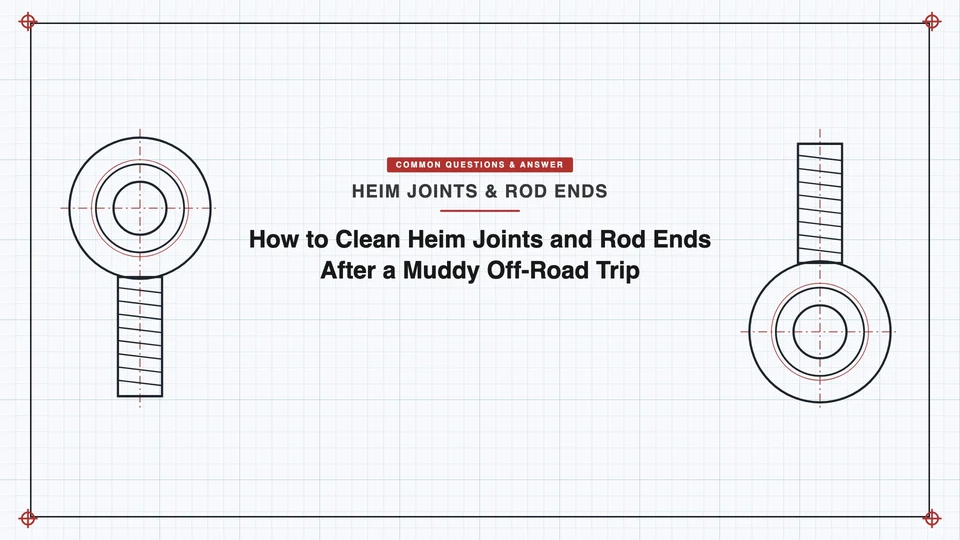
Rinse loose mud off first with low pressure, then flush the joint itself with a fast-evaporating solvent — not soap and water, not a pressure washer aimed directly at the joint. Heim joints have no dust boot protecting the ball-and-race interface the way a sealed tie rod end does, so the cleaning method that works fine for the rest of your undercarriage can actually push grit deeper into the joint if you use it on the exposed bearing itself.
 Off-Road Trip” class=”wp-image-31475″ width=”1600″ height=”720″ loading=”lazy” decoding=”async” />
Why Heim Joints Need a Different Cleaning Approach Than the Rest of the Undercarriage
Most post-trail cleaning advice — hose down the undercarriage, keep the pressure washer moving, don’t blast directly at boots and seals — is written for factory suspension components that have some form of protection: a rubber boot on a tie rod end, a sealed bearing, a bushing pressed into a housing. A Heim joint’s spherical ball and race are exposed by design, because that’s what gives it its range of articulation. There’s no boot that fits over a spherical bearing without limiting the motion it’s there to provide.
That means the biggest risk isn’t leaving mud on the joint — it’s the cleaning method itself. A pressure washer aimed at an exposed rod end can force water, fine silt, and sand past the misalignment spacers and directly into the race, which is exactly the surface a PTFE-lined joint depends on staying smooth. Once grit gets worked into that interface, normal articulation grinds it against the liner instead of flushing it out.
The Cleaning Steps
- Low-pressure pre-rinse. Use a garden hose or spray bottle with mild soapy water to soften caked mud clods around the joint. Skip the pressure washer for this step — the goal is to soak and loosen, not blast.
- Flush with a fast-evaporating solvent. Spray the joint with non-chlorinated brake cleaner or 99% isopropyl alcohol. This cuts through road film and grease while flushing debris out of the cavity between the ball and the housing — and it evaporates fully, unlike soapy water, which can leave moisture trapped against bare metal.
- Agitate with a soft nylon brush. Rotate and articulate the joint while scrubbing gently around the ball and misalignment spacers with a soft nylon detail brush or toothbrush. Work the solvent through the joint’s full range of motion so trapped grit floats out rather than staying wedged in a corner it can’t reach when the joint is held still. Don’t use a wire brush — it will scratch the polished ball surface, giving future dirt more to grip onto.
- Blow out trapped moisture with compressed air. 30–50 PSI is enough to clear water and solvent out of the joint, including the space behind the misalignment spacers. Any moisture left behind on a non-stainless joint leads to flash rust before you’ve even put it away.
- Apply a dry film lubricant, not grease. Spray the ball and race with a dry PTFE or dry silicone lubricant and let it flash off completely. This is the step that trips people up: standard wet grease is the wrong lubricant here. Grease attracts dirt and turns into an abrasive paste inside an exposed joint — the same reason PTFE-lined Heim joints generally shouldn’t be packed with grease at all, on the trail or anywhere else. A dry film leaves a slick, low-friction surface that repels grit instead of trapping it.
If your rod ends use a rubber boot or aftermarket "Seals-it" style cover, slide it back during cleaning so you’re flushing what’s actually trapped underneath, not just cleaning around it — and check the boot for tears before reseating it.
One caveat worth flagging: this solvent-and-dry-lube approach is built around PTFE-lined joints, which is the common configuration on performance rod ends. If you’re running an older metal-on-metal joint with a grease fitting, follow the manufacturer’s lubrication spec instead — some of those designs are meant to be greased regularly, and skipping it isn’t the safe default the way it is on a PTFE-lined joint. Check which type you have before deciding which rule applies.
Quick Post-Clean Inspection
While the joint is clean and accessible, pry against the mounting tab to check for lateral play or a "clunking" feel. Any detectable slop means the internal liner has already worn through, and cleaning won’t fix that — it needs replacement. This is a quick check worth doing every time you clean rod ends after a trip, not just when something already feels loose.
| Step | What it does | What to avoid |
|---|---|---|
| Low-pressure pre-rinse | Softens caked mud without forcing it deeper | Pressure washer aimed directly at the joint |
| Solvent flush | Cuts grease/film, flushes cavity, evaporates fully | Soap and water left to sit and trap moisture |
| Soft nylon brush | Clears grit from around ball and spacers | Wire brush — scratches the polished ball |
| Compressed air (30–50 PSI) | Clears trapped moisture before it causes rust | Skipping this on non-stainless joints |
| Dry PTFE/silicone lube | Repels future dirt and moisture | Wet grease — becomes an abrasive paste |
Cleaning mud off is the easy part. Doing it in a way that doesn’t drive that same mud deeper into the joint is where most generic "post-trail wash" advice falls short for exposed rod ends specifically.
For the desert-racing case — fine sand and silt instead of chunky mud, which behaves differently once it’s inside a bearing — see Desert Racing Maintenance: Removing Sand and Silt From Bearings, which builds on this same base procedure.
Related reading: Desert Racing Maintenance: Removing Sand and Silt From Bearings · The PTFE (Teflon) Liner: How Self-Lubrication Works · How to Check for Excessive Play in a Spherical Bearing