Noise Troubleshooting: Is It Clearance Play or Lack of Lubrication?
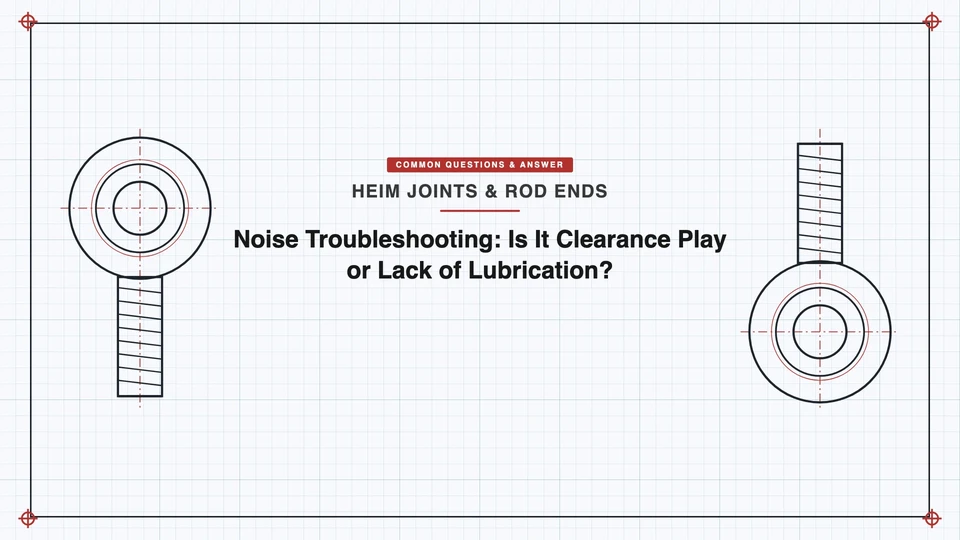
Clearance play creates a click or knock when load reverses; lack of lubrication usually creates squeak, scrape, or rough motion through the stroke. The fastest diagnosis is to watch whether the ball shifts in the race or instead moves tightly but noisily under friction.
How to Check for Excessive Play in a Spherical Bearing (Heim Joint)
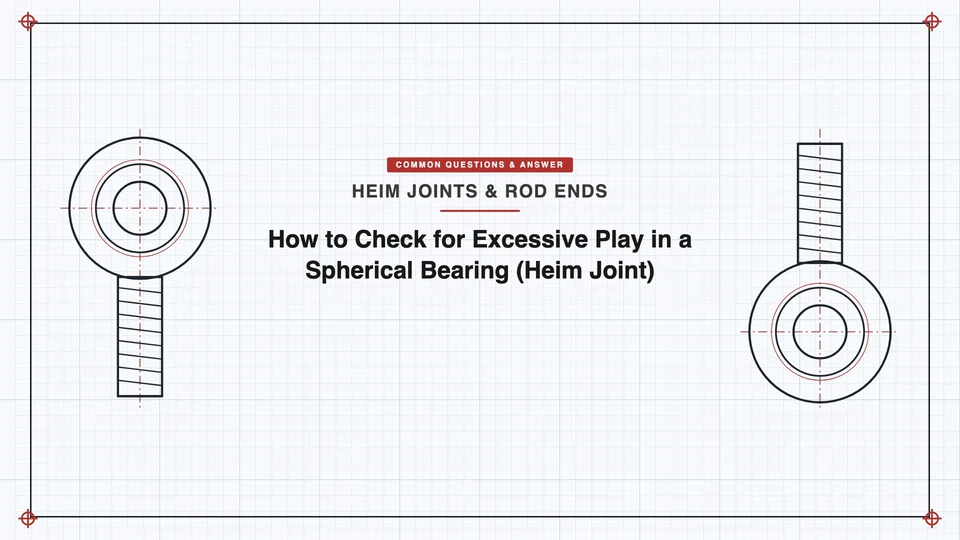
Check excessive play by unloading the spherical bearing, holding the housing, and feeling for ball movement before the connected link moves. Any visible radial shift, sharp click, oval mounting hole, or movement that grows after torque recheck means the joint or mount needs service.
Why Do My Heim Joints Click? Diagnosing the “Clicking” Sound
A clicking heim joint usually means metal-on-metal movement during load reversal. Common causes include worn liners or bearing clearance, loose mounting hardware, elongated bracket holes, backed-off jam nuts, or misalignment contact. Diagnose it by reproducing the motion slowly and watching where movement begins.
Marine Applications: Preventing Seizure in Saltwater Environments
Marine rod ends seize from galvanic corrosion, crevice corrosion, and stainless-thread galling. Preventing seizure means selecting compatible materials, isolating dissimilar metals, using marine-appropriate anti-seize, avoiding dry stainless-on-stainless assembly, and rinsing and inspecting joints before chloride buildup locks them solid.
Monster Truck Tech: Why Massive Heim Joints Handle the Stunts
Monster-truck-style suspension uses massive heim joints because rubber bushings cannot hold zero-play geometry under repeated landing shocks. The joint transmits force through a rigid spherical bearing while allowing articulation, making it inspectable, replaceable, and suited to extreme off-road load paths.
Gym Equipment: Why Rose Joints Are Used in High-End Strength Machines
High-end gym machines use rose joints where press arms, cable arms, or leverage linkages move off a single flat plane. A spherical rod end self-aligns under load, reduces wobble and clicking, and keeps resistance feel consistent through repeated commercial-duty cycles.
Agricultural Machinery: Why Tractor Linkages Need Both Strength and Precision — and How Rod Ends Deliver Both
Tractor and agricultural linkages need both shock-load strength and positional precision. Rod ends help because a controlled ball-to-race fit reduces play, heat-treated materials carry load, and spherical misalignment lets hitch, steering, and harvester linkages move without relying on loose clearance.
Formula Student & Go-Kart: Why Precision Requirements Are Different at Small Scale
Formula Student cars and go-karts need tight rod-end and bearing-interface control because small absolute errors create large handling changes on light vehicles. The key is separating true precision interfaces from ordinary brackets, while avoiding rod ends in bending and single-shear suspension attachments.
Industrial Automation: Corrosion-Resistant Rod Ends for Robotic Linkages
Industrial automation rod ends should be selected by exposure environment, not load rating alone. Washdown, salt spray, chemicals, and continuous cycling often justify 316 stainless, PTFE liners, passivation, or other corrosion-resistant combinations that prevent binding and preserve repeatable robotic linkage motion.
Lawn Mowers & Garden Tractors: Affordable Rod End Solutions for Sloppy Steering
Garden tractor steering usually needs a correctly sized, affordable rod end or ball joint rather than a racing-grade heim. The smart choice starts with measuring thread size, pitch, shank direction, and mounting geometry, then balancing cost, sealing, lubrication, and toe-in adjustment needs.
ATV/UTV A-Arms: Why Standard Ball Joints Fail — and Where Heim Joints Actually Help
Heim joints help ATV and UTV A-arms when long-travel geometry exceeds a ball joint’s angular range or needs camber and caster adjustability. They are not automatically stronger than ball joints; the trade-off is more articulation and serviceability in exchange for sealing, impact strength, and maintenance demands.
Rock Crawler & Ultra4 Steering: Choosing Between Mechanical, Hydro-Assist, and Full Hydraulic
Rock crawler and Ultra4 steering choices depend on tire size, street use, steering force, and failure tolerance. HD mechanical steering keeps a full mechanical link, hydro-assist adds hydraulic force while retaining backup, and full hydraulic steering fits dedicated competition rigs that accept no street-legal mechanical fallback.