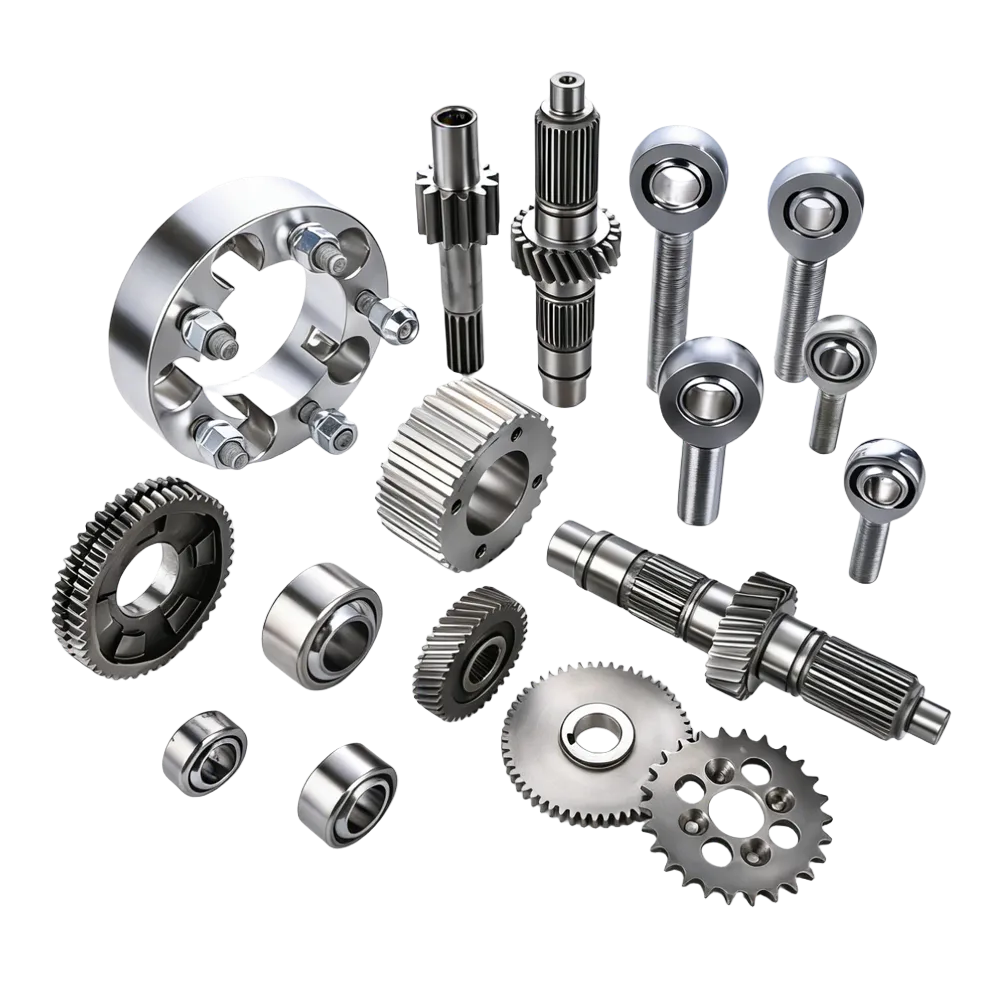

These four words get used almost interchangeably in casual conversation, but they’re not the same category of part. The real dividing line is how the part handles motion: a bushing and a sleeve bearing rely on sliding contact with no rolling elements; a rolling bearing uses balls or rollers instead; and a reducer usually isn’t a motion component at all — it’s a static size adapter. Here’s how they actually break down.
The Four Parts, Compared
| Part | Motion Mechanism | Primary Function | Typical Application |
|---|---|---|---|
| Bushing | Sliding / oscillating — no internal moving parts | Reduces friction between two surfaces, absorbs shock, isolates vibration | Suspension control arms, subframe mounts, linkage pivots, leaf springs |
| Bearing (rolling) | Rolling — via balls, rollers, or needles between races | Supports rotation under higher speed and dynamic load with minimal friction | Wheel hubs, electric motor shafts, transmissions |
| Sleeve | Sliding — same mechanism as a bushing | A thin metal or polymer cylinder that lines a bore or restores a worn shaft diameter | Repairing worn shafts, lining boreholes, used interchangeably with “bushing” in many contexts |
| Reducer | Static — no motion mechanism of its own | Adapts one size (bore, shaft, pipe, fitting) down to another | Plumbing fittings, drive-shaft adapters, hose couplings — see the naming note below |
“Sleeve Bearing” Is a Bushing — Not a Third Category
This is the point most comparisons skip past: a “sleeve bearing” (also called a “sleeve bushing” or journal bearing) isn’t a separate part type sitting between bushings and rolling bearings — it’s a bushing. The distinction that actually matters is mechanical, not naming: a bushing (sleeve or otherwise) works by sliding contact between the shaft and the bore surface, while a rolling bearing works by rolling contact through balls or rollers. If something is called a “sleeve bearing,” you’re looking at a plain bearing — functionally a bushing — not a rolling-element bearing.
“Reducer” Means Two Different Things
The word “reducer” carries a naming split that’s worth clearing up before comparing it to anything else:
- In plumbing/fitting contexts, a reducer is a static adapter that changes a bore, pipe, or fitting from one diameter to another. It doesn’t provide a bearing surface or handle motion — it’s a size adapter, full stop.
- In drivetrain contexts, “reducer” can refer to a gear reducer or speed reducer — a mechanism that changes rotational speed/torque, which internally may contain bearings or bushings as supporting components, but the reducer itself is the speed-changing assembly, not the bushing or bearing inside it.
If you’re comparing a “reducer” to a bushing, it’s worth confirming which meaning is in play — they’re not answering the same question.
When to Use Which
- Sliding, oscillating, or moderate-load, lower-speed motion (a pivot, a suspension arm, a linkage): a bushing or sleeve bearing is the right category.
- High-speed rotation, precision, or heavy dynamic load (a wheel hub, a motor shaft): a rolling bearing is the right category — a bushing isn’t a substitute here.
- Just changing a bore, shaft, or fitting size with no motion involved: that’s a reducer’s job, not a bushing’s or bearing’s.
What About Polyurethane vs. Rubber?
That’s a material question about bushings specifically, not a bushing-vs-bearing-vs-sleeve-vs-reducer question, so it gets its own full treatment elsewhere. Short version: rubber generally wins on vibration isolation and ride comfort; polyurethane generally wins on stiffness, load retention, and resistance to oil and abrasion — neither is universally “better,” and the right call depends on whether comfort or precision matters more for the application. For the full material comparison (including bronze and engineered-plastic options) and brand-level guidance, see What Material Is Best for Bushings, and What Brands Are Worth Considering?
Related reading: What Material Is Best for Bushings, and What Brands Are Worth Considering? · How Much Does It Cost to Replace Bushings?